

When your skin breaks out in thick, red patches covered in silvery scales, it’s more than just a cosmetic issue. For many people, that same immune system misfire that causes psoriasis also starts attacking the joints - leading to something called psoriatic arthritis. It’s not just "skin deep." It’s a full-body autoimmune condition that can quietly destroy joints, limit movement, and wreck your quality of life if left unchecked.
Think of it this way: psoriasis is the warning sign. About 1 in 3 people with psoriasis will go on to develop psoriatic arthritis. That’s not rare - it’s common. And here’s the twist: for some, the joint pain comes first. You wake up with stiff, swollen fingers or a lower back that won’t move right - and weeks or months later, the skin rash shows up. This isn’t coincidence. It’s your immune system on overdrive.
How Psoriasis Turns Into Joint Damage
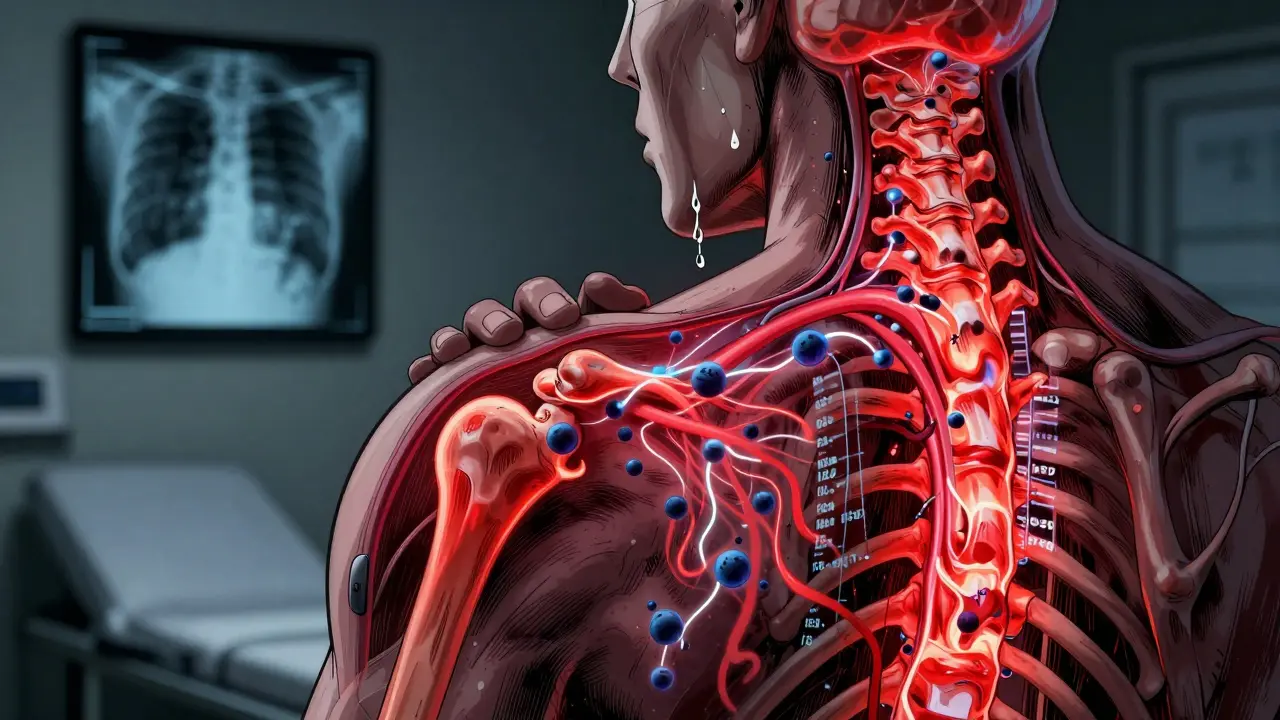
Psoriasis isn’t just dry skin. It’s your immune system sending the wrong signal. T-cells, which are supposed to fight infections, start attacking healthy skin cells. That triggers inflammation, rapid skin cell turnover, and those telltale plaques. But the same inflammatory chemicals - especially TNF-alpha and IL-17 - don’t stop at the skin. They travel through your bloodstream and settle into your joints, tendons, and even the places where ligaments attach to bone.
This is where psoriatic arthritis (PsA) kicks in. Unlike rheumatoid arthritis, which mainly targets the lining of joints, PsA attacks the entheses - the spots where tendons and ligaments meet bone. That’s why you might feel pain in your Achilles tendon, the bottom of your foot, or where your ribs connect to your spine. It’s also why fingers and toes swell up like sausages - a sign called dactylitis. It happens in about 4 out of 10 people with PsA.
Nail changes are another red flag. If your nails are pitted, thickened, or lifting off the nail bed, it’s not just a fungal issue. About 8 in 10 people with PsA have these changes. They’re often the earliest clue, even before joint pain starts.
Diagnosis Isn’t Just a Skin Check
Doctors don’t diagnose PsA by looking at your skin alone. There’s a strict system called the CASPAR criteria - developed in 2006 and still the gold standard today. To get a confirmed diagnosis, you need inflammatory joint disease plus at least three of these:
- Current or past psoriasis (3 points)
- Psoriatic nail changes (1 point)
- Negative rheumatoid factor blood test (1 point)
- Dactylitis (1 point)
- Characteristic bone changes on X-ray (1 point)
A score of 3 or higher? That’s PsA. It’s not perfect, but it’s accurate - 91% sensitive and 99% specific. That means false positives are rare.
But here’s what most people don’t realize: you might need more than one test. Blood work checks for inflammation (CRP and ESR levels), but it can be normal even when damage is happening. X-rays show bone erosion in 60-70% of established cases, but early on, they look fine. That’s why MRI and ultrasound are becoming essential. They can spot swelling and inflammation in joints and entheses before any bone damage shows up. A single swollen finger might look like a sprain - an ultrasound reveals the truth.
What Happens If You Ignore It
PsA doesn’t just hurt. It destroys. Left untreated, it causes permanent joint damage. In 30-40% of cases, you’ll see what’s called a "pencil-in-cup" deformity - where bone erodes on one side and grows abnormally on the other. Fingers can become crooked. Spines can fuse. Mobility vanishes.
And it’s not just the joints. PsA is a systemic disease. That means it affects your whole body. About half of people with PsA have metabolic syndrome - high blood pressure, high sugar, belly fat, and bad cholesterol. That doubles your risk of heart attack. Studies show PsA patients have a 43% higher chance of having a heart attack than the general population.
Depression and anxiety hit 1 in 3 people with PsA. Why? Chronic pain, visible skin changes, fatigue, and the loss of independence take a heavy toll. Quality of life scores for PsA patients are 30-40% lower than people their age without the disease. It’s not "just arthritis." It’s a life-altering condition.
Treatment Has Changed Dramatically
Five years ago, treatment was simple: NSAIDs for pain, methotrexate if it got worse. Today, we have targeted therapies that stop the disease in its tracks.
For mild cases, NSAIDs like ibuprofen or naproxen help with pain and swelling. But they don’t stop damage. That’s where DMARDs like methotrexate come in - taken weekly, they slow progression. But for moderate to severe PsA, we now have biologics and targeted oral drugs that work with laser precision.
TNF inhibitors - like adalimumab (Humira), etanercept (Enbrel), and infliximab (Remicade) - block the main inflammation driver. They work for about 50-60% of patients, with 30-40% seeing at least half their symptoms improve.
IL-17 inhibitors - like secukinumab (Cosentyx) and ixekizumab (Taltz) - are now first-line for patients with heavy skin involvement. They clear plaques faster than anything before.
IL-23 inhibitors - like guselkumab (Tremfya) and risankizumab (Skyrizi) - are newer, with long-lasting effects. Many patients stay in remission for over a year between doses.
And then there’s deucravacitinib (Sotyktu), the first oral TYK2 inhibitor approved for psoriasis and PsA. It’s taken as a daily pill, with fewer side effects than older systemic drugs. It’s not for everyone, but for those who can’t tolerate injections, it’s a game-changer.
What Success Looks Like
Doctors aren’t just trying to reduce pain anymore. The goal is minimal disease activity - a specific set of targets:
- Tender joints: 1 or fewer
- Swollen joints: 1 or fewer
- Skin involvement: 1% or less of body surface
- Pain level: 15mm or less on a 100mm scale
- Global well-being: 20mm or less
- Function (HAQ score): 0.5 or lower
- No fatigue
If you hit all these? You’re not just managing symptoms - you’re in remission. And studies show that achieving this within the first year of diagnosis dramatically reduces long-term joint damage.

The Hidden Connection: Gut, Skin, and Joints
New research is pointing to your gut. Scientists now believe the microbiome - the trillions of bacteria living in your intestines - plays a key role. People with PsA have different gut bacteria than those without it. Some studies even show that changes in the gut happen before skin or joint symptoms appear.
Could probiotics or diet changes help? Not yet proven as a standalone treatment, but it’s a major area of research. One 2025 study found that patients who followed a Mediterranean-style diet (rich in fish, olive oil, vegetables) had lower inflammation markers and better skin clearance. It’s not a cure, but it’s a powerful tool alongside medication.
What’s Next?
By 2027, experts predict 70% of PsA patients will be on biologic or targeted therapy within two years of diagnosis. That’s up from 40% today. Why? Because we now know: early, aggressive treatment saves joints.
There’s also emerging hope in biomarkers. Blood tests for calprotectin, MMP-3, and specific autoantibodies might soon tell us who’s at risk for severe disease before symptoms even start. Imagine catching PsA before it ever hits your joints.
For now, the message is clear: if you have psoriasis and notice joint pain, stiffness, or swollen fingers - don’t wait. See a rheumatologist. If you have joint pain and later develop skin plaques - get tested. PsA isn’t inevitable, but it’s common. And it’s treatable - if you act fast.
Aisling Maguire
March 1, 2026 AT 07:31Just went through my first biologic shot last week - Cosentyx. Honestly? Life-changing. My nails stopped lifting, the scalp flakes are gone, and my knees don’t creak like old hinges anymore. No more hiding my hands in public. If you’ve got psoriasis and even a hint of joint stiffness - don’t wait. Go see a rheum. Seriously.
Also, the Mediterranean diet thing? I started eating more olive oil and salmon. Not a miracle, but my CRP dropped. Small wins count.
Ben Estella
March 2, 2026 AT 02:07So let me get this straight - we’re giving people expensive biologics because their immune system got lazy? Sounds like a government handout to me. Back in my day, we toughed it out with aspirin and cold showers. Now we’ve got people on monthly IVs because they won’t just eat less sugar.
Also, who funded this study? Big Pharma? Of course they say biologics work. They’re the ones selling them.
Katherine Farmer
March 3, 2026 AT 16:06It’s fascinating how the CASPAR criteria remain the gold standard despite being developed in 2006. One must wonder whether the field has stagnated. The reliance on X-rays - which are notoriously insensitive in early disease - while MRI and ultrasound are demonstrably superior, speaks to institutional inertia.
And let’s not pretend the "Mediterranean diet" is some novel insight. It’s basic nutritional epidemiology. The fact that this is presented as groundbreaking suggests a profound disconnect between clinical practice and academic rigor.
Brandie Bradshaw
March 5, 2026 AT 07:15There is a profound, almost metaphysical, implication here: the body does not lie. When the immune system turns on itself - when T-cells, those noble sentinels of defense, become traitors - it is not a malfunction of biology, but a revelation of systemic dissonance. We are not merely treating joints; we are confronting the fragmentation of the self.
The gut-skin-joint axis is not a coincidence. It is a symphony of inflammation, a chorus of miscommunication between trillions of microbes and a wounded soul. We treat symptoms because we fear the silence between them. But what if the silence is the message?
And yet - we persist. We inject. We pill. We scan. We measure. We quantify. And still, we do not listen.
Angel Wolfe
March 6, 2026 AT 12:59Y’all know this is all a scam right? The FDA, Big Pharma, and the AMA are in bed together. Psoriasis and PsA? They’re not real diseases - they’re just side effects of the government’s fluoride-and-vaccine agenda. They want you scared so you’ll take the shots. The real cause? 5G radiation and GMOs. Look up Dr. Lillian Cross - she got fired for saying this.
My cousin’s friend’s neighbor had this "arthritis" and he just stopped eating gluten and did yoga. Gone in 3 weeks. They’re hiding the cure. They want you dependent. Wake up.
Also - why do all the meds have "biologic" in the name? That’s code for "we’re injecting alien tech into your blood."
Sophia Rafiq
March 7, 2026 AT 16:22Been living with this for 8 years. Skin flares? Yeah. Joint pain? Always. But the real kicker? The fatigue. Like, 3pm nap every day, no matter what. No one talks about that. It’s not the pain. It’s the exhaustion that makes you feel like a ghost in your own life.
Humira changed everything. Not cured. But now I can play with my niece without wincing. That’s the win. Also - dactylitis? Sausage fingers? Yep. That’s the one that scared me into seeing a rheum. Don’t ignore it. Ever.
Spenser Bickett
March 9, 2026 AT 03:55So you’re telling me that after decades of being told "it’s just eczema," now we’ve got a whole new fancy word for it? Psoriatic arthritis? Sounds like a marketing team got bored and decided to invent a new disease. Meanwhile, people are still getting told to "use moisturizer" and "stop stressing."
Also, why do they keep saying "it’s treatable" like that’s some kind of victory? I don’t want to be "treated." I want to be healed. There’s a difference.
Christopher Wiedenhaupt
March 9, 2026 AT 09:27Thank you for this comprehensive overview. The distinction between enthesitis and synovitis is critical, and I appreciate the emphasis on early intervention. The data on cardiovascular risk is particularly concerning and warrants greater public awareness. I have shared this with my primary care physician to improve screening protocols in our practice. The CASPAR criteria remain robust, though I agree MRI should be more routinely integrated. Well-researched.
Martin Halpin
March 11, 2026 AT 09:00Okay, but have you considered that maybe psoriatic arthritis isn’t caused by your immune system - maybe it’s caused by the fact that we’re all just too damn stressed? I mean, think about it. We live in a world where people are glued to screens, eating processed garbage, and sleeping 5 hours a night. Your body’s not "attacking itself" - it’s screaming for help. And instead of telling people to chill out, get sunlight, and stop drinking soda, we throw a $10,000-a-year biologic at them?
And don’t even get me started on how the medical system ignores the emotional toll. I had a friend who lost her job because her hands swelled up. No one asked if she was okay. They just handed her a prescription.
Also - why are we not talking about trauma? I’ve read studies. Childhood trauma correlates with autoimmune flares. But nope. We’re too busy talking about IL-17 inhibitors. We’re treating the symptom, not the soul.
Eimear Gilroy
March 11, 2026 AT 20:32Does anyone know if there’s data on how long people typically wait between psoriasis diagnosis and PsA onset? I was diagnosed with scalp psoriasis at 19, and joint pain didn’t show up until I was 27. That’s 8 years. Was I just lucky? Or did I miss early signs?
Also - I have nail pitting and zero skin plaques now. Could that still be PsA? My dermatologist said "probably not." But my rheumatologist said "let’s get an ultrasound." I’m confused.
Ajay Krishna
March 13, 2026 AT 04:23This is beautiful. Thank you for writing this with such clarity. I’m from India, and here, most doctors still think psoriasis is "just a skin problem." I’ve seen people told to use coconut oil and pray. It breaks my heart. This post could save lives here.
I’ve been on risankizumab for a year. My skin is clear. My knees don’t hurt. But the real win? I can hug my daughter without worrying she’ll see my nails and ask why they look broken.
You’re right - early action matters. Don’t wait. Speak up. Find a rheumatologist. Even if you have to travel. It’s worth it.
Charity Hanson
March 14, 2026 AT 10:24Y’all, I was diagnosed last year. I thought it was just carpal tunnel. Then I got a rash. Then my toes looked like little sausages. I cried for 3 hours. But now? I’m on Sotyktu. Daily pill. No needles. My skin’s 90% clear. My energy’s back. I’m back to dancing.
Don’t let fear stop you. The meds aren’t magic - but they’re your best shot. And if you’re scared of side effects? Talk to your doc. Ask questions. You got this. I’m rooting for you.
P.S. Eat the avocado. Drink the water. Move your body. Small things matter too.