

How many times have you rubbed your eyes after a long day staring at your phone, laptop, or tablet? You’re not alone. More than 61% of American adults report digital eye strain - dry eyes, blurred vision, headaches - and it’s only getting worse. With people spending nearly 7 hours a day on screens in 2024, our eyes are under more stress than ever. But here’s the real question: is blue light the culprit, or are we blaming the wrong thing?
What Exactly Is Blue Light?
Blue light isn’t just the glow from your phone. It’s a specific band of visible light between 415 and 455 nanometers - short wavelength, high energy. Think of it like a tiny, fast-moving particle that can bounce off surfaces and penetrate deep into your eye. Unlike UV light, which gets blocked by your cornea and lens, blue light reaches the retina. That’s where things get complicated.
Some studies show this light can trigger oxidative stress in retinal cells. A 2018 NIH review found that exposure to 450 nm blue light at moderate intensity for just 24 hours dropped corneal cell viability by nearly 40%. Other research from 2022 showed a 218% spike in reactive oxygen species (ROS) after only 30 minutes of exposure. That’s a lot of cellular chaos.
But here’s the twist: the American Academy of Ophthalmology says there’s no solid proof blue light from screens damages your eyes. They’ve been clear since 2022: “No scientific evidence supports the need for blue light glasses.” So why do so many people swear by them?
The Real Problem: Eye Strain, Not Retinal Damage
Let’s cut through the noise. The symptoms you feel - dry eyes, blurry vision, headaches - aren’t caused by blue light burning your retina. They’re caused by how you use screens.
When you stare at a screen for hours, you blink less. Like, 66% less. That means your tear film evaporates faster. Your eyes dry out. Your focus muscles lock in, trying to hold a close-up image. Your brain gets tired. Your neck and shoulders tighten. That’s digital eye strain. It’s not a disease. It’s a side effect of behavior.
Dr. Robert Graham from Lenox Hill Hospital puts it plainly: “These are temporary effects. They go away with rest.” And that’s the key. You don’t need special glasses. You need to change how you look at your screen.
Screen Filters: Do They Help?
There are two types of blue light filters: software and hardware.
Software filters like Night Shift (iOS), Night Light (Android), or f.lux adjust screen color temperature. They reduce blue light by 10-20%. Sounds good, right? But here’s the catch: they don’t touch the 415-455 nm “peak hazard” range identified by the International Commission on Illumination. You’re still getting the most energetic part of the spectrum.
Hardware filters - like screen protectors or glasses - are more effective. Amber-tinted blue light glasses can block 65-100% of blue light. But they come with a trade-off: color distortion. A 2022 University of Manchester study found they reduced visual acuity by over 8% in color-sensitive tasks. For designers, photographers, or anyone who needs accurate color, that’s a dealbreaker. One professional photographer on DPReview said: “The yellow tint ruins my skin tone grading.”
Even then, results are mixed. Consumer Reports tested popular “blue light blocking” lenses in 2023 and found they only reduced blue light transmission by 12%, not the 20% manufacturers claimed. And a 2021 study in Contact Lens and Anterior Eye found no real difference in dry eye symptoms after four weeks of use.
So do filters work? Maybe - but not because they’re stopping retinal damage. They might help if they reduce glare or make screens easier to look at. But they’re not magic.
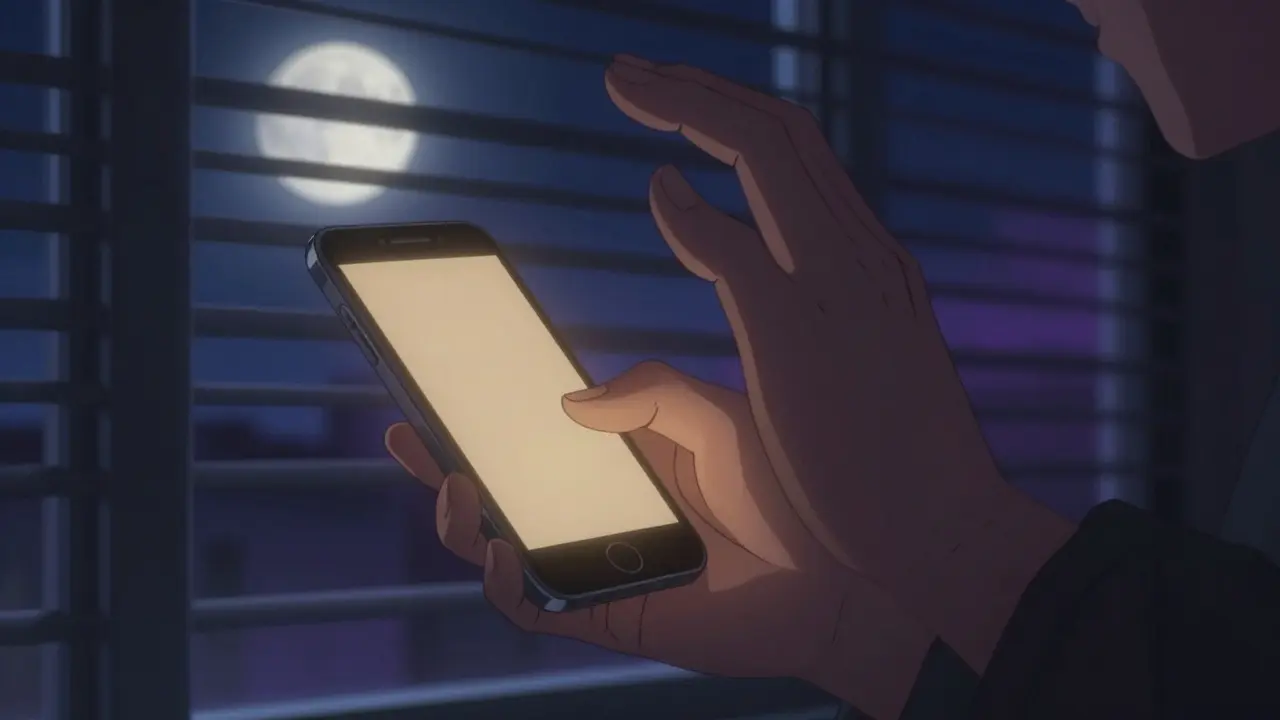
The Habits That Actually Make a Difference
Forget buying new glasses. Start with these four habits. They’re free. They’re backed by science. And they work.
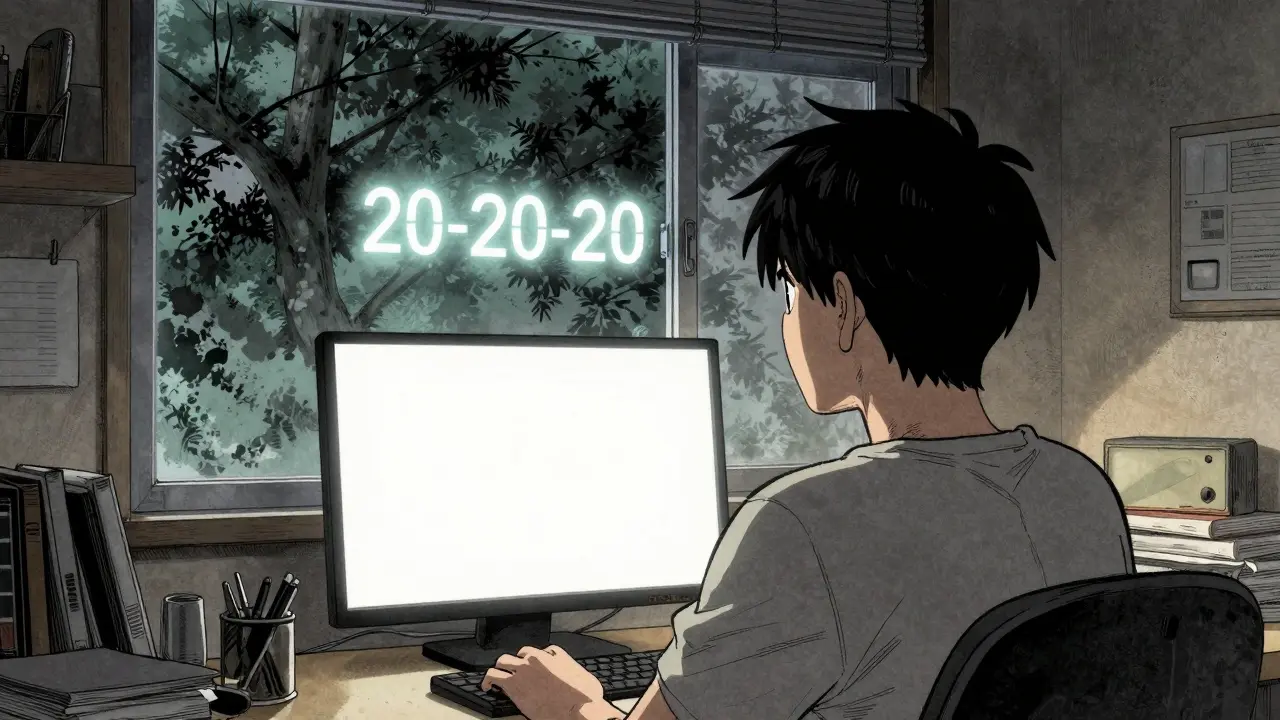
- Use the 20-20-20 rule - every 20 minutes, look at something 20 feet away for 20 seconds. A 2021 study in Optometry and Vision Science found this cut eye strain by over 53%. It’s not a suggestion. It’s a reset button for your eyes.
- Match your screen brightness to your room - if your screen is way brighter than the walls around you, your eyes strain to adjust. Aim for 300-500 lux ambient light. That’s about the brightness of a cloudy afternoon. Don’t work in a dark room with a bright screen. Or vice versa.
- Keep your screen at least 20 inches away - that’s about an arm’s length. The American Optometric Association says this reduces focusing demand by 3.7 diopters. Sitting too close forces your eyes to work harder. It’s like holding a book an inch from your nose.
- Turn on night mode two hours before bed - blue light suppresses melatonin. Harvard research shows it delays sleep onset by 105 minutes compared to green light. Night mode doesn’t need to be extreme. Just reduce the color temperature. A 2018 University of Toronto study found this boosted melatonin production by 58%.
These aren’t “nice to have” tips. They’re baseline habits for anyone using screens daily. And they’re easier than buying glasses.
What About Supplements?
There’s new research on lutein and zeaxanthin - nutrients found in leafy greens, eggs, and corn. A February 2024 study in Nature Communications showed that taking 10 mg lutein and 2 mg zeaxanthin daily for six months increased macular pigment density by 0.12. That’s like having a natural, internal blue light filter.
It’s not a cure. But if you’re already eating a healthy diet, adding more kale, spinach, or carrots might help. No pills needed. Just real food.
The Future: Built-In Solutions Are Coming
The market for blue light glasses is booming - $3.12 billion in 2022. But that’s changing. Apple’s iOS 17.4 (March 2024) introduced adaptive color temperature. It uses your phone’s ambient light sensor to adjust blue light reduction in real time. Independent tests showed it reduced melatonin suppression by 37% over older Night Shift.
Manufacturers are moving fast. OLED screens now reduce blue light emission at the hardware level. Samsung’s 2025 roadmap aims for 50% reduction in the 415-455 nm range with less than 2% color shift. Corning’s quantum dot lenses (still in prototype) can filter 45% of blue light without tinting.
That means the future isn’t about buying filters. It’s about buying better screens.
What Should You Do Right Now?
You don’t need to spend $50 on glasses. You don’t need to buy a new monitor. Start here:
- Set a timer to remind you to look away every 20 minutes.
- Lower your screen brightness until it blends with the room.
- Move your screen to arm’s length.
- Turn on night mode at sunset.
- Get outside for 15 minutes in daylight - natural light helps regulate your rhythm.
If you still feel strain after two weeks? Talk to an optometrist. Maybe you need glasses for near work. Maybe your lighting is off. Maybe you’re dehydrated. Blue light isn’t the villain here. Poor habits are.
Why the Confusion?
Why do experts disagree so much?
Because they’re studying different things.
Dr. Martin Rosenberg (NIH) looks at lab conditions: intense blue light on isolated cells. That’s not your life. You’re not staring at a 10 mW/cm² LED for 24 hours. You’re scrolling on your couch.
Dr. Stephen Lockley (Harvard) studies circadian rhythm. He’s right - blue light at night messes with sleep. But that doesn’t mean it’s burning your retina.
The American Academy of Ophthalmology isn’t denying discomfort. They’re saying: “There’s no proof this causes permanent damage.” And they’re right. No long-term studies show screen use leads to macular degeneration.
The truth? Blue light isn’t the enemy. Poor posture, bad lighting, and never looking away are.
Do blue light glasses really help with eye strain?
For most people, blue light glasses don’t significantly reduce eye strain. Studies show no major difference in dry eye symptoms or discomfort compared to regular lenses. The relief some users feel may come from reduced glare or placebo effect. The real fix is taking breaks, adjusting screen distance, and matching brightness to your environment.
Is blue light from screens harmful to my eyes long-term?
There’s no conclusive evidence that blue light from screens causes permanent eye damage like macular degeneration. Lab studies show high-intensity exposure can stress cells, but real-world screen use doesn’t reach those levels. The American Academy of Ophthalmology states there’s no scientific basis for claiming screen blue light harms eyes. The bigger risks are eye strain and sleep disruption.
Should I use night mode on my phone and computer?
Yes - but not because it protects your retina. Night mode reduces blue light before bed, which helps your body produce melatonin and fall asleep faster. Research shows it can increase melatonin levels by over 50% compared to standard settings. Use it two hours before sleep for the best effect. It won’t fix eye strain during the day, but it will improve your sleep.
What’s the best way to prevent digital eye strain?
Follow the 20-20-20 rule: every 20 minutes, look at something 20 feet away for 20 seconds. Also, keep your screen at least 20 inches from your eyes, match screen brightness to room lighting, and blink consciously. These habits reduce strain more effectively than any filter or glasses. If symptoms persist, see an eye care professional - you might need corrective lenses for close work.
Are blue light-blocking supplements like lutein worth taking?
Lutein and zeaxanthin supplements can increase macular pigment density, which naturally filters some blue light. A 2024 study found daily intake of 10 mg lutein and 2 mg zeaxanthin raised pigment density by 0.12 - equivalent to about 25% of a blue light filter. But you can get these from food: spinach, kale, eggs, and corn. Supplements aren’t necessary if you eat a balanced diet. They’re not a replacement for good screen habits.
Final Thought
Blue light is real. The damage? Not so much. What’s real is the strain, the dryness, the headaches, the sleepless nights. And those aren’t caused by photons. They’re caused by how we live. We stare. We don’t blink. We don’t move. We don’t rest.
Fix that, and you won’t need a filter. You’ll just need a break.
Gigi Valdez
March 1, 2026 AT 09:29It's frustrating how easily people are sold on solutions that don't address root causes. We're conditioned to buy our way out of problems instead of changing behavior.
Sneha Mahapatra
March 2, 2026 AT 00:04It's not about filters. It's about remembering we're animals, not machines.
Angel Wolfe
March 3, 2026 AT 09:48Eimear Gilroy
March 4, 2026 AT 08:22Ajay Krishna
March 5, 2026 AT 16:19Ben Estella
March 6, 2026 AT 02:59Jimmy Quilty
March 6, 2026 AT 16:51Miranda Anderson
March 7, 2026 AT 10:38bill cook
March 8, 2026 AT 22:53Katherine Farmer
March 10, 2026 AT 03:21Full Scale Webmaster
March 10, 2026 AT 13:50