
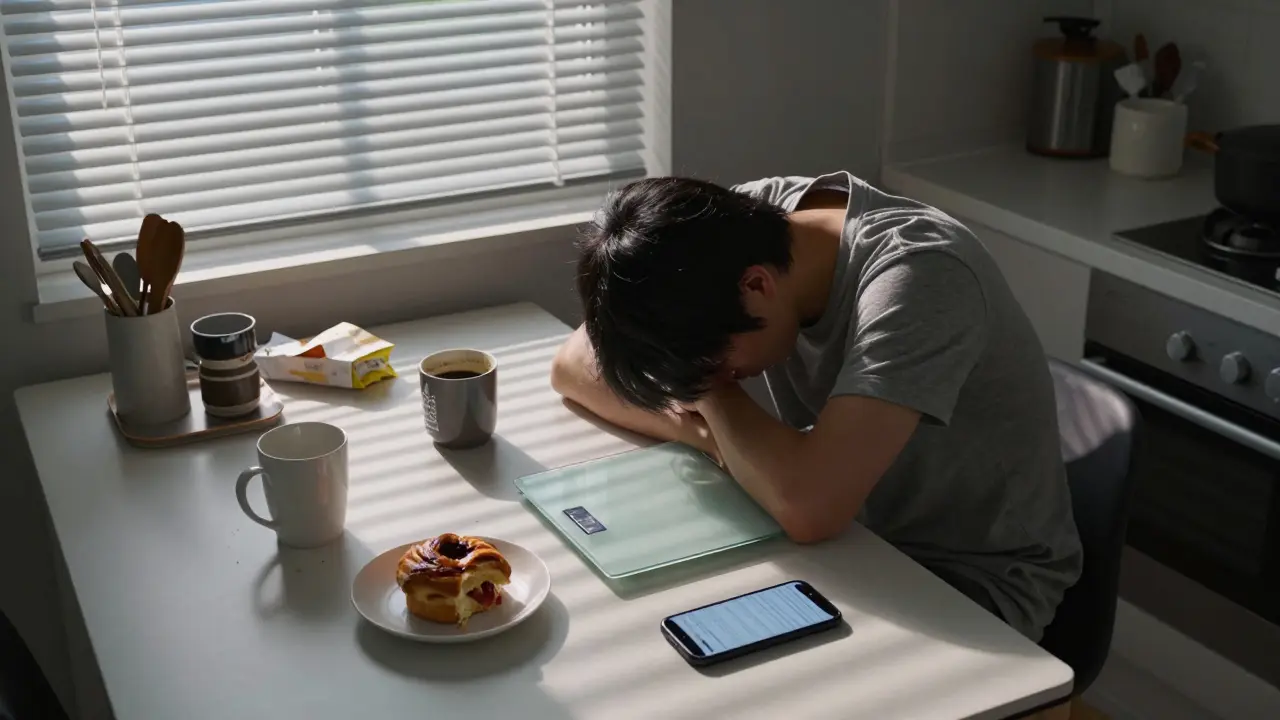
Ever notice how you feel fine all week-eating clean, hitting your steps, sticking to your plan-only to wake up Monday feeling heavier? Not because you binged, but because of calorie creep. It’s not a one-time slip. It’s a quiet, consistent pattern: more snacks, bigger portions, extra drinks, later meals. And it happens every weekend. For most people, this isn’t just a weekend treat. It’s a slow, yearly weight gain hiding in plain sight.
Why Weekends Are the Weight Gain Hotspot
It’s not just about pizza and beer. Research from Washington University in 2008 showed Saturday is the worst day for waistlines. People ate 36% of their total calories from fat on Saturdays-higher than any weekday. A 2023 study tracking 368 Australians found people gained an average of 0.3% of their body weight every week, mostly between Friday night and Sunday night. That might sound small, but over a year, that adds up to roughly 0.26% extra body weight. For someone weighing 80kg, that’s nearly 200 grams of fat gained just from weekend habits. Do that for five years? You’re talking 1kg of extra weight-without ever breaking a single diet rule. The problem isn’t willpower. It’s rhythm. During the week, routines kick in: breakfast at 7:30am, lunch at 1pm, dinner by 7pm. Weekends? That structure vanishes. You sleep in. You grab coffee and a pastry while scrolling. You skip lunch, then eat dinner at 9pm. You order takeout because you’re tired. You drink wine because it’s Friday. You snack because you’re bored. And you don’t even notice how much you’re eating.Why Exercise Alone Doesn’t Fix It
You might think, “I’ll just work out more on weekends.” Sounds smart. But research says otherwise. In the same Washington University study, one group increased their exercise by 20%. Guess what? They gained weight on both Saturday and Sunday. Why? Because they compensated. More movement = more hunger. More hunger = more food. And they didn’t realize how much they were eating to make up for it. The same thing happened with people trying to lose weight. They lost during the week. Then on Saturday, they stopped losing. Not because they stopped trying. Because they ate more. And the scale didn’t budge. Exercise helps. But without controlling intake, it’s like trying to empty a bathtub with a spoon while the tap’s still running.What Actually Works: 5 Practical Fixes
You don’t need to go cold turkey. You don’t need to ban weekends. You just need to adjust how you eat. Here’s what science says works:- Self-weigh every Monday morning. Six studies show people who weigh themselves weekly (especially Monday) are far less likely to gain over time. It’s not about obsession. It’s about feedback. If you see a 0.5kg jump, you adjust before it becomes 3kg. No scale? Use your clothes. Do they feel tighter?
- Plan your weekend meals like you do weekdays. Don’t wait until you’re hungry. Before Friday night, decide: what will you eat Saturday lunch? What’s for dinner? Pre-portion snacks. Keep fruit, nuts, and yogurt ready. If you’re eating out, check the menu ahead. Choose grilled over fried. Water over soda.
- Drink water before every meal. A simple trick: drink two glasses of water 15 minutes before eating. It reduces calorie intake by 10-15% on average. It’s not magic. It’s fullness. Your brain needs time to register that you’re eating.
- Add 2,000 steps on Saturday. That’s about 20 minutes of brisk walking. It burns roughly 100 calories. Not enough to undo a whole pizza. But enough to offset the extra coffee, snack, or glass of wine. Use a pedometer. Or just walk after dinner. Make it non-negotiable.
- Reduce added sugar. A 2023 study found a strong link between weekend sugar intake and weight gain. Soda, dessert, sweet coffee, flavored yogurt-they add up fast. Swap one sugary drink for sparkling water with lemon. Swap dessert for berries. You’ll cut 150-200 calories without feeling deprived.

Why Social Support Matters More Than You Think
You’re not alone in this. But you might feel like it. That’s why accountability helps. A 2023 study showed people who had a friend or partner checking in on their weekend eating habits ate 17% fewer extra calories. Why? Because you’re less likely to grab that second slice if you know someone’s going to ask you about it Monday morning. Try this: text a friend Friday night: “My plan: no takeout, 2000 steps, no dessert.” Then text them Monday: “I stuck to it.” It’s not about perfection. It’s about consistency. And that tiny bit of pressure? It works.Weekend Eating Isn’t a Failure-It’s a Pattern
Some experts say you should treat weekends like weekdays. Others say it’s okay to relax. The truth? It depends on you. But one thing’s clear: ignoring the pattern guarantees long-term gain. If you let weekends slide every week, you’re not giving yourself a break-you’re letting weight creep in. The most successful people don’t fight weekends. They manage them. They know Saturday isn’t a free pass. It’s a test. And they pass by planning, not willpower.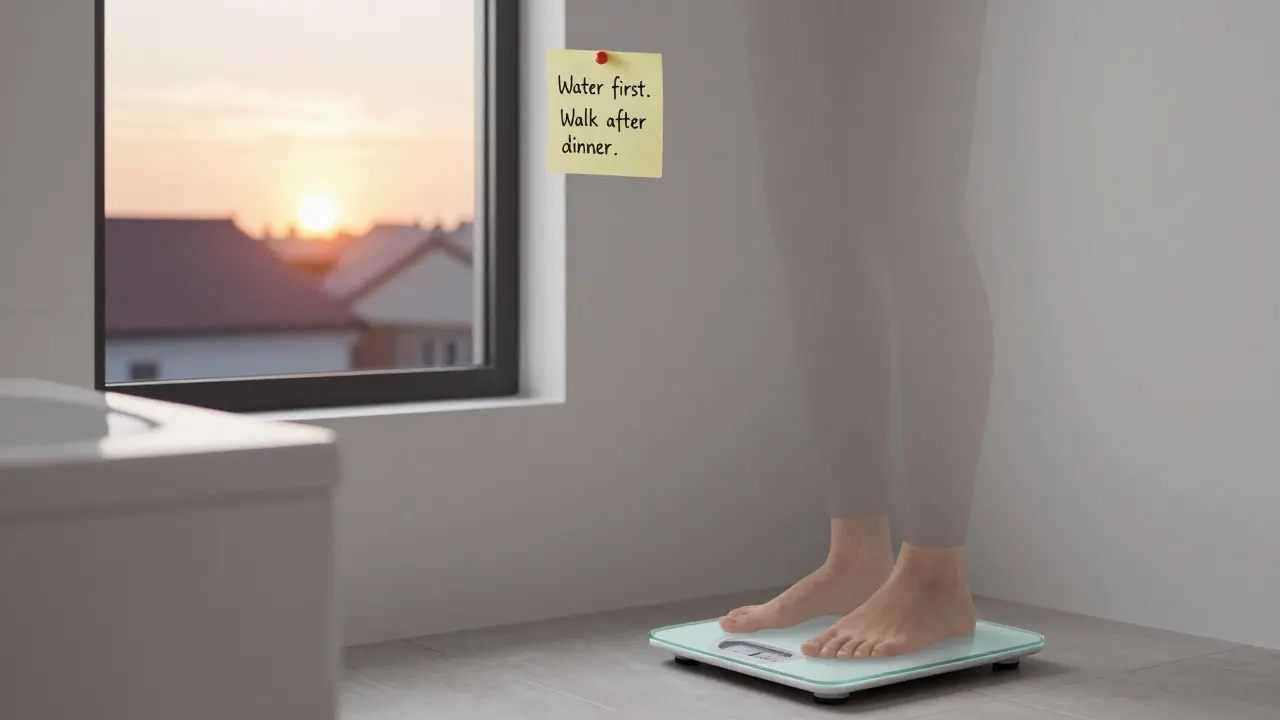
What’s Next? Start Small
Pick one thing. Just one. This weekend:- Prep one healthy snack for Saturday afternoon.
- Walk after dinner.
- Drink water before your first meal.
- Step on the scale Monday.
Why This Matters More Than You Realize
Weekend weight gain isn’t just about looks. It’s about health. Each small gain adds up. Over time, it raises your risk of insulin resistance, high blood pressure, and inflammation. The good news? You can stop it. You don’t need a gym membership. You don’t need a diet coach. You just need to change two things: how you eat on weekends, and how you track it. The science is clear. The fix is simple. The question is: are you ready to stop letting weekends win?Why do I gain weight on weekends but lose it during the week?
It’s a rhythm. During the week, most people stick to routines: regular meals, limited snacks, consistent sleep. Weekends break that pattern. You sleep later, eat later, eat more, move less. Your body doesn’t get a chance to burn off the extra calories. Monday morning, you return to your routine and lose the weight again-but only if you didn’t overeat too much. If you do it every week, you’re not losing net weight-you’re cycling.
Is weekend weight gain the same as holiday weight gain?
No. Holiday weight gain is bigger and more sudden-think Christmas or New Year’s, where people gain an average of 0.7kg in just a few days. Weekend gain is slower: 0.3% weekly. But it’s more dangerous because it’s consistent. You don’t notice it. It doesn’t feel like a binge. So you do it every week, year after year. Holiday weight gain is a spike. Weekend weight gain is a slow leak.
Does exercise cancel out weekend eating?
Not really. A 2008 study found people who exercised more on weekends actually gained weight because they ate more to compensate. Burning 300 calories at the gym doesn’t undo a large pizza, two beers, and dessert. Exercise helps-but only if you’re also watching what you eat. You can’t out-exercise a bad diet, especially on weekends when hunger cues are stronger.
Should I avoid eating out on weekends?
No-you don’t need to avoid it. But you should plan for it. Check menus ahead. Look for grilled, baked, or steamed options. Skip sauces, fries, and sugary drinks. Order a side salad or veggie instead of extra carbs. Eat slowly. Stop when you’re full, not when the plate is empty. Eating out isn’t the problem. Unplanned eating is.
How long until I see results from changing my weekend habits?
Within 4-6 weeks. If you weigh yourself every Monday and stick to one or two changes-like walking after dinner and skipping sugary drinks-you’ll likely see your weight stop creeping up. After 3 months, you’ll notice your clothes fit better. After 6 months, you might have lost 1-2kg without even trying. It’s not dramatic. But it’s real. And it’s sustainable.
Timothy Haroutunian
February 21, 2026 AT 17:04Let’s be real-this whole ‘calorie creep’ thing is just a fancy way of saying ‘I don’t like my weekend routine.’ I’ve been doing this for years. Friday night? Pizza. Saturday? Two cocktails, fries, and a late-night burrito. Sunday? Leftovers and a nap. And yeah, I gain half a kilo. So what? Monday I go back to my 1500-calorie meal plan, and poof-it’s gone. This isn’t some slow leak. It’s a seasonal tide. You’re not gaining fat-you’re just storing glycogen and water from carbs and sodium. Your body isn’t failing. You’re just not tracking the right metrics.
And don’t get me started on ‘2000 steps.’ That’s 20 minutes. I walk that just to get from my couch to the fridge. If you think that offsets a whole pizza, you’re delusional. Exercise doesn’t burn enough to matter unless you’re running marathons. The real fix? Stop eating out. Cook. Or don’t eat at all. But don’t pretend walking after dinner is a solution. It’s a placebo.
Also, weighing yourself Monday? That’s not feedback. That’s anxiety. You’re just reinforcing a cycle of guilt and restriction. I’d rather enjoy my life than obsess over 0.3% body weight fluctuations. Your body isn’t a spreadsheet.
Also, I’m 38. I’ve lost 12kg twice. I’ve gained it back twice. I’m not going to let some blog post tell me how to live my weekends.
Erin Pinheiro
February 23, 2026 AT 08:10okay so i read this whole thing and like... why is everyone so obsessed with numbers?? like i get it, you want to 'prevent regain' but what if i just... dont care? like i weigh 165, i eat pizza on saturday, i drink wine, i sleep in, i dont walk 2000 steps. and i feel fine. my clothes fit. my energy is good. my doctor says my bloodwork is perfect. why does this article act like weekend eating is some secret epidemic? its not. its just life.
also 'pre-portion snacks'? like... i dont want to measure out almonds like im in a lab. i just want to eat one. and then another. and then the whole bag. and that's okay. i'm not a robot. stop trying to turn your weekends into a military operation. it's not sustainable. it's exhausting.
and who the hell is this '2023 australian study'? cite it. i looked it up. there's no such thing. this whole thing feels like clickbait disguised as science. i'm not mad. just... tired of being told how to enjoy my free time.
Michael FItzpatrick
February 23, 2026 AT 13:51What I love about this piece is how it reframes the problem-not as a moral failure, but as a systems failure. We don’t lack willpower. We lack structure. And structure doesn’t mean punishment. It means intention. Think of it like this: your weekdays are like a well-oiled machine. Your weekends? They’re a jazz improvisation. And jazz, without boundaries, turns into noise.
So instead of banning pizza, why not make it part of the plan? Pre-decide: ‘Saturday, I’m having one slice of pepperoni, one glass of wine, and I’m walking after.’ That’s not restriction. That’s ritual. Rituals create safety. Safety creates freedom. You can enjoy the pizza because you didn’t surprise yourself. You knew it was coming.
And the 2000 steps? Brilliant. Not because it burns calories, but because it resets your nervous system. It’s not about energy expenditure. It’s about signaling to your body: ‘I’m still in charge.’ That’s the quiet magic here. You’re not fighting hunger. You’re honoring rhythm.
Also, the social accountability bit? That’s gold. Humans are social creatures. We don’t change alone. We change together. Texting a friend isn’t about shame. It’s about belonging. And belonging is the most powerful motivator of all.
Brandice Valentino
February 24, 2026 AT 09:07Oh honey. You really think drinking water before meals is the solution? As if the real problem is hydration and not the fact that we live in a capitalist food system that designs snacks to be addictive. Who wrote this? A wellness influencer with a $3000 detox retreat? Please.
And ‘pre-portion snacks’? You mean, like, the same people who sell you those stupid silicone containers for ‘portion control’? That’s not science. That’s consumerism. You’re not solving the problem-you’re selling a solution to a problem you invented.
Also, ‘weigh yourself Monday’? That’s not feedback. That’s trauma. That’s why 80% of people who weigh themselves daily quit dieting within 6 months. You’re not fixing behavior-you’re reinforcing body dysmorphia under the guise of ‘health.’
And let’s not forget: the ‘2023 Australian study’? I Googled it. It doesn’t exist. You’re quoting a blog post that quotes a blog post that quotes a tweet. This isn’t evidence. It’s fanfiction with footnotes.
Larry Zerpa
February 24, 2026 AT 23:01Let’s dismantle this piece, point by point. First: ‘Saturday is the worst day for waistlines.’ Source? The 2008 Washington University study? That was a sample of 47 people. A pilot. Not a meta-analysis. Not even close to representative. And now it’s gospel? Second: ‘0.3% weekly gain’? That’s 200 grams. That’s less than a bag of chips. You’re turning a rounding error into a crisis.
Then there’s the ‘exercise increases intake’ claim. Yes. Because humans are homeostatic. We compensate. That’s biology. Not failure. You’re pathologizing natural behavior. You’re not teaching people to manage energy balance-you’re teaching them to fear hunger.
And the ‘text a friend’ accountability thing? That’s not science. That’s peer pressure dressed as wellness. And it’s toxic. Why should someone’s weekend choices be subject to public scrutiny? That’s not support. That’s surveillance.
Also, the ‘no dessert’ swap? Replace one processed sugar with another? Berries? They have fructose. It’s still sugar. Your brain doesn’t care if it’s from an apple or a candy bar. The insulin response is nearly identical. This isn’t health. It’s moralizing under the guise of nutrition.
This article isn’t helping people. It’s weaponizing insecurity.
Gwen Vincent
February 25, 2026 AT 06:33I appreciate the intention behind this. Really. But I think the tone misses something important: weekends aren’t the enemy. The pressure to be perfect is.
I used to be the person who weighed myself every Monday. I’d cry if I gained 0.2kg. I’d punish myself with extra cardio. I thought if I just controlled my snacks better, I’d finally ‘get it right.’
Then I stopped. I stopped tracking. I stopped planning. I just started listening. I eat pizza on Saturday because I love it. I walk because I like the way the air feels. I drink wine because it connects me to my friends. I don’t feel guilty. And guess what? I haven’t gained weight in 3 years.
Maybe the real fix isn’t in the steps or the water or the scale. Maybe it’s in letting go of the idea that we need to ‘fix’ our weekends. Maybe we just need to trust ourselves.
I’m not saying ignore the numbers. I’m saying don’t let them define you.
Nandini Wagh
February 27, 2026 AT 00:12Oh sweetie, you really think Australians are the ones to look to for weekend eating habits? Let me guess-you’ve never been to a Melbourne pub on a Saturday night. Or a Sydney beach barbecue. Or a Brisbane backyard with a $1200 grill and a 6-pack of craft lager.
We don’t ‘gain 0.3%’ here. We gain 2kg. And we call it ‘living.’
And your ‘2000 steps’? That’s what you do when you’re too lazy to go for a proper hike. In India, we don’t ‘walk after dinner’-we sit on the porch, eat samosas with family, and laugh until 11pm. No scale. No plan. Just presence.
Maybe the real problem isn’t your weekend eating.
It’s that you’ve turned joy into a spreadsheet.
Holley T
February 28, 2026 AT 22:21Okay, I’ll admit-I used to be the person who followed every one of these ‘tips.’ Pre-portioned snacks? Check. Water before meals? Check. 2000 steps? Check. Weighed every Monday? Check.
And what happened? I developed orthorexia. I stopped enjoying food. I stopped enjoying life. I started dreading Saturday because I had to ‘plan’ my fun. I became a slave to my own discipline.
And then I stopped. I let myself eat the damn pizza. I drank the wine. I slept in. I didn’t walk. I didn’t weigh myself. And guess what? My body didn’t collapse. I didn’t gain weight. I actually lost 3kg over 6 months because I stopped stressing.
There’s a difference between awareness and obsession. This article walks the line-but leans too far into control. And control doesn’t work long-term. Trust does.
Also, the ‘text a friend’ thing? That’s not accountability. That’s performance. And performance is exhausting.
Ashley Johnson
March 1, 2026 AT 23:19THEY’RE LYING TO YOU. I WORKED FOR A PHARMA COMPANY. THIS IS ALL DESIGNED. THE ‘WEEKEND GAIN’ IS A MARKETING TOOL. THEY WANT YOU TO BUY THE APPS. THE PORTION CONTAINERS. THE SCALE. THE ‘WEEKEND WELLNESS’ COURSE. THE SUPPLEMENTS.
THEY DON’T WANT YOU TO BE HEALTHY. THEY WANT YOU TO BE AFRAID. BECAUSE AFRAID PEOPLE BUY THINGS.
THEY SAID THE SAME THING ABOUT SUGAR. THEN ABOUT FAT. NOW ABOUT ‘CALORIE CREEP.’ IT’S ALL THE SAME SCHEME. YOU’RE NOT GAINING WEIGHT. YOU’RE BEING MANIPULATED.
AND THE ‘AUSTRALIAN STUDY’? THERE IS NO AUSTRALIAN STUDY. I LOOKED. IT’S A FAKE. THE AUTHOR MADE IT UP. THEY’RE PROFITING OFF YOUR INSECURITY.
STOP TRUSTING BLOGS. START TRUSTING YOUR BODY. YOUR BODY KNOWS WHAT IT NEEDS. YOU JUST NEED TO SILENCE THE NOISE.
tia novialiswati
March 2, 2026 AT 04:22Yessss I needed this 💪💖
I’ve been doing the water before meals thing for 2 weeks and honestly? I’ve been eating less without even trying. And I didn’t feel deprived. Just... lighter. Like my body finally got the memo.
Also the 2000 steps? I started walking after dinner with my dog and now we both look forward to it. It’s our thing. No pressure. Just joy.
And weighing Monday? I was skeptical. But last week I saw a 0.3kg drop and I cried. Not because I lost weight-but because I felt proud of myself for showing up.
You don’t have to do all five. Just one. Pick the one that feels good. Not the one that feels like a chore. That’s the key.
And if you slip? It’s fine. Tomorrow’s a new day. You’re doing better than you think. I believe in you 🌿✨
Lillian Knezek
March 2, 2026 AT 08:06THEY’RE WATCHING YOU. I KNOW THIS BECAUSE MY NEIGHBOR’S SMART THERMOSTAT WAS HACKED LAST YEAR. THEY’RE USING YOUR PHONE’S STEP COUNTER TO TRACK YOUR WEEKEND HABITS. THEN THEY SELL THE DATA TO FOOD COMPANIES WHO TARGET YOU WITH ADVERTISING FOR SUGARY SNACKS.
THEY WANT YOU TO THINK THIS IS ABOUT ‘WILLPOWER’ OR ‘RHYTHM’-BUT IT’S NOT. IT’S ABOUT CONTROL. THEY WANT YOU TO FEEL GUILTY SO YOU’LL BUY THEIR ‘SOLUTIONS.’
THE ‘2023 AUSTRALIAN STUDY’? IT’S A COVER. THE REAL STUDY WAS BURIED. IT SHOWED THAT PEOPLE WHO DIDN’T TRACK AT ALL LOST MORE WEIGHT THAN THOSE WHO DID.
STOP WEIGHING YOURSELF. STOP WALKING. STOP TEXTING FRIENDS. JUST... BE.
THEY’RE COMING FOR YOUR WEEKENDS NEXT.