
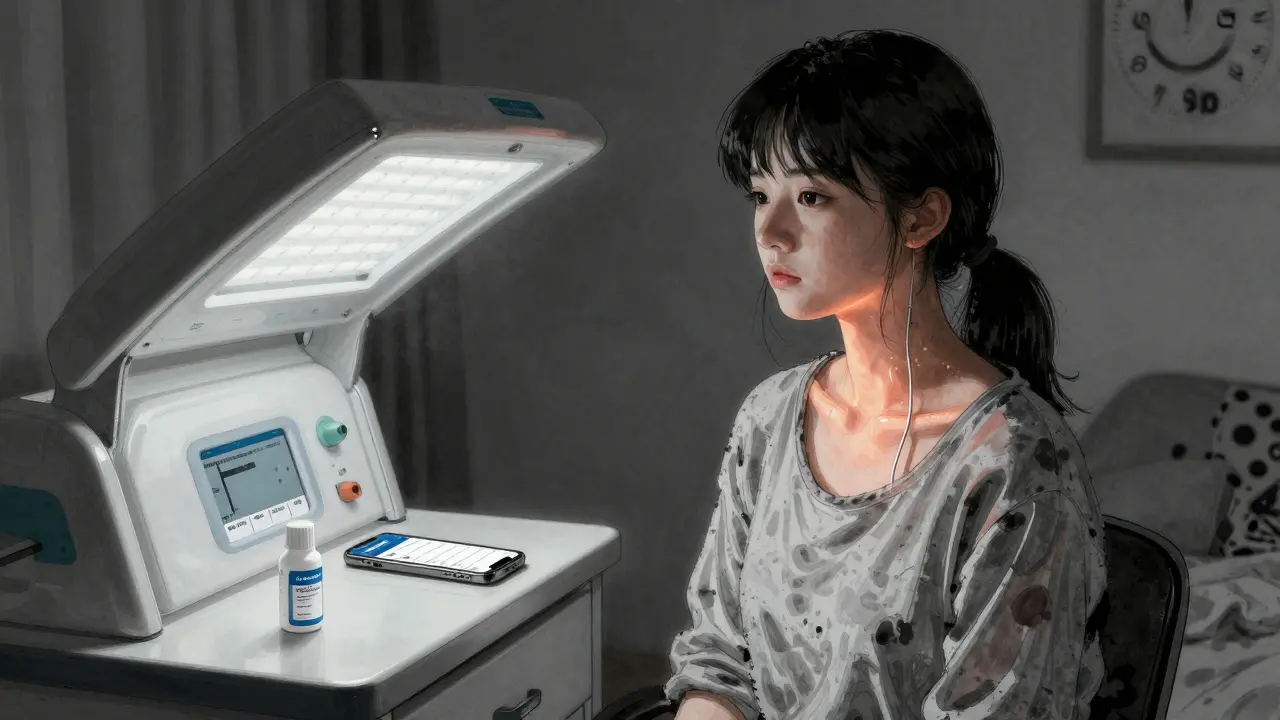
When you have vitiligo, the white patches on your skin aren’t just a cosmetic issue-they can change how you see yourself. Many people assume the goal is to make those patches disappear overnight. But the reality is more complex. Phototherapy is one of the most effective ways to bring back color, but it doesn’t work alone. And it’s not the same as depigmentation, which is a completely different strategy for advanced cases.
What Phototherapy Actually Does
Phototherapy doesn’t mask vitiligo. It doesn’t cover it up with makeup or dye. It works from the inside out. The treatment uses controlled doses of ultraviolet light to wake up the dormant melanocytes-those are the pigment-producing cells-that still live in your hair follicles, even in the whitest patches. These cells aren’t gone; they’re just inactive. The light triggers them to multiply and move up to the skin’s surface, slowly restoring color. The most common type is narrowband ultraviolet B (NB-UVB), which uses a precise 311-313 nm wavelength. It’s safer than older methods and doesn’t require swallowing pills. You stand in a light booth for seconds to minutes, two to three times a week. Sessions start short-sometimes just 30 seconds-and increase gradually based on your skin type and how your skin reacts. It’s not a one-size-fits-all process. A fair-skinned person might start at 200 mJ/cm², while someone with darker skin might begin at 700 mJ/cm². The goal isn’t to burn you; it’s to get just enough redness (erythema) to signal the cells are responding.Why You Can’t Combine Phototherapy With Depigmentation
There’s a big misunderstanding here. Some people think you can do both-lighten the dark areas and darken the white ones at the same time. That’s not how it works. Depigmentation is a last-resort treatment for people who have lost more than 80% of their skin pigment. Instead of trying to restore color, doctors use a strong topical cream called monobenzone to permanently fade the remaining pigmented skin. The result? A uniform, pale appearance. It’s irreversible. You’re not treating vitiligo-you’re accepting it. Phototherapy and depigmentation are opposites. One tries to bring color back. The other removes what’s left. Doing both together makes no medical sense. The American Academy of Dermatology’s 2023 guidelines clearly state these are separate pathways, chosen based on how much skin is affected. If you have patches on your face and arms, phototherapy is your best bet. If you’ve lost pigment over nearly your whole body, depigmentation might be discussed-but only after years of trying other options.How Effective Is Phototherapy Really?
Success isn’t guaranteed, but the numbers are promising. A major 2017 study in JAMA Dermatology followed over 1,200 patients and found that after six months of NB-UVB, about 37% saw at least half their pigment return. By 12 months, that jumped to 57%. About one in three got 75% or more repigmentation. But location matters a lot. The face and neck respond best-up to 80% of patients see strong results. The hands and feet? Only 15-20% improve, even after a full year. That’s why many people get frustrated and quit. They see their face changing but their fingers stay white. You need patience. The JAMA study made it clear: you can’t judge phototherapy after three months. You need at least six. Most doctors recommend sticking with it for a full year before deciding if it’s working. And even then, some areas may never fully repigment. That’s normal.Home vs. Clinic: Which One Works Better?
You don’t have to go to a clinic every time. Home phototherapy units are now FDA-approved and widely used. The Philips TL-01 model costs between $2,500 and $5,000 upfront, but Medicare covers 80% for qualifying patients. A 2020 study found home users were 35% more likely to stick with treatment than those going to clinics. Why? No commute. No waiting. No taking time off work. But there’s a catch. Home users had 22% more burns. Why? Incorrect dosing. If you don’t follow the schedule, increase the time too fast, or skip the eye protection, you risk irritation. That’s why the best home users use apps to log each session. UC Davis Health found that 92% of patients who tracked their treatments with a phone app stayed on schedule. The worst mistakes? Skipping sessions because you’re tired, or pushing the light too close to your skin because you want faster results.
Combining Phototherapy With Creams
Here’s where things get smarter. Phototherapy doesn’t have to be done alone. When paired with topical treatments, results improve dramatically. The two most common partners are calcineurin inhibitors (like tacrolimus or pimecrolimus) and ruxolitinib cream. Calcineurin inhibitors calm the immune system right where it’s attacking melanocytes. Studies show they boost repigmentation by 25-30% when used alongside NB-UVB. You apply them daily to the patches, then do your light session later. No interaction. No extra side effects. Just better outcomes. Ruxolitinib, approved by the FDA in 2022, is newer but powerful. The 2023 Ruxotmel trial showed that when used with phototherapy, 54% of patients achieved over 50% repigmentation in just 24 weeks. That’s faster than phototherapy alone. It’s especially helpful for people who’ve struggled with slow progress. The catch? It’s expensive-over $5,000 a year without insurance.What’s New in 2026?
The field is moving fast. In October 2023, the FDA cleared the first AI-assisted phototherapy device: Vitilux AI. It uses your smartphone to take a picture of your patches and calculates your exact light dose-cutting dosing errors by 37%. No more guesswork. No more burns from misjudging exposure. Another breakthrough? Afamelanotide implants. These tiny rods, placed under the skin, release a pigment-boosting hormone over two months. The VITCURE-2 trial, launching in early 2024, is testing if they can speed up phototherapy results. Early lab data suggests patients might need fewer sessions overall. Even more exciting? Researchers are now looking at genetic markers to predict who will respond best to NB-UVB. Some people have a natural advantage. If you carry certain gene variants, your melanocytes might react faster. Personalized treatment plans based on your DNA could be here within five years.Real People, Real Results
One patient from Melbourne, 34, started NB-UVB after her vitiligo spread to her neck and chest. She used a home unit and applied tacrolimus every night. After nine months, she had 70% repigmentation on her neck. “I stopped hiding my collarbones,” she said. “I wore tank tops again.” Another, a 12-year-old boy with patches on his hands, tried phototherapy for a year. His fingers barely changed. His parents considered quitting-until they added ruxolitinib. At 14 months, he had visible color returning on his knuckles. “It wasn’t perfect,” his mom said, “but it was enough to stop the bullying at school.” But not everyone wins. A woman in Sydney gave up after 10 months. Her feet stayed white. She said, “I didn’t realize how little progress I’d make there. I thought the light would fix everything. It didn’t.”
What to Expect If You Start
If you’re considering phototherapy, here’s what you’re signing up for:- 2-3 clinic or home sessions per week, every week
- At least 6 months before you see real change
- Eye protection and genital shielding during every session
- Gradual increases in light exposure-no jumping ahead
- Topical creams applied daily, unless your doctor says otherwise
- Tracking your progress with photos or an app
Arjun Seth
January 15, 2026 AT 01:01People think this light stuff is magic? Nah. It’s just another way to waste money. I’ve seen folks spend years on it and still have white patches on their hands. Why not just accept it? You’re not broken. You’re just different.
Mike Berrange
January 16, 2026 AT 10:26Phototherapy doesn’t ‘wake up’ melanocytes-that’s pseudoscience. Melanocytes aren’t asleep; they’re destroyed by autoimmune attack. The UV light just suppresses inflammation temporarily. And no, it doesn’t ‘restore color’-it causes hyperpigmentation in some spots while leaving others untouched. The JAMA study? Flawed selection bias. Most patients who responded were already lighter-skinned to begin with.
Dan Mack
January 16, 2026 AT 18:59Did you know the FDA approved Vitilux AI because Big Pharma wanted to monetize skin scanning? They’re not curing vitiligo-they’re selling data. Your smartphone camera tracks your patches, then sells the patterns to insurance companies. That’s why they push home units-so you’re constantly feeding them your biometrics. And ruxolitinib? It’s a repurposed cancer drug. They’re testing it on you to see if it triggers melanoma. Watch your skin.
Amy Vickberg
January 17, 2026 AT 12:48I started phototherapy last year and honestly, it’s been life-changing. Not because my skin looks perfect-but because I stopped hiding. I used tacrolimus every night and tracked every session with an app. Even my feet got a little color back after 11 months. It’s not fast, but it’s real. You don’t have to win the whole battle-just show up for yourself every day.
Ayush Pareek
January 18, 2026 AT 09:29As someone from India who’s been through this, I get it. The pressure to ‘look normal’ is real. But phototherapy isn’t about perfection-it’s about progress. My cousin did it for 14 months. His face repigmented 80%, hands stayed white. He stopped feeling ashamed. That’s the win. Don’t compare your neck to your fingers. Compare where you are now to where you were a year ago.
Nishant Garg
January 18, 2026 AT 21:50Look, in my village, we used turmeric paste and sunbathing for ‘skin lightening’-we didn’t know it was vitiligo. Now we have lasers and AI? The world’s gone mad. But honestly? I’m glad. My niece started NB-UVB at 8. She cries sometimes because it hurts. But she laughs now when she sees her knees turning back to brown. Science is strange-but sometimes, it’s beautiful.
Nicholas Urmaza
January 19, 2026 AT 12:25If you’re serious about treatment you don’t wait six months. You start with ruxolitinib and phototherapy together. That’s the protocol. The data is clear. The FDA approved it for a reason. Stop listening to random Reddit posts. Talk to a dermatologist who specializes in pigmentation disorders. This isn’t a DIY project. It’s medicine. Treat it like it.
Sarah Mailloux
January 19, 2026 AT 22:13Home unit + tacrolimus + app tracking = my secret sauce. I didn’t tell anyone I was doing it at first. I was scared. But now I post progress pics on Instagram. People ask me how I did it. I say: patience. And don’t skip your eye shields. I learned that the hard way.
Nilesh Khedekar
January 20, 2026 AT 21:50Oh wow, another ‘science is magic’ post. Let me guess-you also believe the sun is a government drone? Phototherapy is expensive. Ruxolitinib costs more than my car payment. And you’re telling me this isn’t just a cash grab by pharma? The ‘AI device’? It’s a glorified camera with a subscription model. They’ll charge you $50/month to ‘analyze’ your patch. Meanwhile, the real cure? Stress reduction. Meditation. Yoga. That’s what actually helps. Not UV lamps.
Jami Reynolds
January 22, 2026 AT 01:11There is no such thing as ‘dormant melanocytes.’ That is a myth propagated by outdated textbooks. Melanocyte stem cells reside in the hair follicle bulge and are activated by Wnt signaling pathways-not UVB. The 2017 JAMA study used non-standardized protocols. The 2023 Ruxotmel trial? Funded by Incyte. Conflict of interest. And Afamelanotide? It’s a melanocortin-1 receptor agonist that increases melanin synthesis-but it’s only effective in Type I and II skin phototypes. This entire article is dangerously oversimplified.
Amy Ehinger
January 23, 2026 AT 09:39I’ve been living with vitiligo since I was 7. I’ve tried everything. Creams, lasers, tanning beds (don’t do that), even acupuncture. Phototherapy didn’t fix me-but it gave me something better: time. Time to learn who I am without hiding. I don’t care if my feet are still white. I wear sandals now. I used to wear socks in the pool. Now I splash around like a kid. That’s the real win. Not the color. The courage.
RUTH DE OLIVEIRA ALVES
January 24, 2026 AT 15:33It is imperative to acknowledge that the clinical efficacy of narrowband ultraviolet B phototherapy, while statistically significant in controlled cohorts, remains heterogeneous across diverse phenotypic and genetic subpopulations. Furthermore, the cost-benefit analysis of adjunctive ruxolitinib therapy must be contextualized within the socioeconomic framework of the patient’s healthcare access. The assertion that phototherapy is ‘the most proven’ modality is not universally valid, particularly in resource-limited settings where consistent access to equipment and follow-up is not guaranteed. A more nuanced, patient-centered approach is warranted.
Crystel Ann
January 24, 2026 AT 18:44I didn’t think I’d ever say this-but I’m glad I didn’t give up. My daughter’s patches on her arms faded enough that she stopped saying she hated her skin. We didn’t need perfect. We just needed hope. And sometimes, hope is just one more session.
Nat Young
January 25, 2026 AT 09:00Everyone’s acting like phototherapy is some miracle cure. What about the 63% who don’t respond? The ones who get burned? The ones who spend $15k and get nothing? You’re glorifying a treatment that only works for a lucky minority. And what about the people who use it and then get skin cancer? No one talks about that. This isn’t empowerment-it’s a sales pitch wrapped in science.
Niki Van den Bossche
January 26, 2026 AT 15:59How quaint. You speak of melanocytes as if they are mere cells, not sacred vessels of identity. Phototherapy? A crude instrument of colonial aesthetics-forcing the body to conform to a chromatic ideal born of Eurocentric beauty standards. Ruxolitinib? A chemical surrender to the tyranny of pigmentation. We must transcend the skin. The soul does not wear color. The true cure is not in the lamp, but in the dismantling of the gaze that demands it.