

QT Prolongation Risk Calculator
Risk Assessment Tool
This tool estimates your risk of Torsades de Pointes based on key factors from the article. Remember: This is for informational purposes only and not a medical diagnosis. Always consult your healthcare provider.
Every year, about 4 in every million women and 2.5 in every million men experience a sudden, terrifying heart rhythm called Torsades de Pointes. It doesn’t come with warning signs. No chest pain. No dizziness. Just a heartbeat that twists out of control - and if it’s not stopped fast, it turns into cardiac arrest. This isn’t rare. It’s preventable. And it’s often caused by medications you or someone you know might be taking right now.
What Exactly Is Torsades de Pointes?
Torsades de Pointes (TdP) is a type of dangerous irregular heartbeat that shows up clearly on an ECG. The name means "twisting of the points," and that’s exactly what it looks like - the QRS complexes on the tracing twist around the baseline like a ribbon. It doesn’t happen out of nowhere. It only happens when the heart’s electrical cycle is too long - specifically, when the QT interval is prolonged. The QT interval measures how long it takes the heart’s ventricles to recharge after each beat. If that time stretches too far, the heart muscle doesn’t reset properly. That’s when abnormal electrical sparks, called early afterdepolarizations, can trigger this chaotic rhythm. It can last a few seconds and resolve on its own, or it can spiral into ventricular fibrillation - a fatal rhythm that stops blood flow entirely. Between 10% and 20% of people who experience TdP die if it’s not treated immediately.Which Medications Cause QT Prolongation?
Over 200 commonly prescribed drugs can lengthen the QT interval. The biggest culprits aren’t always the ones you’d expect. Many are used for everyday conditions:- Antibiotics: Erythromycin, clarithromycin, moxifloxacin
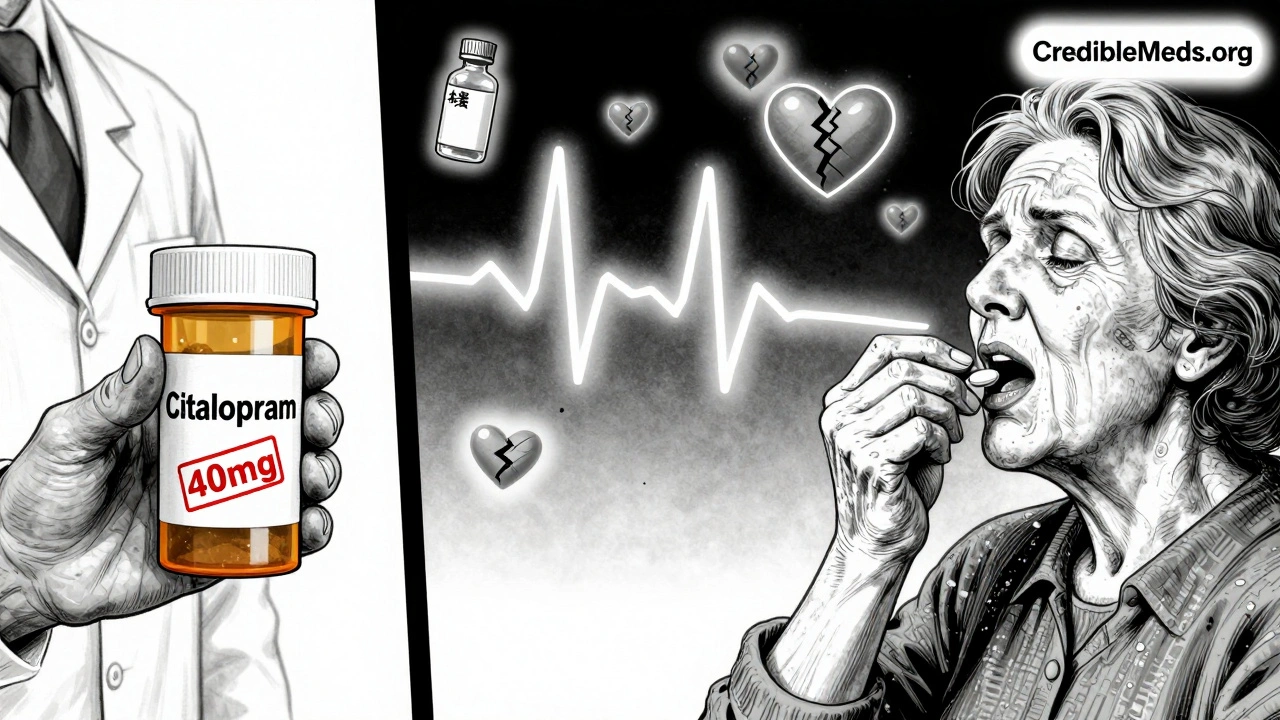
- Antidepressants: Citalopram, escitalopram (especially at doses above 20 mg/day in older adults)
- Antipsychotics: Haloperidol, ziprasidone, thioridazine
- Anti-nausea drugs: Ondansetron (especially IV doses over 16 mg)
- Pain management: Methadone (risk increases sharply above 100 mg/day)
- Antifungals: Ketoconazole, voriconazole
- Antiarrhythmics: Quinidine, sotalol, dofetilide (ironically, drugs meant to fix rhythms can cause them)
Who’s at Highest Risk?
It’s not just about the drug. It’s about the person taking it. Most TdP cases happen because of a dangerous mix of factors:- Women: 70% of TdP cases occur in women, even though men and women experience similar QT prolongation. Hormonal differences and smaller heart size play a role.
- Age 65 and older: 68% of cases are in seniors. Kidneys and liver don’t clear drugs as well, so levels build up.
- Low potassium (hypokalemia): Present in 43% of cases. A level below 3.5 mmol/L triples the risk.
- Low magnesium (hypomagnesemia): Found in 31% of cases. Below 1.6 mg/dL increases risk by 2.7 times.
- Slow heart rate (bradycardia): Seen in 57% of cases. The slower the heart, the longer the QT interval becomes.
- Multiple QT-prolonging drugs: 28% of cases involve two or more. Combining, say, azithromycin and citalopram multiplies the danger.
- Heart disease or kidney/liver problems: 41% of patients have pre-existing heart conditions. Impaired kidneys mean drugs like citalopram stick around longer - 4.8 times higher risk if creatinine clearance is under 30 mL/min.
How Is It Diagnosed?
The only reliable way to catch QT prolongation before it turns deadly is an ECG. The key numbers:- Normal QTc: under 450 ms in men, under 460 ms in women
- Prolonged QTc: over 450 ms (men) or 460 ms (women)
- High-risk QTc: over 500 ms - doubles or triples TdP risk
- Warning sign: QTc increases by 60 ms or more from baseline
How to Prevent It
The good news? Almost all TdP cases are preventable. Here’s what works:- Check the patient’s meds. Before prescribing any new drug, review every medication the patient is taking. Use CredibleMeds.org to check if any are on the "Known Risk" list.
- Do a baseline ECG. Get an ECG before starting high-risk drugs like methadone, sotalol, or citalopram. Re-check after 1-2 weeks and after any dose increase.
- Fix electrolytes. If potassium is below 4.0 mmol/L or magnesium is below 2.0 mg/dL, correct it - don’t wait. Giving IV magnesium is often the first step in treating TdP, so why not prevent it?
- Avoid combinations. Don’t give two QT-prolonging drugs together unless absolutely necessary. If you must, reduce the dose of one and monitor closely.
- Know the limits. Citalopram max dose: 40 mg/day (20 mg if over 60). Ondansetron IV max: 16 mg. Methadone: start low, go slow. ECG required if dose exceeds 100 mg/day.
- Screen for congenital LQTS. If there’s a family history of sudden death, fainting, or deafness in childhood, use the Schwartz score to assess risk.
What to Do If TdP Happens
If someone goes into TdP, time is everything:- Give magnesium sulfate: 1-2 grams IV over 1-2 minutes. Works in 82% of cases, even if magnesium levels are normal.
- Start temporary pacing: Speed up the heart to over 90 bpm. This shortens the QT interval and stops the arrhythmia in 76% of cases.
- Correct electrolytes: Get potassium above 4.5 mmol/L and magnesium above 2.0 mg/dL.
- Use isoproterenol if needed: A second-line drug that increases heart rate if pacing isn’t available.
- Stop the offending drug immediately. Don’t wait for confirmation.
What’s Changing in 2025?
New tools are making prevention smarter:- Machine learning models: Mayo Clinic’s algorithm predicts individual TdP risk with 89% accuracy by analyzing 17 factors - age, sex, kidney function, drug combinations, electrolytes, and more.
- Concentration-QTc modeling: The FDA now allows some drugs to skip full QT studies if they can show a clear link between drug levels and QT changes - speeding up development.
- The PREVENT TdP Act: Proposed in 2022, this law would require standardized ECG monitoring for high-risk drugs across all U.S. hospitals. If passed, it could prevent 185-270 deaths per year.
- Updated CredibleMeds list: In 2023, 12 new drugs were added to the "Known Risk" list, including lesinurad and fedratinib. Domperidone was downgraded from "Known" to "Possible" based on new data.
Why This Matters
This isn’t just about avoiding a bad ECG. It’s about keeping people alive. Thousands of prescriptions are written every day for drugs that can cause TdP. Most prescribers know the risks - but they don’t always act. A patient on citalopram with low potassium and a slow heart rate? That’s a ticking bomb. A 72-year-old woman on clarithromycin and ondansetron? High risk. The solution isn’t to stop prescribing these drugs. It’s to prescribe them safely. With a quick ECG, a blood test for potassium, and a quick check of the CredibleMeds database, you can avoid a tragedy.Can Torsades de Pointes happen without any symptoms?
Yes. About half of all TdP cases occur without any warning signs like dizziness, palpitations, or fainting. The first sign can be cardiac arrest. That’s why ECG monitoring is critical for high-risk patients - you can’t rely on symptoms.
Is a prolonged QT interval always dangerous?
Not always. A QTc between 450-500 ms carries low risk in healthy people with no other factors. But when combined with low potassium, female sex, older age, or multiple drugs, even a QTc of 480 ms can be dangerous. Risk isn’t about the number alone - it’s about the context.
Why are women more at risk for TdP than men?
Women naturally have longer QT intervals than men, even at rest. Hormones like estrogen can further slow repolarization. Also, women tend to have smaller hearts and slower heart rates, which makes them more vulnerable to early afterdepolarizations. Plus, they’re more likely to be prescribed QT-prolonging drugs like antidepressants and antiemetics.
Can I use a home ECG device to check my QT interval?
Consumer ECG devices like Apple Watch or KardiaMobile can detect irregular rhythms, but they are not accurate enough to measure QTc reliably. QT measurement requires a 12-lead ECG interpreted by a trained clinician. Don’t rely on consumer devices for QT assessment.
What if I need a QT-prolonging drug but I’m at high risk?
You can still take it - safely. Work with your doctor to: correct electrolytes first, start at the lowest dose, avoid other QT drugs, get a baseline ECG, and repeat ECGs after 1-2 weeks. Many patients on methadone or citalopram live safely for years with proper monitoring.
Are there any new drugs that don’t prolong QT?
Yes. Newer antidepressants like vortioxetine and antipsychotics like lurasidone have minimal QT effects. New antibiotics like delafloxacin show lower risk than moxifloxacin. Drug developers now test for hERG channel binding early in development - so newer medications are safer by design.
Larry Lieberman
December 9, 2025 AT 16:48Lisa Whitesel
December 11, 2025 AT 10:03Sabrina Thurn
December 12, 2025 AT 00:44iswarya bala
December 12, 2025 AT 22:42Simran Chettiar
December 13, 2025 AT 17:53Anna Roh
December 15, 2025 AT 09:42om guru
December 16, 2025 AT 06:41Richard Eite
December 17, 2025 AT 08:40Philippa Barraclough
December 18, 2025 AT 16:49Olivia Portier
December 20, 2025 AT 03:53Tiffany Sowby
December 21, 2025 AT 01:39Asset Finance Komrade
December 22, 2025 AT 04:43Jennifer Blandford
December 23, 2025 AT 04:14Brianna Black
December 24, 2025 AT 00:00