
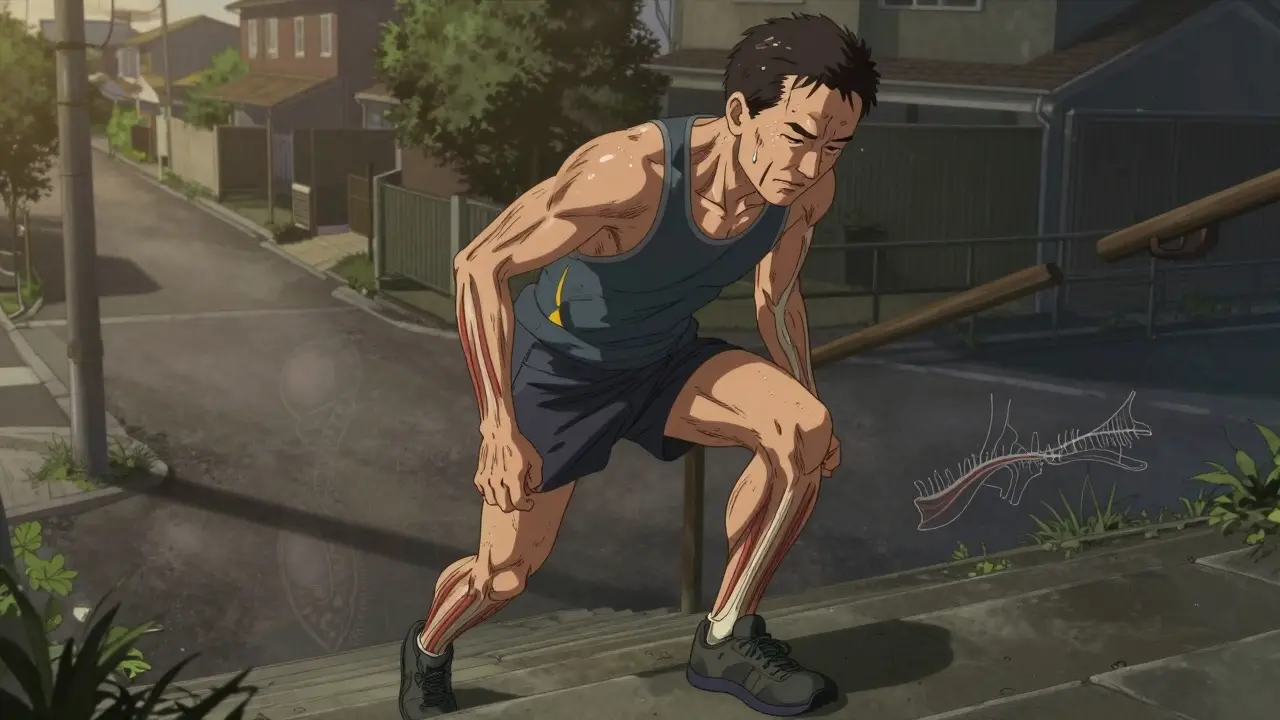
If you’ve been dealing with persistent tendon pain-whether it’s your knee, heel, or shoulder-you’re not alone. Tendinopathy affects about 30% of all sports medicine patients, and it doesn’t just hit athletes. Office workers, parents, and retirees all get it. The good news? You don’t need surgery or endless injections to fix it. The best evidence points to two powerful tools: eccentric training and smart injection choices.
What Exactly Is Tendinopathy?
Tendinopathy isn’t just inflammation. That’s the old idea. Today, we know it’s a degenerative breakdown of tendon tissue-think frayed ropes, not swollen ones. Pain comes from nerve growth and chemical changes in the tendon, not swelling. You’ll feel it when you jump, run, or even stand up after sitting. It lingers for months, sometimes years, if you don’t treat it right. The two most common sites? The Achilles (back of the ankle) and patellar (front of the knee). These tendons take the most load. Runners, basketball players, and dancers get hit hard. But so do people who stand all day or suddenly start walking more.Eccentric Training: The Gold Standard
Eccentric training means slowly lowering your weight under control. Think of lowering yourself into a squat, or lowering your heel from a raised position. It’s not about lifting fast-it’s about controlling the descent. In 1998, Dr. Hakan Alfredson showed that doing 180 heel drops a day for 12 weeks helped 80% of people with Achilles tendinopathy get back to running. Since then, dozens of studies have confirmed it works for other tendons too. For Achilles tendinopathy: Stand on a step, rise up on both feet, then lower down slowly on just the painful foot. Do 3 sets of 15 reps, twice a day. Keep your knee straight to target the calf muscle (gastrocnemius), then bend your knee slightly to hit the deeper soleus muscle. Rest 60-90 seconds between sets. You’ll feel pain-around 4-6 out of 10. That’s normal. If it hits 8 or higher, or lasts more than 24 hours, you’re pushing too hard. For patellar tendinopathy: Use a 25-degree decline board. Do single-leg squats, lowering slowly over 3-5 seconds. Three sets of 15 reps, daily. The decline board increases the load on the tendon just enough to trigger healing without tearing it. Studies show this kind of training increases tendon stiffness by 15-20% and realigns collagen fibers. Ultrasound scans after 8-12 weeks show the tendon thickens and looks healthier. VISA scores-a measure of pain and function-improve by 40-65% in most people.Heavy Slow Resistance: A Strong Alternative
You don’t have to do Alfredson’s protocol to get results. Heavy slow resistance (HSR) training works just as well-and many people stick with it longer because it hurts less at first. HSR means lifting a weight that’s about 70% of your max, slowly. For example: leg press or seated calf raise. Lift in 3 seconds, lower in 3 seconds. Three sets of 15 reps, three times a week. A 2015 study comparing HSR to eccentric training for Achilles tendinopathy found both groups improved by 60-65% after 12 weeks. But HSR had an 87% adherence rate. Eccentric training? Only 72%. Why? Because HSR doesn’t start with extreme pain. It builds up gradually. If you’re new to exercise or hate the idea of doing 180 heel drops a day, HSR is your friend. It’s easier to fit into a routine. And it works.Isometric Exercises: Quick Pain Relief
Eccentric training takes weeks to fix the tendon. But what if you need to play a game tomorrow? Or walk your dog without wincing? Isometric exercises-holding a muscle still under tension-give fast relief. For the knee, sit with your leg straight, push your knee down into a rolled towel for 45 seconds. Repeat five times. For the ankle, stand with both feet flat, press your heels down hard into the floor for 45 seconds. Do this before activity. Rio et al.’s 2015 study showed isometrics cut pain by 50% within 45 minutes. Eccentric training? Only 20%. That’s why many physical therapists now do isometrics first, then eccentric later in the day.
Injection Options: What Actually Works?
Injections are tempting. Quick fix. But they’re not magic. Corticosteroid injections: These reduce pain fast-30-50% improvement in 2-4 weeks. Great for getting through a big event. But here’s the catch: 65% of people need another treatment within six months. The tendon keeps breaking down. Studies show people who get steroid shots are more likely to rupture their tendon later. Don’t use them unless you’re desperate. Platelet-rich plasma (PRP): This sounds fancy. You get your own blood spun down, then injected into the tendon. Sounds natural, right? But a 2020 review found PRP only beats placebo by 15-20% at six months. That’s not enough to justify the cost (often $500-$1,000 per shot). Most insurance won’t cover it. Other injections: Dry needling, sclerosing agents, or bone marrow aspirate? No strong evidence. Some help a few people. But no consistent results. Don’t waste your money unless you’ve tried exercise first. Bottom line: Injections are a band-aid. Eccentric or HSR training is the cure.Why Some People Don’t Get Better
About 30% of people don’t respond to eccentric training. Why? One big reason: they don’t do it long enough. You need 12 weeks minimum. Most people quit after 4-6 weeks because they don’t see results. But ultrasound changes take time. Pain reduction starts around week 6. Structural healing shows up at week 10-12. Another reason: bad form. Doing decline squats with your knee caving in? Or letting your heel wobble during heel drops? That shifts load away from the tendon. A 2023 study found self-managed patients made mistakes 40% more often than those working with a therapist. Third reason: they ignore load management. You can’t do 180 heel drops and then go for a 10K run the same day. You need to reduce high-impact activity while you rebuild. Gradual return is key.How to Stay on Track
Success comes down to consistency. - Use an app like Tendon Rehab (version 3.2, 2023). It tracks reps, gives video demos, and reminds you. Users with apps had 85% adherence. Paper logs? Only 65%. - Work with a physical therapist for the first two sessions. They’ll check your form, adjust your pain tolerance, and help you scale up. People who did this had a 92% success rate. Those who went solo? 68%. - Track your pain. Use a 1-10 scale. Acceptable pain during exercise? 2-5. Pain that lasts more than 24 hours? Stop and back off. - Don’t compare yourself to others. Your tendon heals at your pace. Some people feel better in 8 weeks. Others need 16. That’s normal.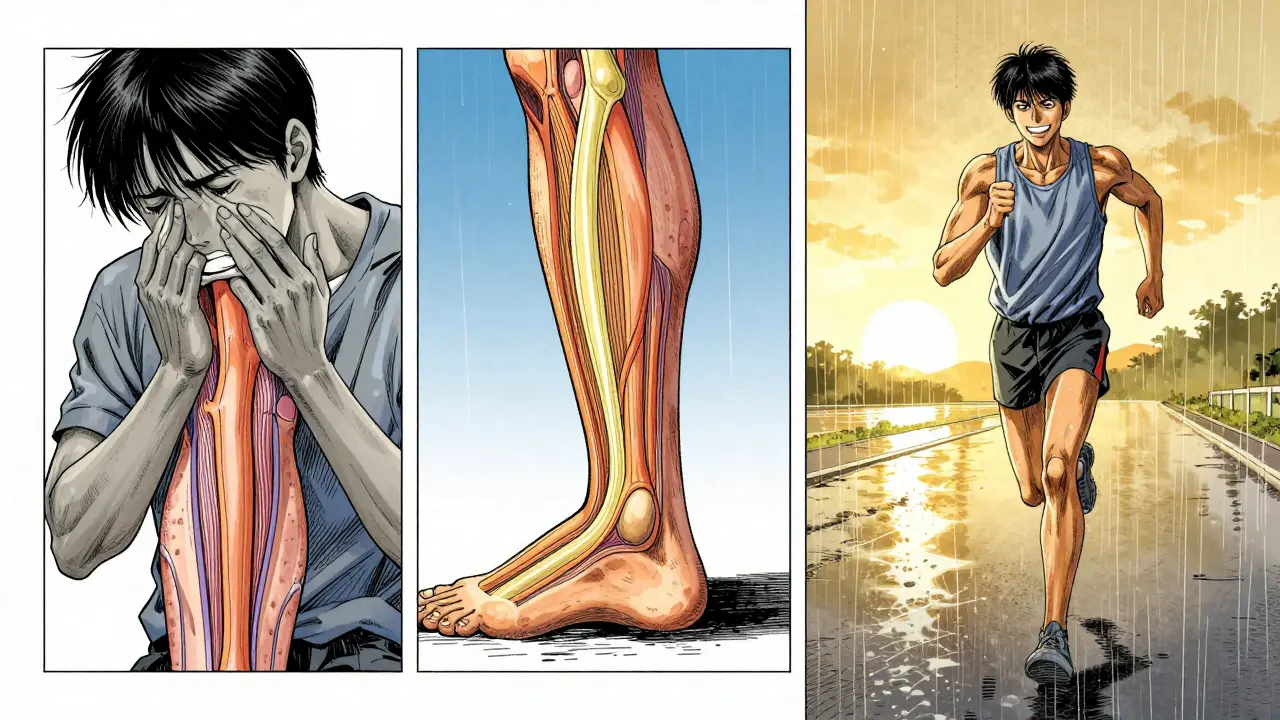
Bradly Draper
December 29, 2025 AT 19:06I had Achilles pain for two years. Tried everything-rest, ice, fancy shoes. Then I started the heel drops. Week 1 felt like my tendon was screaming. Week 8, I walked without wincing. Week 14, I ran a 5K. No shots. No surgery. Just slow, dumb, consistent work. If you’re reading this and hurting-just start. Don’t wait.
ANA MARIE VALENZUELA
December 31, 2025 AT 14:56Of course it works. Everyone who doesn’t do this is just lazy or addicted to quick fixes. Steroid shots are for people who want to keep living in denial. You think your body’s a car you can just refill with gas? Tendons aren’t magic. They respond to stress. If you won’t do the work, don’t complain when you’re still in pain at 60.
Sydney Lee
December 31, 2025 AT 19:02Let’s be honest-this whole ‘eccentric training’ thing is just a rebranding of 1980s physical therapy that got repackaged by overeager PTs with YouTube channels. The real reason people get better? Placebo effect and natural healing cycles. Also, 80% success rate? That’s cherry-picked data from studies where participants were monitored daily. Most people quit by week 3. The system is rigged to make you feel guilty for not being a martyr to your tendon.
Ryan Touhill
January 1, 2026 AT 18:52Interesting how the article completely ignores the role of systemic inflammation and metabolic dysfunction in tendinopathy. You can’t just ‘load’ your way out of a condition that’s likely rooted in insulin resistance, vitamin D deficiency, or gut dysbiosis. This is the same reductionist thinking that got us hooked on NSAIDs for decades. Tendons are not isolated mechanical parts-they’re biological systems embedded in a whole organism. If you’re only doing heel drops and ignoring your diet, sleep, and stress levels, you’re treating symptoms, not causes.
And PRP? It’s not just overpriced-it’s a symptom of a broken healthcare system that profits from ‘biotech solutions’ while ignoring foundational health. I’ve seen patients with identical tendon pathology recover fully after switching to a low-glycemic diet and 8 hours of sleep. No eccentric training required.
Also, why is there no mention of the microbiome? Emerging research links gut flora imbalance to chronic tendinopathy. But nope, let’s just tell people to do more squats.
oluwarotimi w alaka
January 3, 2026 AT 08:45They don’t want you to know this but the real cause of tendon pain is 5G radiation messing with collagen structure. I know this because my cousin in Lagos had the same problem and after he stopped using smartphones and started praying to ancestors every morning, his knee healed in 3 weeks. Also, the government pays PTs to push these exercises so you keep going to clinics and spending money. Eccentric training? More like economic training. They want you broke and dependent.
Hakim Bachiri
January 4, 2026 AT 14:52Look, I’ve been to med school, I’ve read the papers, and I’ve seen the data. You people think you’re being ‘smart’ by doing heel drops? Newsflash: the original Alfredson study had 24 subjects. 24. That’s not science, that’s a coffee-table anecdote. And don’t get me started on ‘HSR’-it’s just bodybuilding with a fancy name. You want real results? Go lift heavy. Squat. Deadlift. Build tendon density the old-fashioned way. Not some 180-drop torture ritual. Also, why is everyone using apps? Are we robots now? I did my rehab with a notebook and a stopwatch. And I’m still standing. You’re welcome.
Teresa Marzo Lostalé
January 5, 2026 AT 04:46It’s wild how we’ve turned healing into a productivity challenge. ‘Do 180 reps a day!’ ‘Track your pain on a scale!’ ‘Use an app!’ Like if you don’t optimize your tendon recovery like a startup, you’re failing at life. I did the heel drops. I cried. I hated it. But I kept going. And now? I can walk barefoot on the beach again. That’s not a metric. That’s a gift. Maybe we don’t need to quantify everything. Maybe we just need to show up, even when it sucks.
Also, I’m 71. I didn’t need PRP. I didn’t need a therapist. I just needed to stop pretending I was 25. 🌿
Kelsey Youmans
January 5, 2026 AT 09:58Thank you for this comprehensive and evidence-based overview. I appreciate the emphasis on longitudinal outcomes and the demystification of injection therapies. It is imperative that clinicians and patients alike recognize the biomechanical and biochemical nature of tendinopathy as a degenerative process rather than an inflammatory one. The data supporting eccentric loading is robust and reproducible across multiple cohorts. I would only add that the psychological component-particularly the fear-avoidance behavior common in chronic pain-is often under-addressed in rehabilitation protocols. A multidisciplinary approach, incorporating cognitive behavioral principles, may further enhance adherence and long-term success.
Debra Cagwin
January 5, 2026 AT 22:26Thank you for this. I’m a physical therapist and I see so many people who’ve been told to ‘rest’ for months, only to come back with worse pain. You’re right-tendons need load, not silence. I tell my patients: ‘Pain during rehab isn’t the enemy. Fear of pain is.’ I’ve had clients cry doing heel drops. I’ve had clients quit. But the ones who stuck with it? They’re the ones hiking mountains two years later. Don’t give up. Even if it’s slow. Even if it’s ugly. You’re rebuilding something real.