
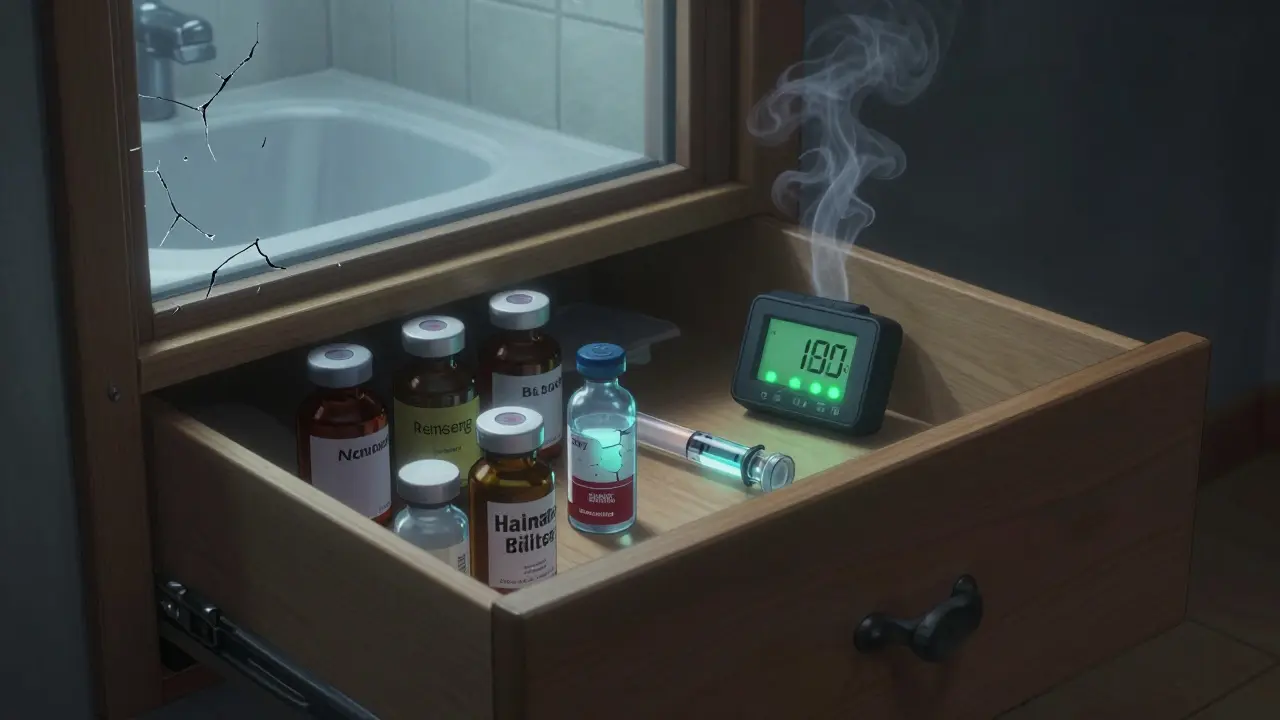
Storing your medications wrong isn’t just a mistake-it can make them useless, or worse, dangerous. A pill that’s been too hot or too damp might not work at all. Or worse, it could break down into something harmful. In 2022, nearly 8 out of 10 drug recalls in the U.S. were tied to temperature or humidity problems during storage. That’s not a small number. That’s a system failure affecting real people. And it’s happening in homes, clinics, and pharmacies across the world.
Why Temperature and Humidity Matter More Than You Think
Medications aren’t like canned food. They’re complex chemical compounds, many of them made from proteins, hormones, or live biological materials. Insulin, for example, is a protein. If it freezes or gets too warm, the protein structure unravels. Once that happens, it won’t lower your blood sugar. It’s just liquid in a syringe. Antibiotics, birth control pills, and chemotherapy drugs are just as sensitive. A 2022 study from Baystate Health showed that exposure to temperatures outside the 59°F-77°F range cut effectiveness by 23% to 37%. Hormone-based drugs were the worst hit. Humidity is just as dangerous. Too much moisture causes tablets to break down, capsules to stick together, and powders to clump. This isn’t just about expiration dates. It’s about chemical changes you can’t see. The World Health Organization says 15-20% of all medications wasted globally are lost because of bad storage. That’s $35 billion a year-money, and lives, thrown away.The Official Storage Rules (And What They Mean)
There are four clear temperature categories used by the U.S. Pharmacopeia (USP) and the FDA:- Room Temperature: 68°F-77°F (20°C-25°C). This is where most pills, capsules, and creams go. Excursions between 59°F-86°F (15°C-30°C) are allowed for short periods-but not for weeks.
- Controlled Cold: 36°F-46°F (2°C-8°C). This is for insulin, some vaccines, eye drops, and injectables. Not your fridge door. Not the back wall. The center shelf.
- Frozen: -13°F to 14°F (-25°C to -10°C). Used for very sensitive biologics. Never freeze unless the label says so.
- Deep Frozen: Below -4°F (-20°C). Only for specific vaccines and research drugs.
Where Not to Store Medications (And Why)
Bathrooms are the worst place in your house. The steam from showers raises humidity. The heat from the water heater makes the air rise. Even if your bathroom cabinet feels cool, the humidity spikes every time someone showers. A 2023 study found that humidity in bathroom cabinets regularly hit 70-80%-way above safe levels. Kitchens? No. The oven, toaster, and dishwasher create heat waves. Even a microwave can raise the air temp near your cabinet. Windowsills? Sunlight heats up bottles and breaks down light-sensitive drugs like nitroglycerin or certain antibiotics. And never, ever freeze a medication unless it says so. Insulin freezes at around 32°F. Once frozen, even if it thaws, the structure is ruined. That’s not a myth. That’s science.
What Good Storage Looks Like
In a home, the best spot is a closet in a central room-away from heat, humidity, and light. A drawer in a bedroom dresser works fine. Keep it dry. Keep it cool. Keep it dark. In clinics and pharmacies, it’s more technical. Refrigerators must be medical-grade, not kitchen fridges. They have better temperature stability and alarms. The CDC says: store vaccines in the center of the fridge, not on the door. Door shelves swing up to 5°F with every opening. That’s enough to ruin a vaccine. Temperature stratification is real. Helmer Scientific found a 6.3°F difference between the top and bottom shelves of a standard pharmacy fridge. That’s why you need to monitor multiple spots, not just one.Monitoring Equipment: Not Optional
A thermometer on the fridge door? Useless. That’s not a data logger. That’s decoration. Real monitoring requires a buffered probe, logging every 30 minutes, with alarms for out-of-range temps. It needs a current calibration certificate. The CDC’s 2023 toolkit says this outright. And yet, Polygon Group’s 2023 survey found 73% of pharmacies used equipment that didn’t meet basic standards. Over 40% used non-buffered probes-so when someone opened the fridge, the spike looked like a glitch, not a real problem. In 2026, the FDA requires all healthcare facilities to have real-time remote monitoring for temperature-sensitive meds by December. That means alarms that text your pharmacist. Logs that auto-upload. Systems that flag problems before a drug goes bad.What Happens When You Skip the Rules
In 2022, the FDA sent out 147 warning letters for improper storage. That’s not a fine. That’s a red flag. It means they’re watching. And if you’re a pharmacy or clinic, it could mean losing your license. But the bigger cost is patient harm. The Joint Commission found that 17% of medication errors in hospitals trace back to storage issues. A patient gets a weakened antibiotic? They don’t get better. They get sicker. They come back. They need a stronger drug. More visits. More cost. More risk. And then there’s the waste. The WHO says half of all vaccines are lost due to temperature failures. That’s not just money. That’s lives. In low-income countries, only 28% of clinics have proper monitoring. That’s why 35% more medicines fail there than in wealthy nations.
What’s Changing in 2026
New tech is making this easier. AI systems now predict when a fridge is about to fail-before the alarm even sounds. One system from Polygon Group cut excursions by 76% in testing. Blockchain tracking, used by Pfizer and Moderna, records every temperature change from factory to patient. Accuracy: 99.98%. Phase-change materials are now in transport coolers. These are special gels that absorb heat and keep meds at 2-8°C for up to five days-no electricity needed. That’s huge for rural clinics or disaster zones. USP is tightening humidity rules. By 2027, moisture-sensitive drugs will need to be kept at 45% ± 5% humidity, not 50%. That’s a big shift. Pharmacies will need new dehumidifiers and sensors.What You Can Do Right Now
If you’re a patient:- Check the label. If it says “refrigerate,” do it. Don’t guess.
- Don’t store meds in the bathroom or kitchen.
- Keep them in their original bottles. The packaging is designed to protect them.
- If a pill looks crumbly, sticky, or smells weird-don’t take it. Return it.
- Replace old thermometers with CDC-approved data loggers.
- Map your fridge. Put sensors on top, middle, bottom, and door.
- Train staff. ASHP found training cuts excursions by 63%.
- Install remote alerts. Don’t wait for a patient to get sick before you know your fridge failed.
Final Thought: This Isn’t About Compliance. It’s About Trust.
You trust your doctor. You trust your pharmacist. You trust that the pill you take will work. That trust isn’t magic. It’s built on science. And that science depends on cold, dry, stable storage. The next time you pick up a prescription, ask: “Is this stored right?” If the answer isn’t clear, push for it. Because your health doesn’t come with a warning label. But your meds do.Can I store my insulin in the fridge door?
No. The fridge door has the most temperature swings-up to 5°F with every opening. Insulin should be stored in the center of the fridge, where the temperature stays steady at 36°F-46°F. Always keep it upright and away from the freezer compartment.
What if my medication was left in a hot car for a few hours?
If the temperature inside the car went above 86°F (30°C) for more than a few hours, the medication may have degraded. Don’t use it. Return it to the pharmacy. Heat-sensitive drugs like epinephrine, insulin, or thyroid medication can lose potency quickly. It’s not worth the risk.
Do all medications need refrigeration?
No. Most pills, capsules, and creams are fine at room temperature (68°F-77°F). Only those labeled “refrigerate” or “store between 36°F-46°F” need cold storage. Check the label or ask your pharmacist. Storing non-refrigerated meds in the fridge can cause moisture damage.
Is a regular home fridge good enough for vaccines?
Not reliably. Home fridges aren’t designed for medical use. They have poor air circulation, inconsistent temps, and no alarms. Medical-grade refrigerators have temperature mapping, alarms, and backup power. For vaccines, always use a unit certified for pharmaceutical storage.
How often should I check my medication storage temperature?
If you’re using a digital data logger, it records automatically every 30 minutes. You should review the logs weekly. If you’re using a manual thermometer, check it twice a day-morning and night. Always document readings. In clinics, logs must be kept for at least three years.
What’s the difference between room temperature and controlled room temperature?
Room temperature (20°C-25°C or 68°F-77°F) is the standard for most pills. Controlled room temperature allows brief excursions between 15°C-30°C (59°F-86°F), but only for short periods. If a drug is labeled “controlled room temperature,” it can handle a few hours of higher heat-like during delivery. But not days. Always follow the manufacturer’s label.
Can I use a wine cooler to store medications?
No. Wine coolers are designed to maintain a steady temperature for wine, not for pharmaceuticals. They often have higher humidity, poor air circulation, and no alarms. They’re not calibrated for medical use. Even if the temp seems right, the environment isn’t safe for drugs.
What should I do if I suspect a medication was stored improperly?
Don’t use it. Return it to the pharmacy. Tell them what happened-heat exposure, freezing, moisture, etc. They can replace it or report the issue. Never take a drug you suspect is compromised. The risk of side effects or treatment failure isn’t worth it.
Nick Cole
January 16, 2026 AT 03:26Been there. My grandma’s insulin got left in the car during a heatwave. She didn’t know it was ruined until her blood sugar went through the roof. Never again. Always check the label, always ask the pharmacist, and if it looks weird-toss it. Your life isn’t worth the gamble.
Corey Chrisinger
January 17, 2026 AT 10:41It’s wild how we treat pills like they’re magic beans. They’re not. They’re fragile molecules with tiny emotional breakdowns when you expose them to heat 😅. We expect them to save us, but we store them next to the toaster like they’re cereal. We’re the problem.
Bianca Leonhardt
January 19, 2026 AT 05:22Of course people are dying from bad storage-because they treat medicine like it’s a houseplant. You don’t put insulin in the bathroom because it’s "convenient." You don’t. Stop being lazy. Your life depends on this, not your Instagram aesthetic.
Travis Craw
January 20, 2026 AT 13:45man i used to keep my meds in the kitchen cabinet cause it was easy but after reading this i moved em to my bedroom drawer. no more excuses. its just dumb to risk it. thanks for the wake up call
Christina Bilotti
January 21, 2026 AT 16:45Oh wow. A whole article about not putting pills in the bathroom. Who knew? Maybe next we’ll get a PSA about not drinking bleach. The FDA should just send a postcard with a picture of a fridge and the words: "Don’t be an idiot."
brooke wright
January 23, 2026 AT 05:43my mom keeps her thyroid meds in the bathroom because she says the cabinet is "always cool" but i checked the humidity with my phone app and it was 78% after her shower. she’s 72 and refuses to change. i’m so scared for her. anyone else have this problem?
vivek kumar
January 23, 2026 AT 19:57Interesting. But let’s be honest-this is a luxury problem in the Global North. In rural India, many clinics don’t even have electricity. How do you enforce 36°F-46°F when the power cuts twice a day? Tech solutions are great, but they ignore the real world. We need low-cost, low-tech fixes first.
Allen Davidson
January 25, 2026 AT 06:56Good stuff. I work in a clinic and we just upgraded to medical-grade fridges with remote alerts. It cost a bit, but last month we caught a 3-hour spike before any meds were ruined. The system texted the pharmacist at 2am. That’s peace of mind you can’t buy with a thermometer on the door.
Samyak Shertok
January 26, 2026 AT 23:03So we’re now in the era where medicine needs a therapist? A blockchain? A data logger? A certified probe? What’s next? Medications will need therapy sessions to cope with their trauma from being stored in a drawer. We’ve become a society that treats science like a Netflix show-overproduced, overcomplicated, and underfelt.
Rob Deneke
January 28, 2026 AT 14:48just started using those phase-change coolers for my dad’s chemo meds when we travel. no power needed and they hold temp for 5 days. total game changer. got one for the car too. dont sleep on this tech
evelyn wellding
January 30, 2026 AT 07:14YESSS!! I’ve been telling my sister for years to stop keeping her birth control in the bathroom 🙌 she finally listened after her pack got sticky. now it’s in a drawer with a silica pack. she says she feels safer. i love when science wins 💪
Chelsea Harton
January 31, 2026 AT 07:52the 50% humidity rule is outdated. my pharmacy just switched to 45% and the pills last longer. also stop using wine coolers. they’re not fridges they’re mood lighting
Henry Ip
February 2, 2026 AT 05:06my cousin works at a rural clinic in Kentucky. they use ice packs and insulated boxes to keep vaccines cold during deliveries. no fancy tech. just smart people who care. sometimes the simplest solutions are the most reliable
waneta rozwan
February 3, 2026 AT 22:16Let me get this straight-you’re telling me my grandma’s arthritis pills, which she’s taken for 15 years, are now dangerous because she kept them in the drawer next to the sink? And you want me to believe that a $300 data logger is the only way to prevent death? I think you’re selling fear, not facts.