
Prescription Transfer Eligibility Checker
Enter details about your prescription to check if it can be transferred between pharmacies according to DEA regulations.
Enter prescription details to see eligibility
How This Works
Based on DEA regulations and the 2023 transfer rules:
- • Schedule II drugs (like oxycodone) cannot be transferred at all
- • Schedule III-V drugs can be transferred once electronically
- • Transfers require valid refills remaining
- • State laws may impose additional restrictions
When you switch pharmacies, it’s not just about picking a new location or getting better service. It’s about making sure your medications move safely and legally from one pharmacy to another. If you’re taking any prescription drugs-especially controlled substances like painkillers, ADHD meds, or anxiety medications-there are strict federal rules you need to follow. Getting this wrong can delay your treatment, cause confusion at the pharmacy, or even leave you without your meds for days.
What You Need to Give the New Pharmacy
Before you walk in or call, gather these basics:
- Your full legal name (exactly as it appears on your ID)
- Your date of birth
- Your current residential address
- The name of each medication you want transferred
- The name of your prescriber (doctor, nurse practitioner, etc.)
- The pharmacy you’re leaving (name and city)
That’s it for most non-controlled medications. But if you’re taking anything classified as a controlled substance, the rules get much tighter.
Controlled Substances: The DEA’s One-Time Rule
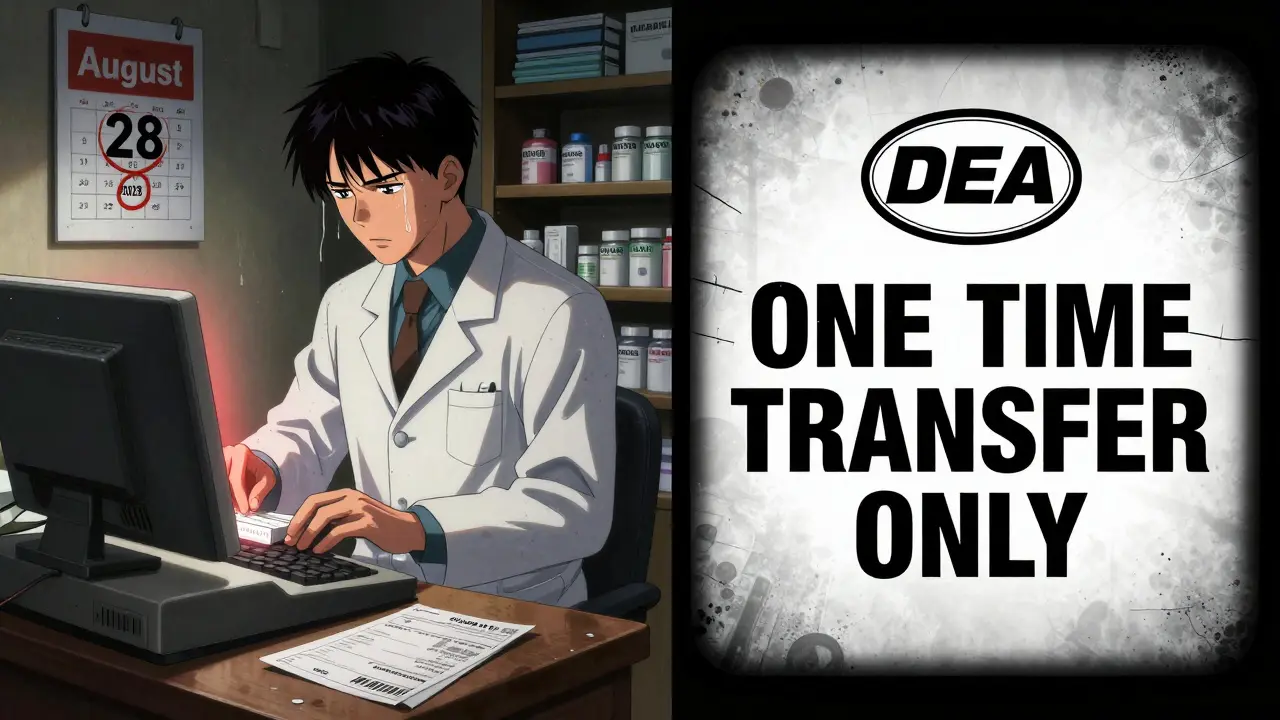
Since August 28, 2023, the Drug Enforcement Administration (DEA) changed how electronic prescriptions for controlled substances (Schedules III, IV, and V) are transferred. Before this, patients had to go back to their doctor every time they switched pharmacies. Now, you can request the transfer directly-but only once per prescription.
Here’s what that means in practice:
- You can transfer a prescription for Adderall, Xanax, or Tramadol one time to your new pharmacy.
- If you need to move it again later-even if you just moved across town-you’ll need a new prescription from your doctor.
- This rule applies even if both pharmacies are owned by the same company, like CVS to CVS.
And here’s the hard part: Schedule II drugs like oxycodone, fentanyl, or Ritalin cannot be transferred at all. If you’re on one of these, you must get a new prescription from your prescriber. No exceptions.
How the Transfer Actually Works
The transfer isn’t something you do yourself. You give the info to your new pharmacy. They call your old pharmacy. But it’s not just a phone call.
The DEA requires:
- The prescription must stay electronic throughout the process. No paper copies, no screenshots, no photos.
- The transfer must happen between two licensed pharmacists. Not a technician. Not a clerk.
- The receiving pharmacy must clearly mark the prescription as “transfer” and record the name, address, and DEA number of the pharmacy that sent it.
- The original pharmacy must mark the prescription as “VOID” in their system after the transfer.
These steps aren’t bureaucracy-they’re safety checks. They prevent someone from getting the same drug from two pharmacies at once, which is a major cause of opioid misuse.
What Happens If You Run Out of Refills?
You can’t transfer a prescription that’s already used up all its refills. Even if it’s just one refill left, the pharmacy can transfer it. But if the refill count is zero, you’re out of luck. You’ll need to contact your doctor for a new prescription.
Don’t wait until your last pill is gone. Call your doctor a week before you run out. That gives them time to send a new prescription electronically to your new pharmacy.
State Laws Can Make It Harder
The DEA rule sets the minimum standard. But states can add their own restrictions.
For example:
- Some states require a signed patient consent form before transferring any controlled substance.
- Others don’t allow transfers across state lines unless both pharmacies are in states with reciprocity agreements.
- A few states still require a paper copy of the prescription to be mailed, even though federal law allows electronic-only transfers.
That’s why your new pharmacy might say, “We can’t transfer that.” It’s not them being difficult-it’s that their state has stricter rules than the federal government.
If this happens, ask them to explain in writing. You have the right to know why. Sometimes, it’s just a software glitch or staff training issue.
How Long Does It Take?
For non-controlled meds, transfers usually take 24 to 48 hours. Most pharmacies have automated systems that handle these quickly.
For controlled substances, expect 2 to 5 business days. Why? Because each transfer requires manual verification by a pharmacist. They have to check the DEA number, confirm the prescription hasn’t been transferred before, and make sure the original pharmacy has voided it.
Patients who report delays often say the issue was missing info-like the transferring pharmacist’s full name or the original prescription number. Make sure you give your new pharmacy everything you have.
What If Your Pharmacy Refuses to Transfer?
It happens. Sometimes it’s because they don’t have the right software. Sometimes it’s because they’re unsure of the rules.
Here’s what to do:
- Ask them to check the DEA’s 21 CFR 1306.25 rule. It’s public and available online.
- Ask if they’re using an electronic prescribing system that’s DEA-compliant.
- If they still refuse, ask for a written explanation. Federal law requires them to provide one.
- If you’re still stuck, call your state’s pharmacy board. They can intervene.
Most pharmacies want to help. But if they’re not trained on the 2023 DEA rule, they might be scared of making a mistake.
What About Multiple Prescriptions?
If you’re taking five medications, and two of them are controlled substances, you can transfer all five-but each controlled prescription only gets one shot.
For example:
- Prescription #1: Lisinopril (high blood pressure) → can be transferred multiple times
- Prescription #2: Gabapentin (nerve pain, Schedule V) → can be transferred once
- Prescription #3: Oxycodone (Schedule II) → cannot be transferred at all
So plan ahead. If you’re switching pharmacies, do it all at once. Don’t transfer your blood pressure med now and your anxiety med next month. That’s when mistakes happen.
What’s Changing in the Future?
The DEA’s 2023 rule was the biggest change to prescription transfers since 2007. But it’s not the end.
They’re collecting data for two years to see how the one-time transfer rule affects patient access and drug misuse. By late 2024, they’ll release an interim report. Experts predict they might allow multiple transfers for Schedule III-V drugs by 2026-if data shows it’s safe.
Meanwhile, more pharmacies are upgrading their systems. As of late 2023, 87% of U.S. pharmacies use DEA-compliant electronic systems. Chain pharmacies like CVS, Walgreens, and Rite Aid were ready on day one. Independent pharmacies took longer.
If you’re in a rural area or use a small local pharmacy, don’t assume they’re up to speed. Call ahead. Ask if they handle electronic transfers for controlled substances.
Pro Tips for a Smooth Switch
- Don’t wait until your last refill. Start the process 5-7 days before you run out.
- Have your old prescription bottle handy. It has the prescription number, prescriber, and refill info.
- Call your new pharmacy first. Ask them what info they need. Don’t assume they know the DEA rules.
- If you’re transferring a controlled substance, confirm with both pharmacies that they’ve completed the transfer before you pick up your meds.
- Keep a list of all your meds, dosages, and prescribers. It saves time and reduces errors.
Switching pharmacies doesn’t have to be a headache. With the right info and a little planning, your meds can move smoothly-safely and legally.
Can I transfer a prescription for oxycodone to a new pharmacy?
No. Oxycodone is a Schedule II controlled substance, and federal law prohibits any transfer of Schedule II prescriptions between pharmacies. You must get a new prescription from your doctor to fill at your new pharmacy.
How many times can I transfer a prescription for Xanax?
Only once. Xanax is a Schedule IV controlled substance, and under the DEA’s 2023 rule, you can transfer it electronically to a new pharmacy one time only. After that, you’ll need a new prescription from your doctor to refill it elsewhere.
What if my old pharmacy won’t send my prescription?
Your old pharmacy is legally required to send the transfer if the prescription is still valid and has refills remaining. If they refuse, ask for a written reason. If they still won’t comply, contact your state pharmacy board. Most states have a formal complaint process.
Can I transfer prescriptions across state lines?
It depends. Federal law allows it, but state laws vary. Some states have reciprocity agreements with neighboring states, while others block out-of-state transfers entirely-especially for controlled substances. Always check with your new pharmacy first. They’ll know their state’s rules.
Do I need to bring my old prescription bottle to the new pharmacy?
You don’t have to, but it helps. The bottle has your name, the prescription number, the prescriber’s name, and the refill count. That info speeds up the transfer. If you don’t have the bottle, just give them the medication name, dosage, and how many refills are left.
How long do pharmacies keep records of transfers?
By federal law, both the transferring and receiving pharmacy must keep records of every transfer for at least two years from the date of the last refill. Some states require longer retention-up to five years. These records are part of the DEA’s audit trail to prevent drug diversion.
Erica Vest
December 18, 2025 AT 16:23Just transferred my gabapentin last week - took 3 days because the old pharmacy had to manually verify the DEA number. Pro tip: call your new pharmacy first and ask if they use a DEA-compliant EHR. If they say 'we do it all the time,' ask for the name of their software. Most independents still use outdated systems.
Chris Davidson
December 19, 2025 AT 14:47Kinnaird Lynsey
December 21, 2025 AT 11:29So basically if you move apartments you’re stuck with your old pharmacy unless you want to beg your doctor for a new script? That’s not a safety measure. That’s a bureaucratic nightmare dressed up as public health.
I get the intent but the execution feels like they’re punishing patients for having chronic conditions.
benchidelle rivera
December 22, 2025 AT 02:04Let me be clear: if your pharmacy refuses to transfer a Schedule III-V prescription because they 'don’t have the right software,' they are violating federal law. This isn’t a suggestion. It’s 21 CFR 1306.25. You have rights. Write down their name, date, and refusal. Then call your state pharmacy board. They will call the pharmacy. Within 24 hours, you’ll get your meds. I’ve done this 17 times. It works.
Stop letting pharmacists gaslight you. You’re not asking for a favor. You’re exercising your legal access to medication.
Isabel Rábago
December 22, 2025 AT 11:56People who don’t understand controlled substance laws are the same people who think 'it’s just a pill' and don’t see the opioid crisis as anything but a statistic. This rule exists because someone’s cousin died from stacking Xanax and hydrocodone because two pharmacies didn’t talk. You think this is overkill? Try explaining to a grieving mother why her son got two prescriptions from two different pharmacies because the system was 'too inconvenient.' This isn’t bureaucracy - it’s damage control.
And if you’re mad about having to get a new script for oxycodone? Maybe don’t take Schedule II drugs unless you absolutely need them.
Matt Davies
December 24, 2025 AT 07:31Switching pharmacies felt like navigating a maze blindfolded - until I realized I could call the new one and say, 'I’ve got my old script bottle, here’s my prescriber’s info, and I need my Adderall transferred before Friday.' They did it in 18 hours. Turns out, if you’re calm, clear, and armed with the right details, most pharmacists are heroes in scrubs. They just need you to speak their language - not your frustration.
Also, props to the DEA for finally updating a 2007 rule. Took long enough.
Meenakshi Jaiswal
December 26, 2025 AT 02:11As someone who manages my mom’s medications across two states, this is gold. In India, we just hand over the bottle and walk out - no paperwork, no calls. But here, it’s a whole operation. The one-time transfer rule for Schedule IV-V is actually brilliant - cuts down on script shopping without being draconian. Just wish more pharmacists knew it.
Always keep a printed list of meds, dosages, prescribers, and Rx numbers. Even if you think you know them by heart, stress makes you forget. I’ve seen it happen.
Connie Zehner
December 26, 2025 AT 09:35OMG I JUST GOT SCAMMED BY CVS!! I tried to transfer my Xanax and they said 'oh we can't do that' and I was like 'but the article says you can!' and they were like 'well we don't know what you're talking about' and I cried in the parking lot because I had 2 pills left and my anxiety was through the roof!!
Then I called my doctor and he sent a new script but now I have to pay $80 more because my insurance won't cover it until next month and I’m so mad I could scream!!!
Also I just got a new boyfriend and he said I'm too dependent on meds but I told him I'm not addicted I'm just sick and he didn't understand and now I'm questioning everything!!
😭😭😭
Monte Pareek
December 27, 2025 AT 12:44Let’s cut through the noise - this isn’t about bureaucracy. It’s about survival. The DEA didn’t make these rules because they hate patients. They made them because in 2017, 15,000 people died from opioid overdoses tied to doctor shopping and pharmacy hopping. I’ve worked in community pharmacies since 2005. I’ve seen people come in with 7 different bottles from 7 different pharmacies - all with the same drug. I’ve seen the empty eyes. I’ve seen the overdose calls. This one-time transfer rule? It’s a lifeline for patients who need continuity - and a wall for predators who exploit gaps.
Yes, it’s inconvenient. Yes, it’s frustrating. But if you’ve ever had to tell a 19-year-old they can’t get their fentanyl patch because the system flagged a duplicate script - you’d understand why we don’t bend on this.
Don’t blame the system. Blame the people who turned pain meds into currency. This rule is the shield we built to protect the vulnerable.
Kelly Mulder
December 28, 2025 AT 10:24It is, of course, utterly preposterous that one must navigate a labyrinthine regulatory framework simply to obtain one’s legally prescribed pharmaceuticals - a privilege, one might argue, that ought to be considered a fundamental human right, rather than a bureaucratic concession granted by a state-sanctioned pharmaceutical oligopoly. The fact that one cannot transfer a Schedule II prescription - even when the patient is terminally ill, even when the prescriber is the same, even when the pharmacy is owned by the same corporation - speaks volumes about the grotesque misalignment between policy and humanity. One is reminded of Kafka’s The Trial, were the protagonist, Josef K., was ultimately punished for not having filled out Form 7B in triplicate.
And yet - one is expected to be grateful.
Edington Renwick
December 28, 2025 AT 14:41My sister’s oncologist prescribed her oxycodone for pain after surgery. She moved to a new city. Couldn’t transfer. Had to wait 11 days for a new script. She was in agony. The pharmacy said ‘it’s the law.’ The doctor said ‘I can’t write a new one until the original expires.’ The system failed her. Not the people. The system.
Now she won’t even fill her meds at the new pharmacy. She keeps the old ones in her purse. Just in case.
This isn’t safety. This is trauma.
anthony funes gomez
December 30, 2025 AT 08:45From a pharmacoeconomic standpoint, the DEA’s 2023 revision to 21 CFR 1306.25 represents a paradigmatic shift in the pharmacovigilance architecture of controlled substance distribution - transitioning from a decentralized, paper-based, multi-actor verification model to a centralized, electronic, audit-trail-compliant protocol. The one-time transfer restriction for Schedules III–V constitutes a non-linear constraint optimization problem wherein patient autonomy is traded for system-level integrity. The empirical data collected over the next 24 months will determine whether this constraint is Pareto-efficient - or merely a regulatory artifact born of precautionary overreach.
Moreover, the variance in state-level implementation introduces heteroskedasticity into the patient experience - a statistical anomaly that undermines the federal standard’s intended uniformity. Until interoperability between state pharmacy boards is achieved, we are not enforcing a national standard - we are enforcing 50 different standards, each with its own error rate.
And yet - the underlying principle remains sound: fragmentation enables diversion. The question is not whether the rule is necessary - but whether its implementation is scalable.
Dikshita Mehta
December 31, 2025 AT 21:24Just want to say - if you’re transferring meds, don’t forget to ask if your new pharmacy offers free delivery. Mine does, and it saved me when I was too sick to drive. Also, keep a screenshot of your prescription details from your old pharmacy’s portal - even if it’s not official, it helps them call faster. And if they say ‘we can’t do it,’ ask for the pharmacist on duty. They’re the ones who actually know the rules.
Gloria Parraz
January 2, 2026 AT 19:01I transferred my gabapentin and my antidepressant last month - took 4 days because the old pharmacy’s system crashed. I sat in my car crying because I thought I’d be without meds for a week. But when I finally got them? I hugged the pharmacist. She didn’t even know why I was crying. I just said ‘thank you.’
Don’t let the bureaucracy make you feel like a burden. You’re not. You’re just trying to survive.
Sahil jassy
January 4, 2026 AT 15:37