

For years, treating type 2 diabetes meant one thing: lower blood sugar. Medications like metformin, sulfonylureas, and DPP-4 inhibitors focused almost entirely on glucose control. But something changed in 2015. A study called EMPA-REG OUTCOME didn’t just show that empagliflozin lowered blood sugar-it revealed something far more powerful. Patients taking it had a 38% lower risk of dying from heart disease. That wasn’t a side effect. It was the point.
SGLT2 inhibitors-drugs like Jardiance, Farxiga, and Invokana-are no longer just diabetes pills. They’re heart and kidney protectors. And for millions of people with type 2 diabetes, that shift could mean the difference between a long life and early complications.
How SGLT2 Inhibitors Actually Work
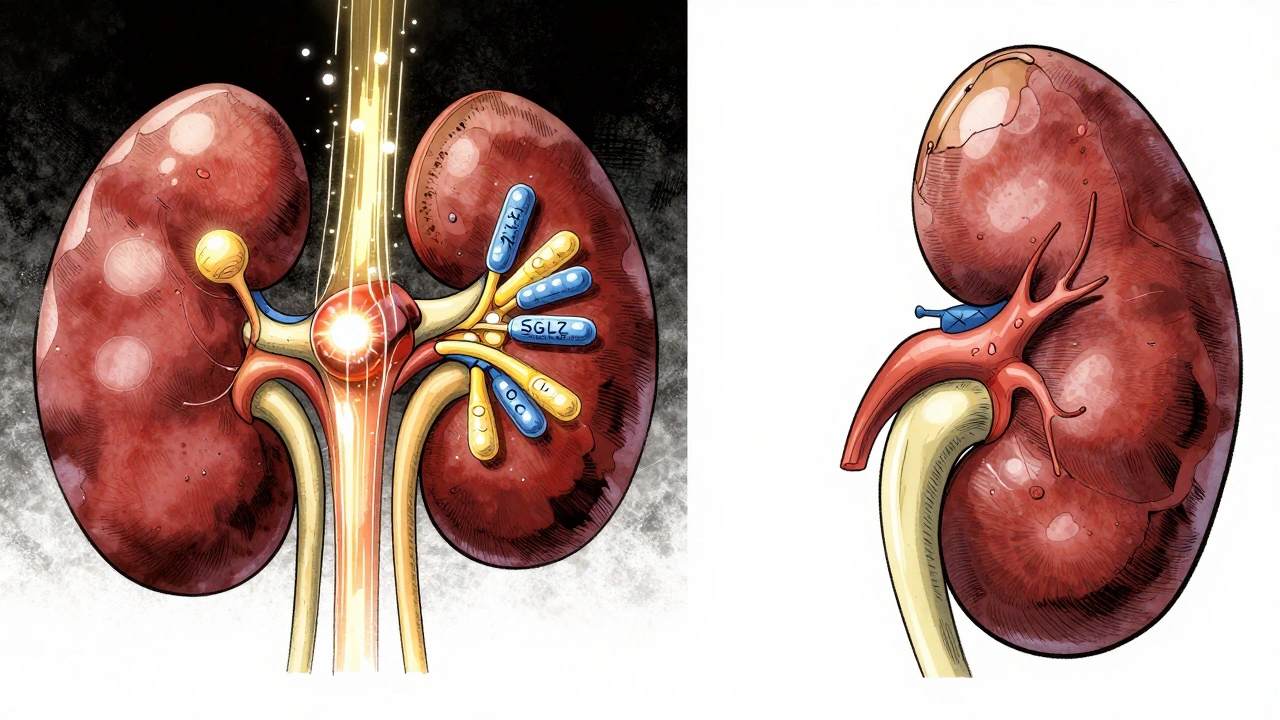
Unlike other diabetes drugs that push your body to make more insulin or make cells more sensitive to it, SGLT2 inhibitors work in your kidneys. They block a protein called SGLT2, which normally reabsorbs glucose from your urine back into your bloodstream. When you block it, glucose leaves your body through pee.
Think of it like a leaky faucet in your kidney. Normally, your body tries to save every drop of sugar. SGLT2 inhibitors let some of that sugar escape. That’s why your blood sugar drops-without needing more insulin. This is why they work even when your pancreas is worn out.
That extra sugar in your urine pulls water with it. That’s why you pee more. And because you’re losing sodium too, your blood pressure drops a few points. You also lose a little weight-around 2 to 3 kilograms on average. These aren’t side effects. They’re part of how these drugs protect your organs.
The Heart Protection You Didn’t Know You Needed
People with type 2 diabetes are two to four times more likely to die from heart disease than those without it. For decades, doctors treated the sugar and hoped the heart would be okay. Then came the trials.
In the EMPA-REG OUTCOME trial, patients with diabetes and existing heart disease who took empagliflozin were 38% less likely to die from heart-related causes. The CANVAS trial with canagliflozin showed a 14% drop in heart attacks, strokes, or heart-related deaths. The DAPA-HF and EMPEROR-Reduced trials went even further-they showed these drugs helped people with heart failure, even if they didn’t have diabetes.
That’s huge. Heart failure used to be treated with ACE inhibitors, beta-blockers, and diuretics. Now, SGLT2 inhibitors are added to that list. The European Society of Cardiology and the American Heart Association both now recommend them as standard care for heart failure with reduced ejection fraction. Some cardiologists are starting to prescribe them before even checking blood sugar levels.
One patient on Reddit, who goes by “HeartFailureSurvivor,” wrote: “My ejection fraction went from 25% to 35% after adding Farxiga. My cardiologist said it was remarkable.” That’s not an outlier. It’s a pattern seen across dozens of trials.
Kidney Protection: Slowing Down the Silent Decline
Diabetic kidney disease is the leading cause of kidney failure in the U.S. And once it starts, it’s hard to stop. Traditional treatments like ACE inhibitors slow it down-but only a little.
The CREDENCE trial changed that. In patients with type 2 diabetes and kidney disease, canagliflozin reduced the risk of kidney failure, doubling of creatinine, or kidney death by 30%. The EMPA-KIDNEY trial, published in late 2023, showed empagliflozin reduced major kidney events by 28%-even in people without diabetes.
How? It’s not just about lowering sugar. SGLT2 inhibitors reduce pressure inside the kidney’s filtering units (glomeruli). This reduces long-term damage. You might see a small dip in kidney function right after starting the drug-it’s normal. It’s not damage. It’s your kidneys adjusting to less strain.
The American Society of Nephrology now recommends starting SGLT2 inhibitors when urine albumin levels are above 30 mg/g, even if your blood sugar is under control. That’s a big shift. It means these drugs are being used to protect kidneys before damage is visible.
How They Compare to Other Diabetes Drugs
Let’s be clear: metformin is still the first choice for most people with type 2 diabetes. It’s cheap, safe, and effective. But it doesn’t protect your heart or kidneys the way SGLT2 inhibitors do.
Sulfonylureas? They lower sugar but cause weight gain and low blood sugar. DPP-4 inhibitors? They’re neutral on weight and heart risk but offer no kidney protection. GLP-1 receptor agonists like semaglutide do help the heart and kidneys-but they’re injectables, more expensive, and can cause nausea.
SGLT2 inhibitors are pills. Once a day. No injections. They don’t cause low blood sugar when used alone. And they help with weight and blood pressure too.
Here’s a quick comparison:
| Medication | Heart Benefit | Kidney Benefit | Weight Effect | Cost (Monthly) |
|---|---|---|---|---|
| Metformin | No proven benefit | No proven benefit | Neutral | $4-$10 |
| Sulfonylureas | No benefit | No benefit | Gain | $10-$15 |
| DPP-4 Inhibitors | Neutral | No benefit | Neutral | $350-$400 |
| SGLT2 Inhibitors | Yes (30-38% risk reduction) | Yes (28-30% risk reduction) | Loss (2-3 kg) | $520-$600 |
| GLP-1 RAs | Yes (up to 26% risk reduction) | Yes (moderate benefit) | Loss (5-10 kg) | $800-$1,000 |
Cost is a barrier. But for people with heart disease, kidney disease, or both, the long-term savings-avoiding hospitalizations, dialysis, or heart transplants-often outweigh the upfront price. Some insurers now cover them without prior authorization if you have documented heart or kidney disease.
What You Need to Watch Out For
These drugs aren’t perfect. The biggest concern is diabetic ketoacidosis (DKA). It’s rare-about 0.1% of users-but it can happen even when blood sugar isn’t very high. That’s called euglycemic DKA. It’s sneaky. You might feel nauseous, tired, or have stomach pain. If you’re sick, fasting, or having surgery, talk to your doctor about pausing the drug.
Genital yeast infections are more common too-about 4-5% of users. Women are more affected, but men can get them too. Good hygiene and keeping dry helps. If you get recurrent infections, your doctor might switch you to another class.
Canagliflozin has a small increased risk of lower-limb amputations, especially in people with prior foot ulcers or poor circulation. That’s why doctors avoid it in those with severe peripheral artery disease.
And if you’re elderly or on diuretics, you can get too dehydrated. Start with a lower dose. Drink water. Monitor your blood pressure.
They’re not for everyone. Avoid them if you have type 1 diabetes, severe kidney disease (eGFR below 30), or if you’re allergic to the drug.

Who Should Be Taking Them?
The American Diabetes Association’s 2023 guidelines say this clearly: If you have type 2 diabetes AND heart disease, heart failure, or chronic kidney disease-start an SGLT2 inhibitor. Right away. Don’t wait.
Even if you don’t have diabetes yet, but you have kidney disease with protein in your urine, SGLT2 inhibitors are now recommended. That’s how powerful the data is.
For most people, they’re added after metformin. But for those with high-risk conditions, they’re now a first-line option alongside or even instead of metformin.
What’s Next?
The science is still moving. The EMPA-KIDNEY trial showed benefits in people without diabetes. That means SGLT2 inhibitors might soon be approved for kidney disease alone-no diabetes needed.
Trials are also looking at whether they help with fatty liver disease, obesity, and even early signs of Alzheimer’s. Early data is promising.
Generic versions are coming. Patents for Jardiance and Farxiga expire between 2025 and 2028. Prices could drop by 60-70%. That will make these life-saving drugs accessible to millions more.
Right now, these drugs are changing the game. They’re not just treating diabetes. They’re preventing heart attacks, strokes, kidney failure, and early death. For many, they’re the most important medicine they’ll ever take.
Do SGLT2 inhibitors cause low blood sugar?
Not when taken alone. Unlike sulfonylureas or insulin, SGLT2 inhibitors don’t force your body to make more insulin. Low blood sugar only happens if you’re also taking insulin or sulfonylureas. Even then, the risk is lower than with those drugs alone.
Can I take an SGLT2 inhibitor if I have kidney disease?
Yes-but only if your kidney function is above eGFR 30. For most people with early or moderate kidney disease (eGFR 30-60), these drugs are not just safe-they’re recommended. Your doctor will check your kidney function before and after starting. A small dip in eGFR at first is normal and means the drug is working to reduce pressure in your kidneys.
How long does it take to see heart or kidney benefits?
Blood sugar drops within days. Weight and blood pressure changes show up in 2-4 weeks. But heart and kidney protection? Those are long-term. Trials showed benefits after 1-3 years of use. The goal isn’t quick results-it’s preventing damage over time.
Are SGLT2 inhibitors safe for older adults?
Yes, but they need monitoring. Older adults are more prone to dehydration and low blood pressure. Doctors often start with a lower dose. Stay hydrated. Check your blood pressure regularly. If you’re on diuretics, your doctor may adjust those too.
Can I stop taking my SGLT2 inhibitor if my A1c is normal?
No. The benefits for your heart and kidneys aren’t tied to your blood sugar level. Even if your A1c is 5.8%, stopping the drug removes the protective effects. These drugs are prescribed for organ protection-not just glucose control. Keep taking them unless your doctor says otherwise.
Final Thoughts
SGLT2 inhibitors are no longer just another diabetes pill. They’re a turning point in how we treat chronic disease. For people with type 2 diabetes and heart or kidney problems, they offer something rare: real, measurable protection against the things that kill. The science is solid. The guidelines have changed. And the data keeps getting stronger.
If you have diabetes and heart or kidney disease, ask your doctor: Is an SGLT2 inhibitor right for me? Don’t wait for your A1c to go up. Protect your organs before they’re damaged.
Marvin Gordon
December 5, 2025 AT 10:08SGLT2 inhibitors are a game-changer. I’ve seen patients go from barely walking to hiking weekends after starting Farxiga. No magic pill, but this is about as close as it gets.
Ali Bradshaw
December 7, 2025 AT 06:45My dad’s on Jardiance. His BP dropped, he lost 5 lbs, and his creatinine stabilized. Doc said it’s the best thing he’s prescribed in 15 years. Still weird to think a diabetes drug is saving his heart.
Ada Maklagina
December 8, 2025 AT 16:18My grandma’s on it. She’s 78, diabetic, and her kidney numbers improved. No more hospital trips. I’m just glad someone finally figured out how to treat the whole person, not just the glucose number.
Lynette Myles
December 8, 2025 AT 18:50It’s not the drug. It’s the trial design. Pharma funded every single one. You think this is science? It’s marketing with a lab coat.
Rupa DasGupta
December 10, 2025 AT 11:40OMG I just started this and now I’m peeing like a racehorse 😅 but my A1c’s down and my shoes fit better?? Who knew diabetes meds could be a weight loss hack?? 🤯
ashlie perry
December 12, 2025 AT 11:23They’re hiding the real danger. The ketoacidosis cases are being buried. I know a guy who went into a coma and the hospital said it was ‘dehydration.’ LIES. Big Pharma doesn’t want you to know you can die from peeing out sugar
Norene Fulwiler
December 13, 2025 AT 14:27I’m a nurse in a rural clinic. We’ve got patients on these meds who couldn’t afford insulin before. Now they’re alive. I’ve seen the data. I’ve seen the people. This isn’t hype. It’s hope.
Chris Brown
December 14, 2025 AT 11:29It is morally irresponsible to promote a drug that increases the risk of genital infections and amputations as a first-line therapy. The precautionary principle must prevail. We are sacrificing long-term safety for short-term metrics.
aditya dixit
December 14, 2025 AT 17:28It’s fascinating how we’ve gone from treating symptoms to treating systems. SGLT2 inhibitors don’t just lower glucose-they reframe the body’s relationship with energy, fluid, and waste. It’s not medicine. It’s a metabolic reset.
Annie Grajewski
December 16, 2025 AT 00:19so like… if i have diabetes but no heart or kidney probs… am i just supposed to take this because? like… what if i dont wanna pee 10x a day? this feels like being forced to drink water to lose weight
Jennifer Patrician
December 17, 2025 AT 01:03Wait-so they’re telling us to take a drug that causes DKA because it ‘protects’ us? And the FDA approved this? Who’s really in charge here? This is the same system that gave us Vioxx. I’m not your guinea pig.
William Chin
December 17, 2025 AT 16:16While the clinical evidence supporting SGLT2 inhibitors is robust and peer-reviewed, it remains imperative to consider the socioeconomic disparities in access. The cost barrier, while potentially offset by long-term savings, excludes millions of vulnerable populations from life-altering therapy. Policy reform must precede widespread adoption.