
A perforated eardrum isn’t something you plan for. One moment you’re flying, swimming, or cleaning your ear with a cotton swab, and the next, you’re hit with sharp pain, muffled hearing, or even fluid draining from your ear. It’s scary, but the good news is: perforated eardrum healing is often straightforward-if you know what to do and what to avoid.
What Happens When Your Eardrum Tears?
Your eardrum, or tympanic membrane, is a thin, paper-like tissue that sits between your ear canal and middle ear. It’s not just a barrier-it’s a vital part of how you hear. Sound waves hit it, it vibrates, and those vibrations get passed along to tiny bones in your middle ear. It also keeps water, dirt, and germs out of your middle ear space. When it tears, you lose some of that protection and sound传导 ability. Most perforations happen because of:- Ear infections (especially in kids)-pressure builds up and pops the membrane
- Loud noises like explosions or gunshots
- Sudden pressure changes-like scuba diving or flying with a cold
- Inserting objects into the ear-cotton swabs, bobby pins, even fingers
- Head trauma or a slap to the ear
How Long Does It Take to Heal?
Healing isn’t the same for everyone. Size, location, and how well you protect the ear make all the difference.- Small tears (under 2mm): Most heal on their own in 3 to 6 weeks. Pain usually fades within a few days.
- Larger tears (over 5mm): Can take 2 to 3 months. Sometimes longer if there’s infection or repeated exposure to water.
- Very large or chronic perforations: May not heal without medical help.
What You Must Avoid During Healing
The biggest mistake people make? Treating a perforated eardrum like a regular earache. You can’t just wait it out-you have to actively protect it. 1. Keep it dry. Water is the #1 enemy. Even a little moisture can lead to infection. Showering? Use a waterproof earplug or pack cotton balls coated in petroleum jelly into your ear canal. Bathe instead of showering if you can. Swimming? Absolutely off-limits until your doctor says it’s safe. 2. Don’t clean your ear. No cotton swabs. No ear drops unless your doctor gives them to you. Your body is trying to heal-it doesn’t need you poking around inside. Cleaning can push debris deeper or tear the healing tissue. 3. Don’t blow your nose hard. Blowing creates pressure that travels up the Eustachian tube and hits your eardrum like a balloon being overinflated. If you need to clear your nose, do it gently-one nostril at a time. 4. Avoid flying and diving. Changes in air pressure during flights or underwater dives can stress the healing membrane. Even if you feel fine, wait at least 6 to 8 weeks. Some doctors recommend waiting 3 months for larger perforations. 5. Skip loud environments. Loud music, construction noise, or fireworks can damage the already weakened eardrum. Use earplugs if you’re in a noisy place.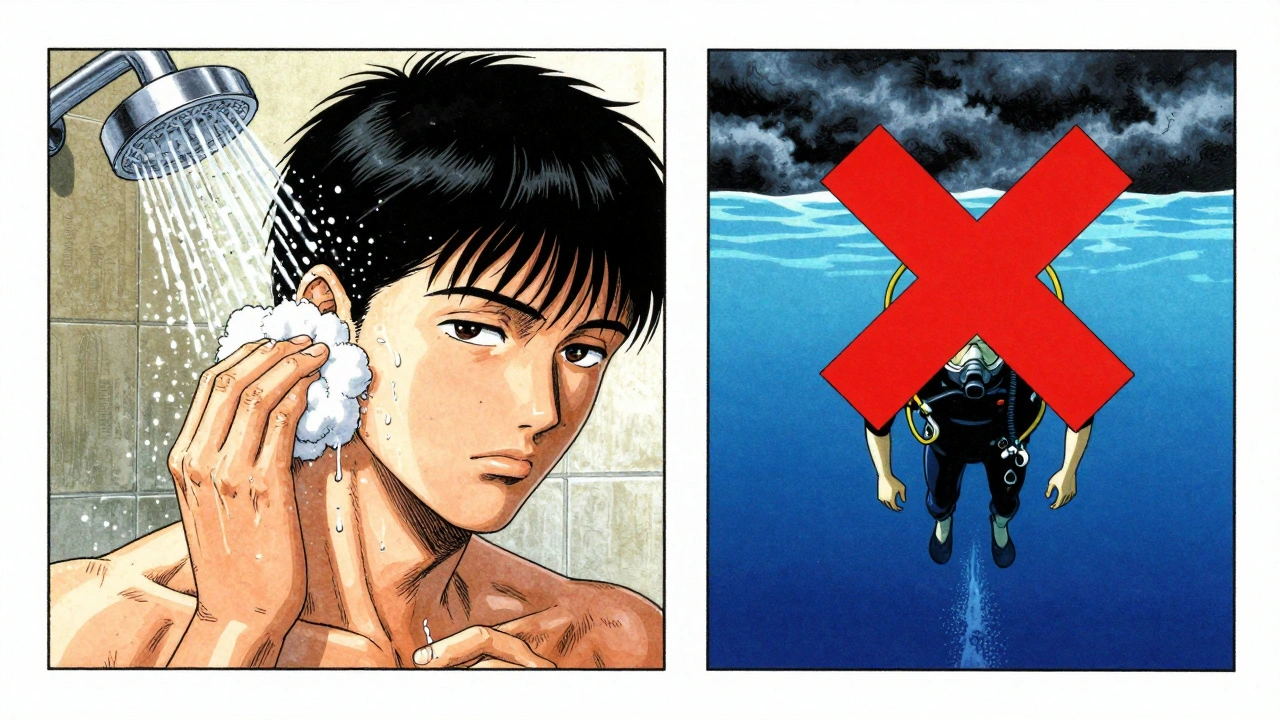
When Do You Need Medical Help?
Most perforated eardrums heal on their own. But you’re not out of the woods just because the pain went away. See a doctor if:- Pain doesn’t improve after 2-3 days
- You notice pus, blood, or clear fluid draining from your ear
- Hearing doesn’t get better after 4 weeks
- You feel dizzy, have balance issues, or ringing in the ear that won’t quit
- Symptoms come back after seeming to improve
What If It Doesn’t Heal?
About 5-10% of perforations don’t close on their own. That doesn’t mean you’re stuck with hearing loss forever. There are two common procedures:- Myringoplasty: A small patch-made of paper, gel, or even fat-is placed over the hole. It’s a quick 10-30 minute outpatient procedure. Success rates with newer materials like hyaluronic acid or platelet-rich plasma are now 85-90%.
- Tympanoplasty: For larger holes, surgeons use your own tissue (often from behind the ear) to rebuild the eardrum. Takes 30-120 minutes. Usually done under general anesthesia.

What’s the Long-Term Outlook?
The prognosis for most people is excellent. If you follow the protection rules, 90-95% of small perforations heal completely within two months. Hearing loss is usually temporary. But if you ignore the advice, risks go up:- Chronic ear infection: Happens in 5-10% of cases without proper care
- Persistent hearing loss: Affects 3-5% of people, usually with larger or untreated perforations
- Mastoiditis: Infection spreads to the bone behind the ear-rare, but serious (1-2% of untreated cases)
- Vertigo or dizziness: Can happen if the inner ear is affected (2-3% of cases)
What to Do After Healing
Once your doctor confirms the eardrum is fully healed, you can go back to normal life. But don’t forget what you learned:- Still avoid inserting things into your ear
- Use ear protection in loud places
- Be careful with pressure changes during flights
- Get regular checkups if you’ve had ear problems before
Can a perforated eardrum heal on its own?
Yes, most small perforations heal on their own within 3 to 6 weeks. Larger tears may take up to 2-3 months. Healing depends on size, location, and whether you protect the ear from water, pressure, and infection. Around 90-95% of cases heal without surgery if proper care is followed.
How do I keep my ear dry while showering?
Use a waterproof earplug made of silicone, or pack cotton balls coated with petroleum jelly into your ear canal. Make sure the cotton is snug but not forced in. Avoid getting water directly into the ear. Some people use a shower cap with a small opening over the ear for extra protection.
Can I fly with a perforated eardrum?
It’s not recommended until the eardrum has fully healed-usually 6 to 8 weeks. Changes in cabin pressure can cause pain, delay healing, or even reopen the tear. If you must fly, consult your doctor first. They may suggest decongestants or special earplugs to help equalize pressure.
Does a perforated eardrum cause permanent hearing loss?
Usually not. Hearing loss from a perforated eardrum is temporary and improves as the membrane heals. In about 3-5% of cases, especially with large or chronic perforations, some permanent hearing loss can occur. This is rare if you follow medical advice and avoid complications like infection.
When should I see an ENT specialist?
See an ENT specialist if your eardrum hasn’t started healing after 3-4 weeks, if you have ongoing drainage, persistent pain, dizziness, or hearing loss that doesn’t improve. They can assess the size of the tear, check for infection, and determine if a procedure like myringoplasty is needed.
Can I use over-the-counter ear drops?
No. Over-the-counter ear drops can irritate the middle ear or introduce bacteria through the tear. Only use ear drops prescribed by your doctor. If you’re in pain, take oral pain relievers like ibuprofen or acetaminophen instead.
How can I prevent a perforated eardrum in the future?
Never insert anything into your ear canal-not cotton swabs, hairpins, or fingers. Treat ear infections promptly. Use ear protection during loud events or when flying with a cold. Avoid diving or swimming if you have a history of ear problems. And always dry your ears gently after water exposure.
Rich Paul
December 8, 2025 AT 13:06bro i blew out my eardrum last year tryin to clean my ear with a bobby pin like a dumbass. pain was insane. thought i was gonna go deaf. turned out it was a 3mm tear. just kept it dry, no flying, no swimmin, and boom-healed in 5 weeks. dont be me.
Delaine Kiara
December 10, 2025 AT 00:54okay but like… what if you’re a swimmer? like a competitive swimmer? do you just quit for 3 months?? my coach said ‘tough it out’ but now i’m scared to even shower. also-why is everyone acting like this is normal?? my mom cried when i told her. this is trauma.
Ruth Witte
December 10, 2025 AT 01:42YOU GOT THIS 💪✨
healing is a journey, not a race 🌱💧
your body is SO smart-it knows exactly what to do if you just let it! 🙌
no cotton swabs = victory 🏆
no water = hero mode 🦸♀️
you’re not broken, you’re rebuilding 🧬💖
trust the process, babe. you’re gonna come out stronger on the other side. i believe in you!!! 🌈🎉
Noah Raines
December 11, 2025 AT 20:19the real villain here is cotton swabs. nobody needs to stick shit in their ear. your ear cleans itself. if you’re using q-tips, you’re not cleaning-you’re pushing wax deeper and risking a perforation. i’ve seen 3 people in my family do this. all ended up in the doc. don’t be one of them.
Katherine Rodgers
December 12, 2025 AT 14:59oh wow. so if i accidentally sneeze too hard, does that count as ‘pressure change’? because i sneeze like a freight train. also, is it illegal to fly with a perforated eardrum or do they just make you sign a waiver like you’re about to skydive into a volcano? 🤡
Lauren Dare
December 14, 2025 AT 10:40the terminology here is technically accurate, but the framing is dangerously reductive. ‘Most heal on their own’ ignores the microbiome disruption, biofilm formation, and Eustachian tube dysfunction that often accompany perforations. you can’t treat this like a scraped knee. the medical literature is clear: early otoscopic monitoring reduces complication rates by 40%. if your GP says ‘wait and see,’ ask for a referral. don’t gamble with your auditory system.
Gilbert Lacasandile
December 16, 2025 AT 09:01my cousin had this last year. she followed everything in this post-no water, no blowing nose, no flying. healed perfectly. just took patience. i’m telling you, people need to stop rushing everything. healing isn’t a sprint. it’s a slow walk in the park with headphones off.
Lola Bchoudi
December 17, 2025 AT 10:04just to clarify-myringoplasty success rates are 85-90% with hyaluronic acid scaffolds, but the real game-changer is autologous platelet-rich plasma (PRP) augmentation. it enhances fibroblast migration and collagen deposition at the margins. for chronic perforations, combining PRP with fascia grafts pushes success past 92%. if you’re considering surgery, ask your ENT about PRP. it’s not magic-it’s science.
Morgan Tait
December 17, 2025 AT 20:28you know what they don’t tell you? this isn’t just about ears. it’s about the government. they want you to think it’s ‘just a tear’ so you don’t ask why your hearing’s going weird after 5G towers went up. also, cotton swabs? they’re laced with microchips. that’s why you can’t ‘just heal.’ your body’s fighting nano-tech. wear aluminum foil ear caps. i did. my tinnitus went away. they can’t track you if you’re grounded.
Darcie Streeter-Oxland
December 18, 2025 AT 04:28It is regrettable that the article employs such a colloquial register, replete with contractions and nonstandard orthography, thereby undermining its didactic function. One might reasonably expect a medical advisory to conform to the conventions of formal scientific discourse, particularly when disseminating information concerning anatomical integrity and clinical outcomes. The use of emoticons and exclamation marks is wholly inappropriate in this context.
Sarah Gray
December 18, 2025 AT 17:24Wow. So you’re telling me that people who use Q-tips are just… stupid? No nuance? No consideration for cultural practices? Some cultures use ear picks. Some people have narrow canals. You’re reducing a complex otological issue to a moral failing. Pathetic.
Noah Raines
December 19, 2025 AT 09:04lol @5701 you sound like the kind of person who still thinks the ear is a vacuum and needs ‘suctioning.’ if you’re using ear picks because your ear canal’s shaped weird, you’re not a cultural purist-you’re a walking infection risk. and no, ‘some cultures’ don’t stick metal sticks in their ears and call it hygiene. they clean the outer part. you’re just making stuff up to feel smart.