

NMS Symptom & Risk Assessment Tool
Symptom Assessment
URGENT: NMS is a medical emergency
Immediate medical attention is required. Call emergency services immediately and inform them about potential NMS.
Key actions: Stop all antipsychotics immediately, request CK blood test, and request cooling measures.
No NMS Indicators Found
Your symptoms do not indicate NMS based on the information provided. However, if symptoms persist or worsen, please consult a healthcare professional.
Neuroleptic Malignant Syndrome, or NMS, isn’t something most people have heard of - until it happens. It’s rare, but when it does, it can turn a routine medication into a life-or-death situation. Imagine waking up feeling like your muscles are made of concrete, your body temperature climbing past 105°F, and you can’t speak or move - all while your heart races and your blood pressure swings wildly. This isn’t a nightmare. It’s NMS, a severe reaction to certain psychiatric and anti-nausea drugs that block dopamine in the brain.
What Exactly Is Neuroleptic Malignant Syndrome?
NMS is a dangerous, sometimes fatal reaction triggered by drugs that block dopamine receptors. These include older antipsychotics like haloperidol and a first-generation antipsychotic used to treat schizophrenia and severe agitation, and even some anti-nausea medicines like metoclopramide and a dopamine antagonist used to treat nausea and gastroparesis. It was first clearly identified in the 1960s after the rise of chlorpromazine, but cases have been documented since the 1950s.
The core problem? Dopamine doesn’t just affect mood - it controls muscle movement, body temperature, and automatic functions like heart rate and sweating. When these receptors are blocked too hard or too fast, your body loses control. The result is a four-part warning sign: severe muscle stiffness, high fever, confusion or altered mental state, and wild changes in heart rate and blood pressure.
Unlike a panic attack or a fever from the flu, NMS doesn’t fade on its own. It gets worse - fast. Left untreated, up to 20% of cases end in death. Even with treatment, recovery isn’t quick. Most people spend days in intensive care, and some take weeks to walk again.
How Do You Know It’s NMS - Not Something Else?
Doctors often miss NMS because it looks like other things. It can be mistaken for a psychotic episode, an infection, or even a seizure. That’s dangerous. A 2021 study found that emergency doctors correctly identified NMS in only 60% of cases. Many patients are misdiagnosed for 24 to 48 hours - and every hour counts.
Here’s how to tell NMS apart from similar conditions:
- NMS vs. Serotonin Syndrome: Serotonin syndrome happens faster - within hours of a new drug or dose change. It causes clonus (involuntary muscle twitching), overactive reflexes, and diarrhea. NMS has slow, stiff muscles - called "lead pipe rigidity" - and little to no GI symptoms.
- NMS vs. Malignant Hyperthermia: Malignant hyperthermia strikes during anesthesia, not from psychiatric meds. It causes jaw spasms and happens within minutes. NMS builds over days and doesn’t involve anesthesia triggers.
Lab tests help confirm the diagnosis. Creatine kinase (CK) levels spike - often above 1,000 IU/L, sometimes over 100,000 IU/L - because muscles are breaking down. White blood cells rise, iron drops, and kidneys struggle as muscle proteins flood the bloodstream. If you’re on an antipsychotic and your CK is sky-high with a fever and stiffness, NMS is likely.
Who’s at Risk?
NMS doesn’t pick favorites, but some people are more vulnerable:
- People on high-dose or rapidly increased antipsychotics: Jumping haloperidol from 5mg to 20mg in a day? That’s a red flag.
- Those on injectable antipsychotics: Long-acting shots can cause sudden, high levels of drug exposure.
- Patients taking lithium with antipsychotics: Lithium makes dopamine blockade worse.
- Young men: NMS occurs twice as often in men as in women.
- People with bipolar disorder: Higher risk than those with schizophrenia.
- Those who suddenly stop Parkinson’s meds: About 5% of NMS cases happen when dopamine drugs like levodopa are withdrawn too quickly.
And here’s the twist: you don’t need to be on a high dose. The FDA warned in January 2023 that about 12% of NMS cases happen at normal, prescribed doses - in people with no known risk factors. That’s why no one is completely safe.
What Happens When NMS Strikes?
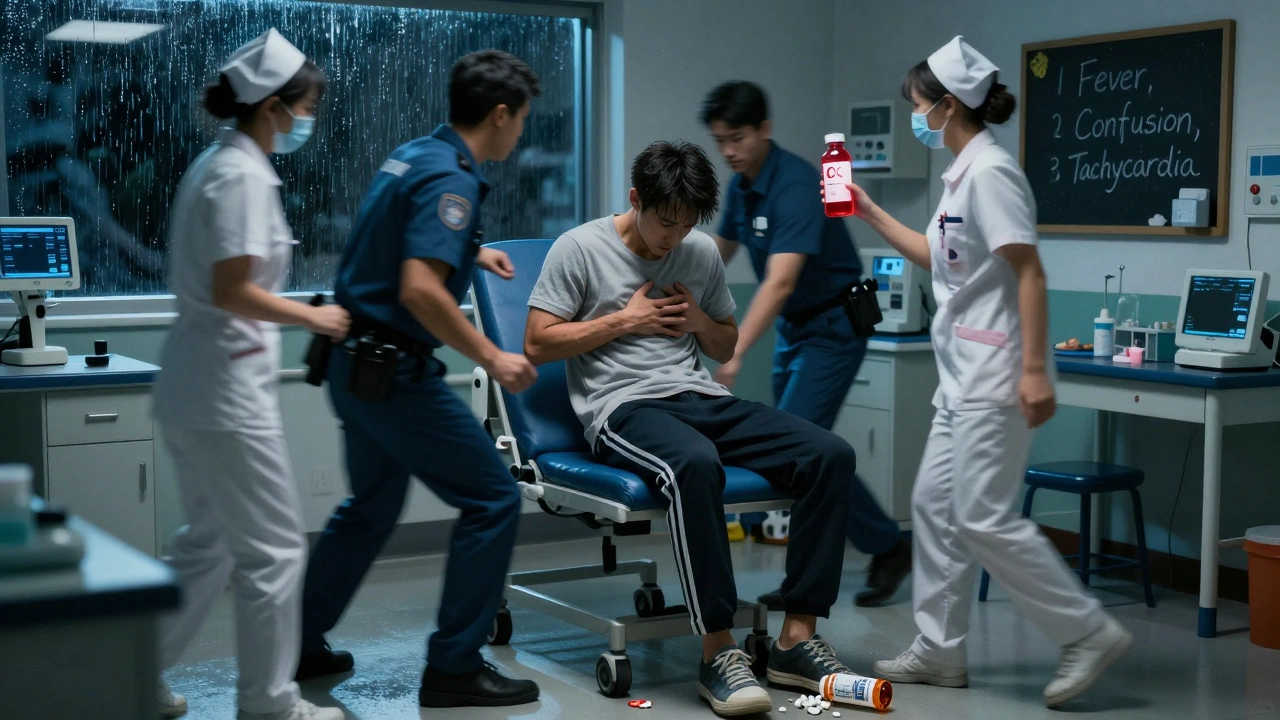
There’s no time to wait. If NMS is suspected, the first rule is simple: stop the drug - immediately. No exceptions. Even if the patient is being treated for psychosis, the medication causing NMS must be pulled.
Then, it’s ICU time. Treatment isn’t about one magic pill - it’s about aggressive, coordinated care:
- Cool the body: Ice packs, cooling blankets, IV fluids - anything to bring the fever below 102°F.
- Hydrate aggressively: At least 1-2 liters of IV fluids right away, then 100-150 mL per hour to protect the kidneys from muscle breakdown products.
- Use dantrolene: This muscle relaxant, usually used for malignant hyperthermia, helps reduce rigidity. Doses start at 1-2.5 mg per kg of body weight, repeated as needed.
- Try bromocriptine or apomorphine: These drugs mimic dopamine to restore balance. Bromocriptine is taken by mouth; apomorphine (still experimental) can be given as a nasal spray and has shown promise in reducing fever in under 4 hours.
- Monitor constantly: CK, kidney function, electrolytes, and heart rhythm need checking every few hours. Some patients need dialysis if their kidneys fail.
Recovery takes time. Most people start improving in 7 to 10 days, but full muscle strength can take weeks or months. One patient on a mental health forum said it took eight weeks to walk without help.
What Happens After Recovery?
Survivors often face a hard choice: go back on antipsychotics or risk relapse.
A 2022 survey found that 65% of NMS survivors were too scared to restart their meds - even when their psychosis returned. That’s a real clinical dilemma. Doctors now recommend waiting at least two weeks after full recovery before considering a new antipsychotic. And when they do, they choose low-risk options: quetiapine and a second-generation antipsychotic with low dopamine blockade risk or clozapine and an atypical antipsychotic with the lowest NMS risk.
Studies show NMS risk has dropped dramatically since the 1990s, thanks to second-generation antipsychotics. Where once 1 in 50 people on haloperidol developed NMS, now it’s closer to 1 in 5,000 with newer drugs. Still, the risk never disappears.
Can NMS Be Prevented?
Yes - but only with awareness.
- Never increase antipsychotic doses too fast - especially haloperidol.
- Watch for early signs: restlessness, confusion, muscle stiffness, or sweating.
- Don’t assume a fever or agitation is just "worsening psychosis."
- Know your meds - even anti-nausea drugs like metoclopramide can trigger NMS.
- Ask your doctor about alternatives if you’re on a high-risk drug.
Some hospitals are testing AI tools that scan electronic records for early NMS clues - like sudden CK spikes or fever paired with antipsychotic use. Early results show they can flag cases 24 hours before symptoms become obvious. That’s a game-changer.
Final Thoughts
NMS is rare, but it’s real - and it’s deadly if ignored. It doesn’t care if you’ve been on your medication for years. It doesn’t care if your dose is "normal." It only cares about dopamine blockade, speed of change, and timing.
If you’re taking an antipsychotic or a dopamine-blocking anti-nausea drug, know the signs: stiff muscles, high fever, confusion, fast heartbeat. If you or someone you care about shows these symptoms, don’t wait. Go to the ER. Say: "I think this might be NMS."
Survival rates have improved from 76% in the 1980s to 95% today - not because of new miracle drugs, but because doctors are learning to see it. Awareness saves lives.
Can NMS happen with newer antipsychotics?
Yes, but it’s much rarer. First-generation drugs like haloperidol carry a 0.5-2% risk. Second-generation drugs like quetiapine, risperidone, and clozapine have a risk of only 0.01-0.02%. Still, cases have been reported with all of them, especially if doses are increased too quickly or combined with other drugs like lithium.
How long does it take to recover from NMS?
Most patients start improving within 7 to 10 days after stopping the drug and starting treatment. Full recovery - including muscle strength and mental clarity - can take weeks to months. About 15% of survivors still have muscle weakness 30 days after discharge.
Can NMS be fatal?
Untreated, NMS has a 10-20% death rate. With prompt treatment - including ICU care, cooling, hydration, and medications like dantrolene - the death rate drops to about 5%. The biggest risk is delay. Every hour without treatment increases complications like kidney failure.
Is NMS the same as serotonin syndrome?
No. Serotonin syndrome happens faster - within hours - and causes clonus (involuntary muscle jerks), hyperreflexia, and diarrhea. NMS develops over days, causes "lead pipe" muscle rigidity, and rarely involves GI symptoms. Both can cause fever and confusion, but the underlying mechanisms and treatments differ.
Can anti-nausea drugs cause NMS?
Yes. About 15% of NMS cases are caused by dopamine-blocking anti-nausea drugs like metoclopramide and promethazine. These are often used in emergency rooms or for chemotherapy side effects, so doctors and patients need to be aware - especially if the patient is also on an antipsychotic.
What should I do if I suspect NMS in someone?
Call emergency services immediately. Do not wait. Tell medical staff: "This person is on an antipsychotic or dopamine blocker and has stiff muscles, high fever, and confusion." Request they check creatine kinase (CK) levels and stop all neuroleptic medications right away. Early recognition is the single most important factor in survival.
Yasmine Hajar
December 5, 2025 AT 22:41I had a cousin go through this after they upped her haloperidol too fast. She was in the ICU for three weeks. They thought it was a psychotic break at first. When the docs finally caught it, she was literally shaking like a leaf and couldn’t speak. I’ll never forget how her hands looked - locked like concrete. If you’re on these meds, know the signs. Don’t wait for someone to say "it’s just stress."
Jake Deeds
December 6, 2025 AT 16:35It’s fascinating how modern medicine still operates like it’s 1987 - reactive, not proactive. We have AI systems that can predict stock trends with 98% accuracy, yet we’re still relying on clinicians to notice "lead pipe rigidity" in a sea of noise. This isn’t a medical emergency - it’s a systemic failure of pharmacovigilance. Someone should sue the pharmaceutical companies for not putting clearer warnings on metoclopramide bottles. It’s not rocket science.
George Graham
December 8, 2025 AT 04:48My sister was on risperidone for bipolar and got NMS after a bad flu. They thought it was the infection at first. Took 48 hours to get the right diagnosis. I’m not a doctor, but I’ve read everything I could find since then. The thing nobody talks about? The mental toll after. Survivors often feel guilty - like they "broke" the medication. But it’s not your fault. It’s a biological glitch. And yes, restarting meds is terrifying. We went with quetiapine after a two-month gap. No issues since. Just… be patient with yourself.
John Filby
December 9, 2025 AT 06:36OMG this is so important 😭 I didn’t know metoclopramide could do this. My mom’s been on it for gastroparesis for years. I’m gonna call her doctor tomorrow and ask if she’s at risk. Also, the CK levels thing - I had no idea muscle breakdown could spike that high. Like, 100,000?? That’s wild. Thanks for laying this out so clearly. Sharing this with my whole family.
Elizabeth Crutchfield
December 9, 2025 AT 19:12i had no idea this was a thing. my bro got really sick after his shot and they thought he was just acting out. he was in the hospital for like 10 days. i wish someone had told us this sooner. pls share this with anyone on antipsychotics.
Ben Choy
December 11, 2025 AT 00:44This is one of those posts that makes you pause. I work in ER and we see a lot of "psychotic episodes" that turn out to be NMS. The delay kills. I’ve seen it. I’ve been the one who missed it. That’s why I now ask: "What meds are they on?" - not just "What’s wrong?" It’s a simple shift. But it saves lives. Thanks for writing this. I’m printing it for my team.
Jenny Rogers
December 12, 2025 AT 00:04It is profoundly regrettable that the medical establishment continues to treat neuroleptic malignant syndrome as an emergent contingency rather than a predictable pharmacological consequence of dopamine antagonism. The absence of mandatory pharmacogenomic screening prior to prescribing such agents constitutes a de facto negligence protocol. Furthermore, the normalization of off-label metoclopramide use in emergency departments without concurrent dopamine receptor monitoring is not merely irresponsible - it is ethically indefensible.
Chase Brittingham
December 13, 2025 AT 14:50I lost my uncle to this. They thought he was having a stroke. He was 42. He’d been on haloperidol for five years. No dose changes. No red flags. Just… one day, he couldn’t move. I wish I’d known what to look for. I still feel guilty. If you’re reading this and you’re on one of these meds - don’t wait. Learn the signs. Talk to your doctor. And if you see someone stiff, hot, and confused - don’t assume it’s "just mental." It might be NMS. Say it out loud.
jagdish kumar
December 14, 2025 AT 11:43Dopamine is the gatekeeper of the body. Block it, and the body forgets how to be alive.
Benjamin Sedler
December 16, 2025 AT 01:13Okay but what if NMS is just the universe’s way of saying "you’re on too many pills, Karen"? Like, we’ve turned human beings into chemical reactors and then act shocked when the reactor melts down. Maybe the real problem isn’t the drug - it’s the entire psychiatric industrial complex. Also, I’ve seen people on clozapine get NMS. So… what’s the point of even trying to rank risk? We’re all just lab rats with insurance.
zac grant
December 17, 2025 AT 03:38From a clinical standpoint, this is textbook. The key is early recognition - CK >1000 + fever + rigidity = NMS until proven otherwise. The real win is the shift to second-gen antipsychotics. Risk dropped from ~1-2% to ~0.02%. That’s a 100-fold improvement. But we still need better ED protocols. AI flagging is the future - especially with EHR integration. If your hospital doesn’t have an NMS alert algorithm, they’re operating in the stone age.
michael booth
December 17, 2025 AT 18:54It is imperative that all healthcare professionals recognize the potential for neuroleptic malignant syndrome to manifest at therapeutic dosages in the absence of traditional risk factors. The FDA advisory of January 2023 is a watershed moment. We must institutionalize mandatory patient education regarding early symptoms. Furthermore, the administration of bromocriptine or apomorphine should be considered standard of care in suspected cases, pending further randomized trials. Delay is the enemy.
Carolyn Ford
December 18, 2025 AT 18:52And yet… here we are. Still. Letting people die because doctors are too lazy to read the damn label. Metoclopramide is OTC in some states. OTC. And people are getting NMS from it. This isn’t a medical mystery - it’s a crime. Someone needs to be held accountable. And no, "it’s rare" is not an excuse. If one person dies because of ignorance, that’s one too many. Shame on every prescriber who didn’t warn their patient.