
When it comes to skin cancer, melanoma is the one you can’t afford to ignore. It makes up less than 2% of all skin cancer cases, but it causes over 80% of skin cancer deaths. The difference between life and death often comes down to one thing: early detection.
Why Timing Matters More Than You Think
If melanoma is caught before it spreads, the 5-year survival rate is over 99%. That’s not a typo. Nine out of ten people diagnosed at this stage live at least five years. But if it’s found after spreading to distant organs, that number drops to 32.1%. That’s a 67-point swing - and it’s all about when you catch it. Most melanomas start as new or changing moles. The ABCDE rule still works: Asymmetry, Border irregularity, Color variation, Diameter larger than 6mm, and Evolving size or shape. But here’s the problem - most people don’t check their skin regularly. And even when they do, many don’t know what to look for. Primary care doctors miss about 30% of melanomas during routine exams. That’s why tools are changing the game.AI Is Now Part of the Skin Check
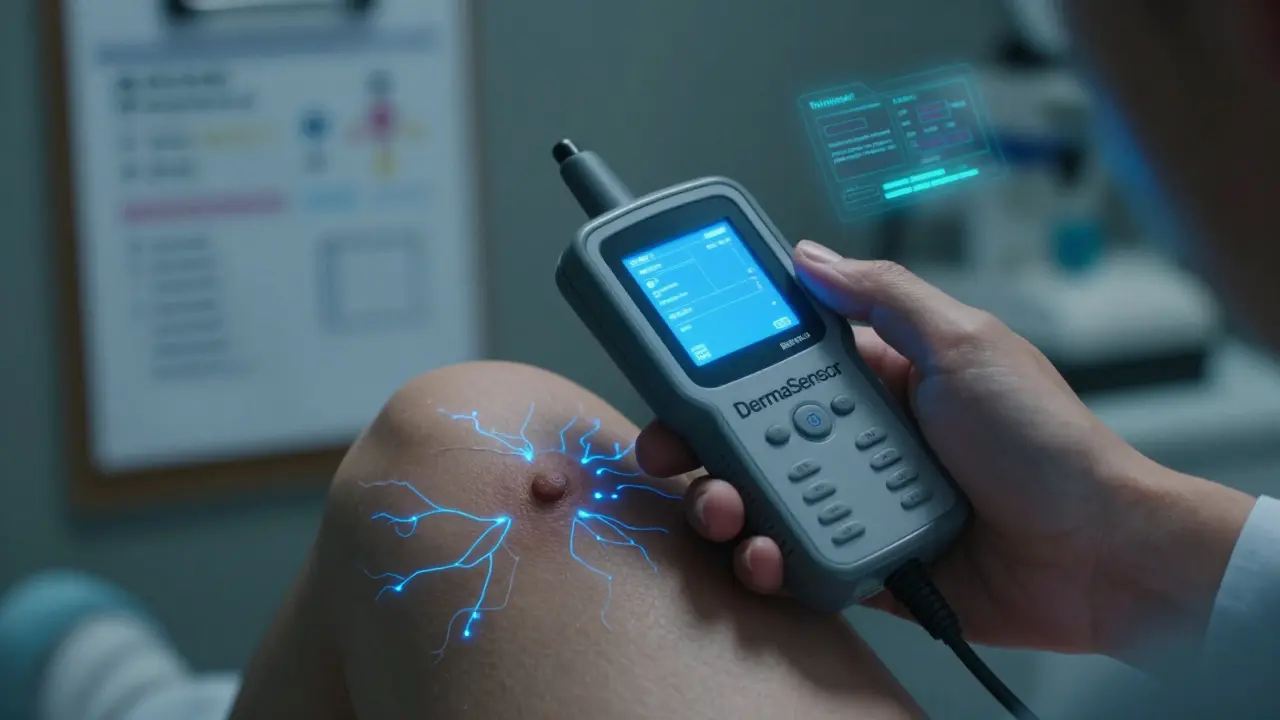
You might think AI in medicine is still science fiction. But in 2025, it’s already in clinics. Systems like SegFusion, developed at Northeastern University, use two AI models working together: one to outline the mole, another to decide if it’s cancerous. It hits 99% accuracy in trials. That’s higher than most human dermatologists. Other tools like the iToBoS full-body scanner can scan your entire skin in six minutes. It doesn’t just take pictures - it maps every spot, compares it to thousands of known cases, and flags anything risky. The system even explains its reasoning in plain language so doctors can trust it. That’s called explainable AI - and it’s a big deal. Then there’s DermaSensor, an FDA-approved device that shines near-infrared light on a mole and measures how it scatters. It’s small, handheld, and doesn’t need a specialist to use. Primary care nurses and GPs can use it after just two hours of training. In trials, 87% of providers said it boosted their confidence. But here’s the catch: its specificity is only 26-40%. That means it flags a lot of harmless moles as suspicious. More biopsies. More anxiety. More cost.The Wearable That Could Change Everything
At Wake Forest, researchers created a tiny, battery-free patch you stick on a mole. It measures electrical differences between healthy skin and cancerous tissue. No cameras. No light. Just subtle changes in how your skin conducts electricity. Early tests on 10 people showed clear, statistically significant differences. The next version will use hydrogel electrodes for better contact and comfort. Imagine wearing this patch for a week. You don’t need to do anything. It silently collects data. Then you plug it into a small reader, and it sends results to your phone. No clinic visit. No waiting. Just peace of mind - or a clear signal to get checked. This isn’t science fiction. It’s in human trials right now. And it’s designed for people who live far from dermatologists, or who can’t afford regular checkups.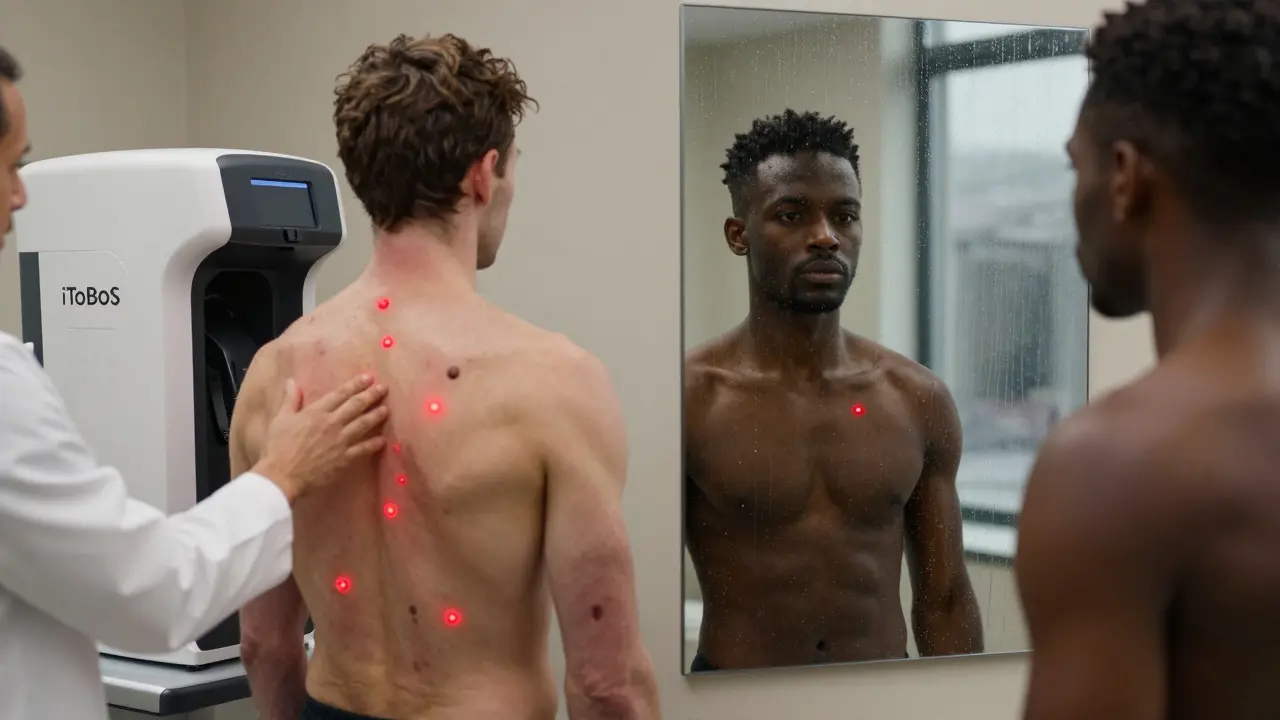
Why AI Still Has a Bias Problem
Here’s the uncomfortable truth: most AI tools were trained mostly on light skin. A 2025 JAMA Dermatology study found these systems perform 12-15% worse on darker skin tones. That’s not just a technical flaw - it’s a life-or-death gap. Melanoma is rarer in people of color, but when it shows up, it’s often found later - and it’s deadlier. Why? Because doctors don’t expect it. And AI doesn’t recognize it as well. The fix isn’t simple. It requires diverse datasets - thousands of images from people with all skin tones. Some labs are working on it. But progress is slow. Until this is fixed, these tools can’t be trusted equally for everyone.Immunotherapy: Turning Your Body Into a Cancer Fighter
If melanoma spreads, traditional treatments like surgery and chemo often fail. That’s where immunotherapy changed everything. Before 2011, metastatic melanoma meant a death sentence within months. Now, some patients live for years - even decades. The breakthrough came with drugs like ipilimumab (Yervoy), which blocks a protein called CTLA-4 that puts the brakes on immune cells. Then came pembrolizumab and nivolumab, which block PD-1. Together, they unleash your T-cells to hunt down cancer cells like targeted missiles. Today, the standard for advanced melanoma is a combo of anti-PD-1 and anti-CTLA-4 drugs. In trials, over half of patients see their tumors shrink. About 20-30% stay in remission for five years or longer. Newer drugs are coming fast. Regeneron’s fianlimab, paired with a PD-1 blocker, showed promising results in early trials. And IMA203 PRAME cell therapy - a personalized treatment that trains your immune cells to target a specific melanoma protein - achieved a 56% complete response rate in Phase 1b trials. These aren’t magic bullets. Side effects can be brutal: fatigue, rash, diarrhea, even autoimmune attacks on the liver or lungs. But for many, the trade-off is worth it.The Reality Check: Overdiagnosis and the Cost of Fear
More detection doesn’t always mean better outcomes. A 2025 study in Taylor & Francis warned that widespread screening might lead to overdiagnosis - finding slow-growing melanomas that would never have harmed you. Treating those cases means unnecessary surgeries, scars, anxiety, and medical bills. One study estimated that up to half of melanomas detected through screening might be overdiagnosed. The key is balance. We want to catch the dangerous ones early - not treat every harmless spot. That’s why experts stress: don’t panic over every new mole. Know the ABCDE signs. Get suspicious ones checked. But don’t rush into biopsies based on a single AI alert.
What’s Working in Real Clinics Right Now
Mayo Clinic rolled out AI-assisted screening across 22 locations in 2025. They saw a 28% drop in unnecessary biopsies. Cleveland Clinic got similar results with DermaSensor. In Europe, 12 clinics are using the iToBoS scanner. Dermatologists report 78% satisfaction - but also a 35% false positive rate. They’re tweaking the AI now. The takeaway? These tools aren’t replacing doctors. They’re giving them superpowers. A dermatologist with an AI assistant spots more melanomas. Misses fewer. And avoids more false alarms than before.What You Can Do Today
You don’t need to wait for the next breakthrough. Here’s what works right now:- Check your skin monthly. Use a mirror. Take photos of moles so you can track changes.
- Know the ABCDE rule. If a mole is evolving - changing shape, color, or size - get it checked.
- Don’t skip annual skin exams if you’re high risk: fair skin, family history, lots of sunburns, or over 50.
- If your doctor uses a dermoscope or AI tool, ask how it works. Ask if they’ve been trained on it.
- Ask about clinical trials if you’ve been diagnosed with advanced melanoma. New immunotherapies are still being tested.
The Future Is Here - But It’s Not Perfect
By 2030, AI-assisted melanoma detection will likely be standard. Immunotherapy will keep getting better. We may soon combine skin scans with blood tests and genetic markers to predict risk before a mole even forms. But technology alone won’t save lives. Awareness will. Regular checks will. Talking to your doctor will. Melanoma is preventable. It’s treatable. But only if you act before it spreads.Can melanoma be cured if caught early?
Yes. When melanoma is found before it spreads beyond the skin, the 5-year survival rate is over 99%. Surgery to remove the tumor is often all that’s needed. Early detection is the most effective treatment.
How accurate are AI tools for detecting melanoma?
Top AI systems like SegFusion and DenseNet-201 achieve 94-99% accuracy in controlled studies using high-quality images. But real-world performance drops due to lighting, skin tone, and image quality. No AI tool is perfect - they’re meant to support, not replace, a dermatologist’s judgment.
What are the side effects of immunotherapy for melanoma?
Immunotherapy can cause the immune system to attack healthy organs. Common side effects include fatigue, rash, diarrhea, and joint pain. More serious reactions can affect the liver, lungs, thyroid, or intestines. These are managed with steroids or other medications, but require close monitoring.
Are AI melanoma detectors available to the public?
Not directly. AI tools like SegFusion and iToBoS are used in clinics, not sold to consumers. Apps that claim to diagnose melanoma from phone photos are unreliable and not FDA-approved. Always see a doctor for any suspicious mole.
Who should get screened for melanoma?
Anyone with a history of sunburns, fair skin, many moles, a family history of melanoma, or a previous skin cancer should have annual skin checks. People with darker skin should also get checked - melanoma often appears on palms, soles, or under nails and is more deadly when missed.
Is melanoma becoming more common?
Yes. Rates have been rising for decades, especially in young women. Increased UV exposure, tanning bed use, and better detection all play a role. But improved treatments are helping more people survive - even with advanced disease.
Spencer Garcia
December 23, 2025 AT 02:42Early detection really is the game-changer here. I had a mole removed last year after my dermatologist spotted it during a routine check - turned out to be stage 1. No chemo, no drama. Just a quick excision and a follow-up. If I’d waited six more months, who knows?
Delilah Rose
December 23, 2025 AT 11:19I’ve been using the SkinVision app for two years now - not because I trust it to diagnose, but because it reminds me to look. I take monthly photos of my moles, compare them side-by-side, and if something shifts even a little, I go in. It’s not AI replacing doctors - it’s AI helping me become my own advocate. I’ve got a family history, so I’m obsessive. But honestly? I’d rather be called paranoid than buried six feet under because I didn’t check a spot that ‘looked fine.’
And yeah, the AI bias thing? Real. My cousin’s dermatologist missed a melanoma on her forearm because the algorithm kept flagging it as a freckle. She’s Afro-Latina. The tool was trained on 90% white skin. That’s not a glitch - that’s systemic negligence. We need diversity in training data, not just lip service. And until then, if you have darker skin, don’t wait for tech to catch up. Trust your eyes. Trust your gut. Get checked.
Lindsey Kidd
December 24, 2025 AT 23:38Just got my first DermaSensor scan at my primary care doc’s office 😍 It felt like sci-fi - tiny device, buzzes a little, spits out a report in 30 seconds. They said it flagged two spots as ‘high concern’ but both turned out benign after biopsy. Still, I’d rather have two unnecessary biopsies than miss one that’s real. Also, the nurse who used it had zero dermatology training - just two hours of online modules. That’s huge for rural areas. My grandma lives 90 minutes from the nearest dermatologist. This could save her life. 🙌
Bret Freeman
December 26, 2025 AT 09:13They’re selling us a fantasy here. AI isn’t saving lives - it’s making Big Pharma richer. Every time one of these devices flags a mole, someone gets a biopsy. Every biopsy means a bill. Every bill means insurance companies profit. And meanwhile, the real problem? We’re being told to panic over every freckle while the government lets corporations pollute the air and water with carcinogens. You think melanoma rates are rising because people aren’t checking their skin? Nah. It’s because the sun’s UV index is through the roof thanks to ozone depletion, and no one’s holding the oil companies accountable. This whole post is a distraction. Fix the environment. Not your moles.
John Pearce CP
December 26, 2025 AT 22:36While I appreciate the technical details, I must emphasize that the United States leads the world in melanoma research and clinical innovation. The integration of AI in dermatology is a testament to American ingenuity. The notion that these tools perform worse on darker skin is not a failure of technology, but a reflection of insufficient data collection - a problem that can and will be rectified through rigorous, federally funded initiatives. We do not shy away from challenges; we solve them. To suggest otherwise is to undermine the very institutions that have extended life expectancy by decades. This is not a flaw - it is a work in progress, and progress demands patience, discipline, and faith in American science.
Aurora Daisy
December 28, 2025 AT 21:20So let me get this straight - we’ve got AI that can spot melanoma better than a dermatologist, but we’re still using a 1980s rule called ABCDE? And the FDA approved a device that has a 60-74% false positive rate? Brilliant. Just brilliant. We’re turning primary care into a guessing game where patients get biopsied for benign moles while the real issue - the lack of dermatologists in rural America - gets ignored. Of course it’s ‘explainable AI’ - because nothing says ‘trust me’ like a robot that’s wrong half the time but explains itself in bullet points. I’m impressed. Truly. The future is here, and it’s a mess.
Paula Villete
December 29, 2025 AT 10:17Immunotherapy is a miracle - but also a financial nightmare. I know someone on nivolumab. She’s been in remission for 3 years. But her co-pays? $12,000 a month. Her insurance finally covered it after a 14-month battle and a letter from her oncologist written in blood (figuratively). The drugs work. The science is revolutionary. But if you’re not rich, or lucky, or connected, you’re just another statistic they cite in a glossy research paper. And don’t get me started on ‘personalized cell therapy’ - yeah, 56% response rate in Phase 1b. Cool. Now tell me how many people will ever get access to it before they die. The future is bright. For some. For others? It’s a waiting room with a $200,000 price tag.
Payson Mattes
December 30, 2025 AT 13:15Did you know the government is using these AI skin scanners to track your DNA through your moles? It’s not just detecting cancer - it’s building a biometric database. The same companies that make these tools also work with the NSA. That’s why they’re pushing them so hard - they want to map every mole on every American before they can opt out. And the ‘patch’? It’s not measuring electrical differences. It’s transmitting your vitals to a cloud server. They’re calling it ‘peace of mind’ - but it’s surveillance with a smiley face. I stopped using all skin apps after reading a whistleblower report in 2024. If you care about freedom, don’t let a device touch your skin. Ever.
Isaac Bonillo Alcaina
December 30, 2025 AT 20:46Overdiagnosis? Please. If you’re not getting every suspicious mole biopsied, you’re gambling with your life. Melanoma doesn’t care if it’s ‘slow-growing’ - it grows when it wants to. I’ve seen people die because their doctor said, ‘It’s probably nothing.’ That’s not medicine. That’s negligence dressed up as caution. The 50% overdiagnosis stat? Probably funded by insurance companies trying to cut costs. Don’t fall for it. If it looks weird - cut it out. No second guesses. No ‘wait and see.’ Your skin is your first line of defense. Treat it like a fortress, not a suggestion box.
Sidra Khan
December 31, 2025 AT 11:27Wait - so the AI works better than dermatologists… but only if you’re white? And the patch that sticks on your mole is ‘battery-free’… but somehow it sends data to your phone? That’s not tech. That’s magic. Or a scam. Pick one.
Diana Alime
January 2, 2026 AT 03:02Okay so I just read this whole thing and now I’m staring at my arm like it’s going to explode. I’ve got a mole I’ve had since I was 12. It’s kinda lopsided. I’m 27. I’ve never shown it to anyone. I’m gonna go check my phone for a skin app right now. I think I’m dying. Or maybe I’m fine. Or maybe I’m just a hypochondriac. Or maybe I’m both. I need a hug. Or a biopsy. Or both. 😭
Christine Détraz
January 2, 2026 AT 15:49What’s missing here is the human cost of all this tech. My mom got diagnosed with melanoma in 2018. She had five biopsies in two years because every doctor had a different opinion. One said ‘watch it.’ Another said ‘cut it now.’ A third said ‘it’s fine, just sunscreen.’ She lost sleep, money, and trust in medicine. We didn’t need AI to tell us something was wrong - we needed a doctor who listened. The tech is cool, sure. But if you’re not training doctors to talk to patients, you’re just giving them fancy toys to hide behind. I’ve seen too many people get dismissed because an AI said ‘low risk.’ Don’t let algorithms replace compassion.
Spencer Garcia
January 3, 2026 AT 18:37Agreed. I’ve seen AI tools miss melanomas on the scalp and between toes - places no one checks. Tech helps, but it doesn’t replace the hands-on exam. I always tell my patients: if you’re worried, get it checked. Even if the app says ‘nope.’ Your intuition is part of the diagnostic process. Don’t outsource your health to an algorithm.