
Drug Interaction Checker
Enter medications you're taking to check for known interactions. This tool highlights potential risks and explains why interactions occur based on the article's information.
When you take more than one medication, something invisible is happening inside your body. Two drugs might be working against each other, or one might be making the other dangerously strong. These are drug-drug interactions-and they’re more common than most people realize. In fact, about 1 in 20 hospital admissions for older adults is linked to a preventable drug interaction. It’s not just about pills you take together. It’s about how your body processes them, how they talk to each other, and what happens when that conversation goes wrong.
How One Drug Changes Another’s Journey Through Your Body
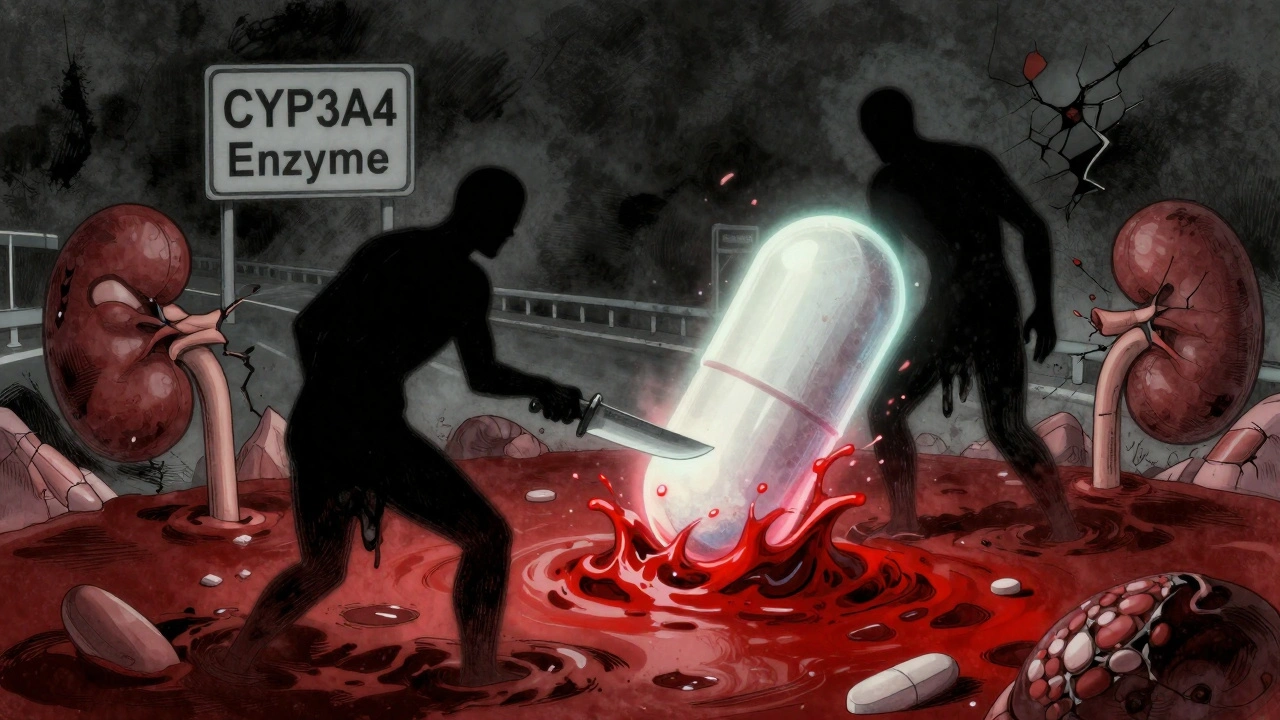
Most drug interactions happen because one drug interferes with how another is absorbed, broken down, or removed from your body. This is called a pharmacokinetic interaction. Think of it like traffic on a highway. Your body has enzymes and transporters that move drugs around, break them down, and flush them out. When another drug shows up and blocks the exit ramp or slows down the cars, the original drug builds up-or disappears too fast.
The biggest player in this process is the cytochrome P450 system, especially the CYP3A4 enzyme. It handles about half of all prescription drugs. If you take ketoconazole (an antifungal) with simvastatin (a cholesterol drug), ketoconazole shuts down CYP3A4. That means simvastatin can’t be broken down properly. Its levels can spike 10 to 20 times higher than normal. That’s not just a minor bump-it raises your risk of rhabdomyolysis, a condition where muscle tissue breaks down and can wreck your kidneys.
It’s not just enzymes. Transporters matter too. P-glycoprotein is like a bouncer at the cell door. It kicks drugs out of cells to keep concentrations low. But if you take verapamil (a heart medication) with digoxin (used for irregular heartbeat), verapamil blocks the bouncer. Digoxin piles up in your blood. Too much digoxin can trigger dangerous heart rhythms. That’s why doctors check digoxin levels closely when starting or stopping other meds.
Even your stomach and gut can be part of the problem. Some drugs change the pH of your digestive tract. Others slow down how fast your stomach empties. That changes how well another drug gets absorbed. For example, antacids can reduce how much levothyroxine (thyroid hormone) your body takes in-leading to under-treated hypothyroidism if not spaced out properly.
When Drugs Talk Directly to Each Other
Not all interactions are about levels. Sometimes, two drugs just team up-or fight-right at the target site. That’s a pharmacodynamic interaction. It doesn’t matter how much of each drug is in your blood. What matters is what they do when they meet.
A classic example is combining two drugs that both slow your heart rate. If you take a beta-blocker like metoprolol with a calcium channel blocker like diltiazem, both are acting on the same system. Together, they can drop your heart rate too low, causing dizziness, fainting, or worse.
Another scary one is QT prolongation. Certain antibiotics like azithromycin and fluoroquinolones like ciprofloxacin each slightly lengthen the QT interval on an ECG. Alone, they’re usually fine. Together? The risk of a deadly heart rhythm called torsades de pointes jumps by more than five times. That’s why doctors avoid this combo unless absolutely necessary.
Then there’s the opposite: drugs that cancel each other out. Take warfarin, a blood thinner, and vitamin K-rich foods like kale or spinach. Vitamin K reverses warfarin’s effect. If you suddenly eat a lot more greens, your INR drops. You’re at risk of clots. Do the opposite-eat less-and you risk bleeding. It’s not the drug changing how it’s processed. It’s the nutrient directly opposing the drug’s action.
Who’s the Perpetrator? Who’s the Victim?
In drug interaction language, there are two roles: the object (or victim) and the precipitant (or perpetrator). The victim is the drug whose effect changes. The perpetrator is the one causing the change.
Perpetrators are either inhibitors or inducers. Inhibitors slow down the system. Like fluconazole blocking CYP2C9, which makes warfarin stick around longer and increases bleeding risk. Inducers speed things up. St. John’s Wort, a popular herbal supplement, turns on CYP3A4 and P-glycoprotein. That’s why people on cyclosporine (after organ transplants) or birth control pills can suddenly have organ rejection or get pregnant-because their drugs are being flushed out too fast.
These effects are ranked. A strong inhibitor can increase a drug’s concentration by five times or more. A moderate one might double it. A weak one? Maybe a 20% bump. That matters because not every interaction needs to be avoided-but some absolutely must be.
Genes Play a Role Too
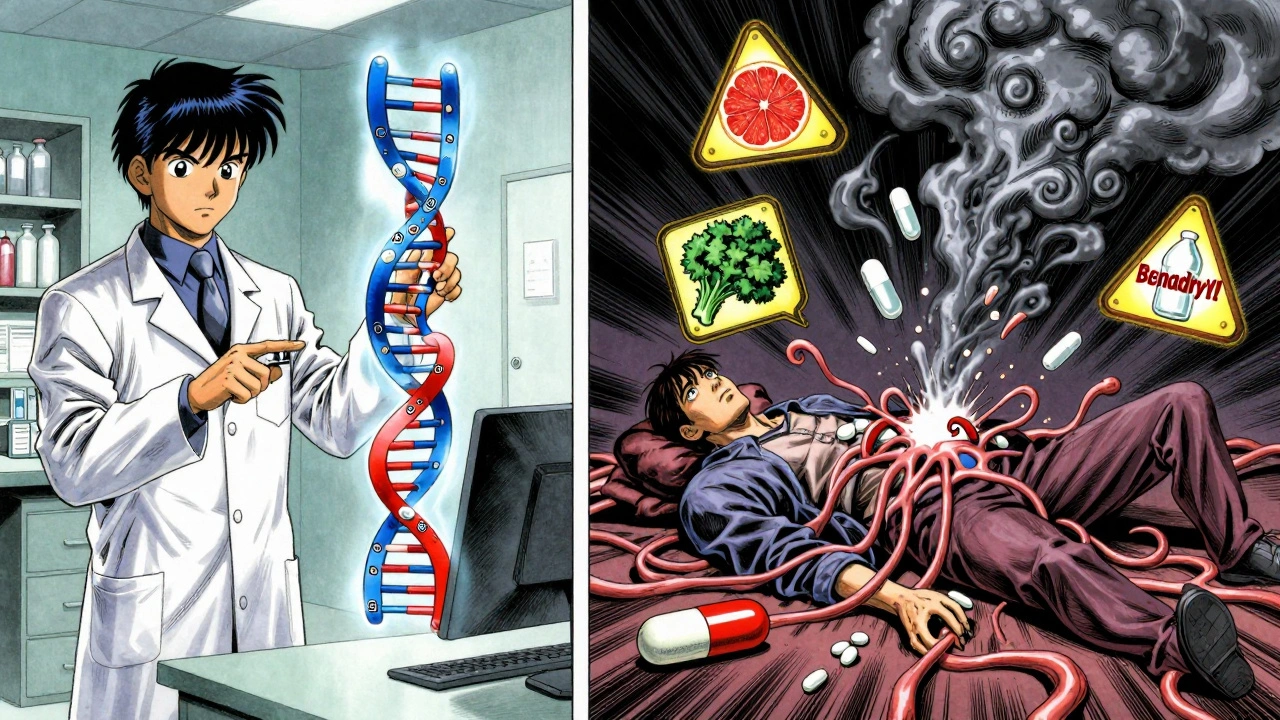
You’re not just a body. You’re a genome. Some people are born with versions of enzymes that work slowly, quickly, or not at all. CYP2D6 is a big one. It turns codeine into morphine. If you’re a “poor metabolizer,” codeine does nothing for pain. If you’re an “ultrarapid metabolizer,” you turn it into morphine too fast. Now add a CYP3A4 inhibitor like clarithromycin? You get a dangerous morphine overload-even with a normal dose of codeine.
That’s why the Clinical Pharmacogenetics Implementation Consortium (CPIC) now has 22 guidelines that tell doctors how to adjust meds based on your genes. This isn’t science fiction. It’s happening in clinics right now. Your DNA can tell your doctor whether a drug interaction is likely to hit you hard-or not at all.
What Happens When You Take Too Many Pills
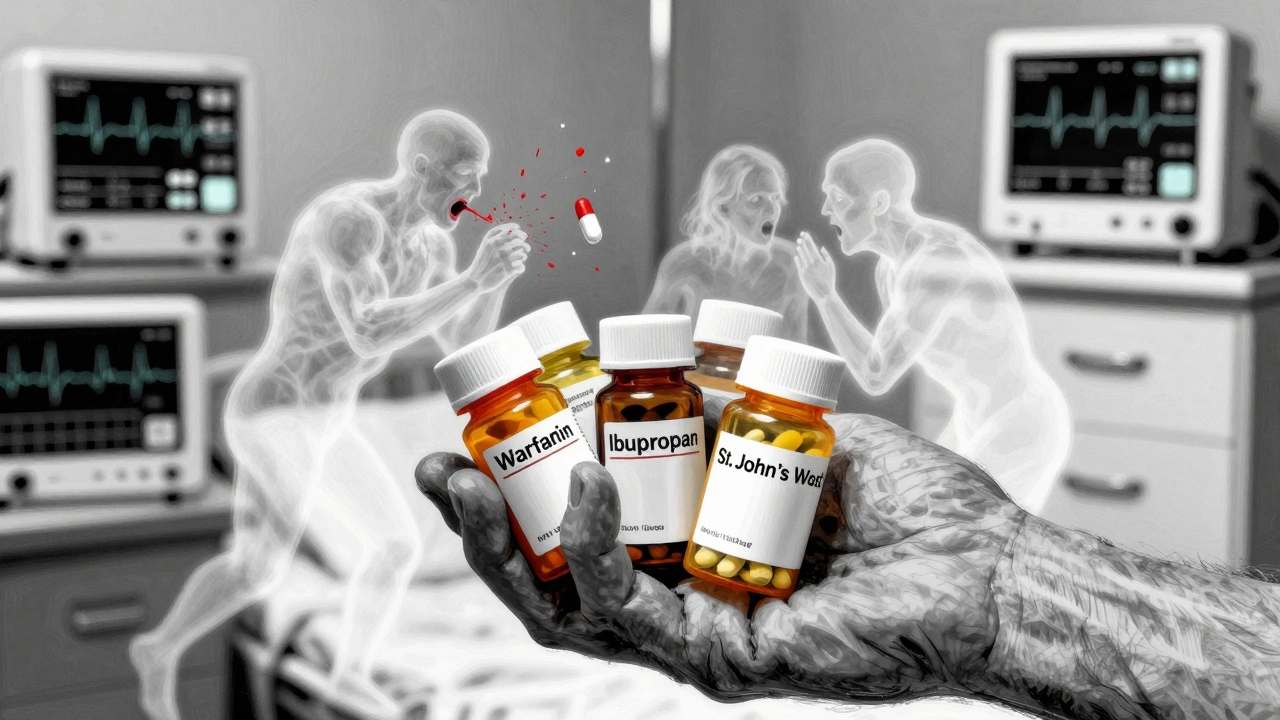
Older adults are at highest risk. Why? They often take five, six, even ten medications. The more drugs you take, the more chances for collisions. The Beers Criteria, updated in 2019, lists 30 dangerous combinations for people over 65. One of the worst? NSAIDs like ibuprofen with blood thinners like warfarin. Together, they can triple or quadruple your risk of a serious bleed.
It’s not just pills. Herbal supplements are a hidden source. Garlic, ginkgo, ginseng-they all interact. St. John’s Wort is the worst offender. It’s not just about birth control or transplants. It can make your antidepressant useless, your HIV meds ineffective, or your cancer treatment fail.
And it’s not always obvious. You might not even realize you’re taking something that interacts. Over-the-counter painkillers, sleep aids, or cold medicines can all be perpetrators. Diphenhydramine (in Benadryl) can worsen confusion in older adults, especially if they’re already on anticholinergics for Parkinson’s or overactive bladder.
How Doctors and Pharmacies Fight Back
Hospitals and clinics use electronic systems to catch these interactions. But here’s the problem: they’re too loud. About 90% of the alerts you see in an EHR are false alarms. Clinicians get tired of them. They start clicking past them-sometimes ignoring real dangers.
That’s why smarter systems are coming. Epic’s “Suggestive Warnings” doesn’t just say “danger.” It says, “This combo increases bleeding risk by 3.5x. Consider switching to acetaminophen.” That kind of context cuts high-risk interactions by 22%.
Pharmacists are on the front lines. A 2021 study found that when pharmacists reviewed meds for 12,500 patients, they cut dangerous interactions by 37%. They spot things doctors miss-like a patient taking a new OTC supplement or not spacing out their thyroid pill and calcium supplement.
Therapeutic drug monitoring helps too. For drugs like warfarin, lithium, or digoxin, doctors check blood levels regularly. If a new drug is added, they retest. It’s not perfect-but it’s better than guessing.
The Future: AI, Personalization, and Prevention
Machine learning is stepping in. A 2021 study trained an AI on 89 million electronic health records. It predicted drug interactions with 94.8% accuracy-far better than old rule-based systems. It doesn’t just look at two drugs. It looks at age, kidney function, other meds, even lab results.
And it’s not just about avoiding bad combos. It’s about finding the right ones. Some interactions are useful. Like adding ritonavir to other HIV drugs to boost their levels. That’s intentional. The goal now is to make these predictions smarter, faster, and personalized.
Research is also looking at the gut microbiome. Bacteria in your intestines can break down drugs before they’re even absorbed. Change your microbiome with antibiotics or diet, and you change how a drug works. This is still early-but it’s a new frontier.
What You Can Do
You don’t need to be a scientist to stay safe. Here’s what works:
- Keep a list of every pill, vitamin, herb, and supplement you take. Bring it to every appointment.
- Ask your pharmacist: “Could any of these interact?” They’re trained for this.
- Don’t start a new supplement without checking. Even “natural” doesn’t mean safe.
- If you’re on warfarin, keep your vitamin K intake steady. Don’t suddenly go vegan or eat a salad every day.
- Report side effects. If you feel weird after starting a new drug, tell your doctor. It might be an interaction.
Drug interactions aren’t rare accidents. They’re predictable, preventable, and often deadly. But with awareness, communication, and smarter tools, we’re getting better at stopping them before they start.
Can over-the-counter medications cause dangerous drug interactions?
Yes. Common OTC drugs like ibuprofen, naproxen, diphenhydramine (Benadryl), and even cold medicines with pseudoephedrine can interact with prescription drugs. Ibuprofen can increase bleeding risk when taken with warfarin or aspirin. Diphenhydramine can worsen confusion or urinary retention in older adults on other anticholinergic medications. Always check with a pharmacist before taking any new OTC product, even if it’s labeled “non-drowsy” or “natural.”
Are herbal supplements safer than prescription drugs when it comes to interactions?
No. Many people assume herbal products are harmless, but that’s not true. St. John’s Wort is one of the most dangerous. It can reduce blood levels of cyclosporine by up to 60%, making organ rejection likely. It can also make birth control fail, antidepressants less effective, or cancer drugs stop working. Garlic, ginkgo, and ginger can increase bleeding risk with blood thinners. Herbal products aren’t regulated like drugs, so their strength and ingredients vary. Always disclose them to your doctor.
Why do some drug interactions only show up after weeks or months?
Some interactions aren’t immediate. Inducers like St. John’s Wort or rifampin take days to weeks to ramp up enzyme production. The effect builds slowly. You might feel fine at first, then suddenly notice your medication isn’t working. The same goes for inhibitors that cause gradual buildup-like when a new antibiotic makes your cholesterol drug toxic over time. That’s why monitoring blood levels and watching for delayed symptoms is critical.
Can food and drinks cause drug interactions too?
Absolutely. Grapefruit juice is the most famous-it blocks CYP3A4 in the gut, raising levels of drugs like simvastatin, felodipine, and some anti-anxiety meds. Alcohol can intensify sedation from opioids, benzodiazepines, or sleep aids. Vitamin K-rich foods like kale and broccoli can weaken warfarin. Even dairy can bind to antibiotics like tetracycline and stop them from being absorbed. Always check the label or ask your pharmacist about food interactions.
What should I do if I think I’m having a drug interaction?
Don’t stop your medication suddenly unless instructed by a doctor. Some drugs, like blood pressure or seizure meds, can cause dangerous rebound effects. Instead, call your pharmacist or doctor. Describe the new symptom-dizziness, nausea, unusual bleeding, heart palpitations-and list everything you’ve taken in the past week. Keep a log. Many interactions are reversible if caught early. Waiting too long can lead to hospitalization.
Next Steps: Staying Safe With Multiple Medications
If you’re on three or more medications, schedule a medication review with your pharmacist every six months. Bring your pill bottles or a current list. Ask: “Is there anything here that shouldn’t be taken together?” Use tools like the Liverpool HIV-Drug Interactions Checker (even if you don’t have HIV) or the American Pharmacists Association’s interaction guide. Keep a printed copy of your meds in your wallet. In an emergency, that list could save your life.
Linda Migdal
December 2, 2025 AT 02:12Let’s be real-pharmacokinetics isn’t some abstract lecture. It’s a battlefield. CYP3A4 gets shut down by antifungals, and suddenly your statin turns into a muscle-eating monster. This isn’t ‘be careful.’ This is ‘your kidneys are about to fail.’ And don’t get me started on how hospitals ignore this until someone’s in the ICU. We need mandatory interaction checks before prescribing, not after the damage is done.
And yes, I’m talking to you, primary care docs who prescribe 8 meds to a 72-year-old and call it ‘standard of care.’
Dennis Jesuyon Balogun
December 3, 2025 AT 12:56What fascinates me is how we treat the body like a machine with isolated parts, when in truth it’s a living ecosystem. The CYP system? It’s not just enzymes-it’s a network shaped by diet, stress, sleep, even gut bacteria. We reduce drug interactions to ‘A inhibits B,’ but we ignore that your microbiome might be metabolizing the inhibitor before it even reaches the liver.
This is why Western medicine fails so many. We diagnose symptoms, not systems. The real solution isn’t more alerts-it’s holistic pharmacology. You can’t fix a broken conversation by shouting louder. You have to listen to the whole room.
And yes, I’ve seen a man on warfarin die because his ‘natural’ turmeric supplement wasn’t flagged. That’s not negligence. That’s ideology.
Shannon Gabrielle
December 5, 2025 AT 11:01Oh wow. A 10-page essay on how drugs don’t play nice. Groundbreaking. Next you’ll tell me water is wet and gravity exists.
Meanwhile, my grandma’s on 12 meds, her pharmacist doesn’t answer calls, and her doctor thinks ‘just take it with food’ is a safety protocol. You wrote a textbook. I live in the dumpster fire you ignored.
Also St. John’s Wort? Yeah, I’ve seen it kill antidepressants. But guess what? Nobody tells you until you’re sobbing on the floor wondering why your Zoloft suddenly turned to dust. Thanks for the info, doc. Too late.
Kshitij Shah
December 6, 2025 AT 15:33In India, we call this ‘mixing chai with medicine.’ People take aspirin with turmeric, metformin with ashwagandha, and wonder why they feel dizzy. No one checks. No one cares. The pharmacist just hands you the bottle and says ‘good luck.’
But here’s the thing-it’s not just about enzymes. It’s about culture. We don’t trust doctors. We trust our aunties. And if your auntie says ‘take ginger for blood pressure,’ you take it. Even if you’re on lisinopril.
Education needs to be in the language people speak, not in EHR pop-ups. Maybe if we made videos in Hindi or Bengali instead of English jargon, people would actually listen.
Sean McCarthy
December 7, 2025 AT 08:34Drug interactions are bad. You take two things. They don't work right. You get sick. Sometimes you die. The system is broken. Doctors don't know. Pharmacies don't care. Patients don't know what to ask. It's a mess. We need better rules. More checks. Less guessing.
Also grapefruit is bad. Don't eat it with pills.
Tommy Walton
December 8, 2025 AT 15:47Let’s be honest: this is just pharmacology’s version of ‘I told you so.’ 🤓
But here’s the real tragedy-most of these interactions are avoidable, yet we treat them like cosmic accidents. We’re not dealing with chemistry. We’re dealing with human arrogance. We think we can outsmart biology. We can’t. Your genome doesn’t care about your insurance plan.
AI can predict interactions at 94.8% accuracy? Cool. Now make it mandatory. Make it real. Stop letting clinicians ignore alerts because they’re ‘annoying.’ That’s not workflow. That’s negligence dressed up as efficiency.
And yes, I’ve seen a patient die because someone clicked ‘dismiss’ on a CYP2D6 warning. I still dream about it.
Genomics isn’t the future. It’s the baseline. We’re still living in the Stone Age of medicine.
💎
James Steele
December 10, 2025 AT 11:09The CYP3A4 system isn’t just a metabolic pathway-it’s a cathedral of enzymatic precision, and we treat it like a broken vending machine. When ketoconazole shuts down CYP3A4, it’s not a ‘drug interaction’-it’s a systemic sabotage. Simvastatin doesn’t just ‘spike’-it becomes a rogue agent, turning myocytes into necrotic slag.
And don’t even get me started on P-glycoprotein. That’s not a bouncer-it’s the guardian of cellular sovereignty. When verapamil bribes it into complacency, digoxin doesn’t ‘pile up’-it infiltrates the myocardium like a silent assassin.
Meanwhile, we rely on EHR alerts that scream like a broken fire alarm. The real innovation isn’t AI predicting interactions-it’s building systems that force human accountability. No more dismissals. No more ‘I didn’t see it.’
This isn’t medicine. It’s forensic pharmacology with a side of negligence.
Louise Girvan
December 12, 2025 AT 00:19They’re lying to you. They’re ALL lying. The FDA doesn’t test for interactions between 10+ drugs because the pharmaceutical industry doesn’t want you to know. Why? Because if you knew how dangerous your cocktail was, you’d stop taking it. And then they’d lose billions.
St. John’s Wort? It’s not ‘natural’-it’s a bioweapon designed by Big Pharma to make you dependent on antidepressants that don’t work because the supplement killed them.
And grapefruit? It’s not just CYP3A4-it’s a coordinated attack on your liver’s detox system. They know. They’ve known for decades. And they’re still selling you the pills.
Don’t trust your doctor. Don’t trust your pharmacist. Trust no one. Keep a log. Burn your pill bottles. Go off everything. Or die quietly.
I’ve seen it happen. To my sister. To my neighbor. To my cousin. They’re all dead now.
They told me it was ‘rare.’ It wasn’t. It was inevitable.
soorya Raju
December 12, 2025 AT 22:30bro the whole cyp thing is overhyped i think its mostly just people taking too many pills and then blaming the drugs
also st johns wort is just a scam i took it for 3 months and my anxiety got worse not better
also why is everyone so scared of grapefruit juice like its poison i drink it every morning and im fine
also why do we even need all these meds anyway maybe we should just eat less sugar and sleep more
also my uncle took 12 pills a day and lived to 90 so maybe the system isnt broken maybe its just people who dont know how to live
Grant Hurley
December 13, 2025 AT 12:55Man, I used to take 6 meds a day. Felt like a walking pharmacy. Then I started asking my pharmacist one question: ‘Which one of these is actually saving my life?’
Turns out, three of them were just ‘just in case’ meds. One was for a condition I didn’t even have anymore. One was causing dizziness that made me fall.
Got rid of the extras. My energy came back. My brain stopped fogging. My insurance premium dropped.
Don’t be afraid to ask: ‘Is this still necessary?’
Also, write your meds down. On paper. In your wallet. In your phone. In your bathroom mirror. I still do it. Saved my life once when I passed out and the EMTs read my list.
You don’t need to be a genius. Just be organized.
And yeah, grapefruit juice? Skip it. Not worth the risk.
Lucinda Bresnehan
December 14, 2025 AT 19:14As a nurse who’s seen patients overdose on simvastatin because they started ketoconazole for a yeast infection, I can tell you: this isn’t theory. It’s Tuesday.
And the worst part? The patients never know. They don’t read the inserts. They don’t tell their doctors about the ginkgo they take for ‘memory.’ They think ‘natural’ = safe. It’s not.
My advice? Bring every bottle-every pill, every capsule, every tea bag-to your next appointment. Even the ones you haven’t taken in a year. Even the ones you think ‘don’t count.’
And if your doctor doesn’t look at them? Find a new one. Your life isn’t a guess.
Also: write it down. Use the app. Use a sticky note. Just don’t rely on your memory. I promise you, you’ll forget.
You’re not being paranoid. You’re being smart.
Nnaemeka Kingsley
December 16, 2025 AT 08:43in nigeria we dont have much access to pharmacists so people just take what the patent medicine seller says
one man took antimalarial with his blood pressure pill and his heart stopped
we need more education in markets and churches
not just in hospitals
also why is everyone so scared of st johns wort? i took it with my antidepressant and i feel better
maybe its not bad for everyone
maybe the system is too scared of natural things
we need balance not fear
ANN JACOBS
December 16, 2025 AT 10:43It is with profound reverence for the intricate biochemical symphony that governs human physiology that I feel compelled to offer this reflection on the matter of pharmacokinetic and pharmacodynamic interactions. The human organism, as a dynamic and exquisitely calibrated system, operates under the influence of a constellation of enzymatic pathways, transporter proteins, and genomic polymorphisms that, when perturbed by exogenous agents, may precipitate outcomes of dire consequence.
It is not merely a matter of ‘drugs interacting’-it is the disruption of homeostatic equilibrium, the alteration of bioavailability, the suppression or induction of cytochrome P450 isoforms, the modulation of P-glycoprotein efflux, and the potential for QT interval prolongation-all of which, when unmonitored, may culminate in catastrophic clinical events such as rhabdomyolysis, torsades de pointes, or hemorrhagic diathesis.
Moreover, the integration of pharmacogenomic data into clinical decision-making represents not an innovation, but an ethical imperative. The Clinical Pharmacogenetics Implementation Consortium (CPIC) guidelines are not suggestions-they are the new standard of care, and failure to adhere constitutes a deviation from the fiduciary duty owed to the patient.
Therefore, I urge all clinicians, pharmacists, and patients to embrace a paradigm of rigorous, evidence-based, and personalized pharmacotherapy. The stakes are not merely clinical-they are existential.
With deepest respect for the sanctity of life,
Dr. Ann Jacobs, Ph.D., Pharm.D., FACP
Alexander Williams
December 18, 2025 AT 10:35Everyone’s acting like drug interactions are some new discovery. Newsflash: we’ve known about grapefruit and statins since the 90s. We’ve known about St. John’s Wort and SSRIs since the 2000s.
So why are we still having this conversation? Because the system doesn’t want to fix it. It’s cheaper to treat the overdose than prevent it.
And don’t get me started on how AI ‘predicts’ interactions. It’s trained on data from people who already got hurt. That’s not prevention. That’s damage control with a fancy name.
Real solution? Reduce polypharmacy. Stop prescribing meds for side effects of other meds. Stop letting primary care doctors act like pharmacists.
It’s not the drugs. It’s the culture.
Scotia Corley
December 19, 2025 AT 09:18The assertion that drug interactions are ‘preventable’ is a dangerous oversimplification. While pharmacokinetic and pharmacodynamic mechanisms are well-characterized, clinical implementation remains inconsistent, poorly resourced, and burdened by cognitive overload in clinical environments. The notion that a pharmacist’s review reduces interactions by 37% is statistically significant but clinically insufficient. The underlying structural deficiencies-understaffing, inadequate EHR integration, lack of provider incentives-remain unaddressed.
Furthermore, the promotion of AI-driven prediction models as a panacea ignores the fundamental issue: predictive accuracy without enforceable intervention is merely surveillance, not safety.
Until regulatory agencies mandate real-time, closed-loop interaction mitigation-with legal liability attached to ignored alerts-this remains a public health failure dressed in algorithmic clothing.
Sean McCarthy
December 20, 2025 AT 14:23My mom took warfarin and started eating kale. She almost bled out. Now she eats one spinach salad a week. No more surprises.
Also: always tell your doctor about every supplement. Even the ones you think are ‘just vitamins.’
And don’t mix alcohol with painkillers. It’s not worth it.