
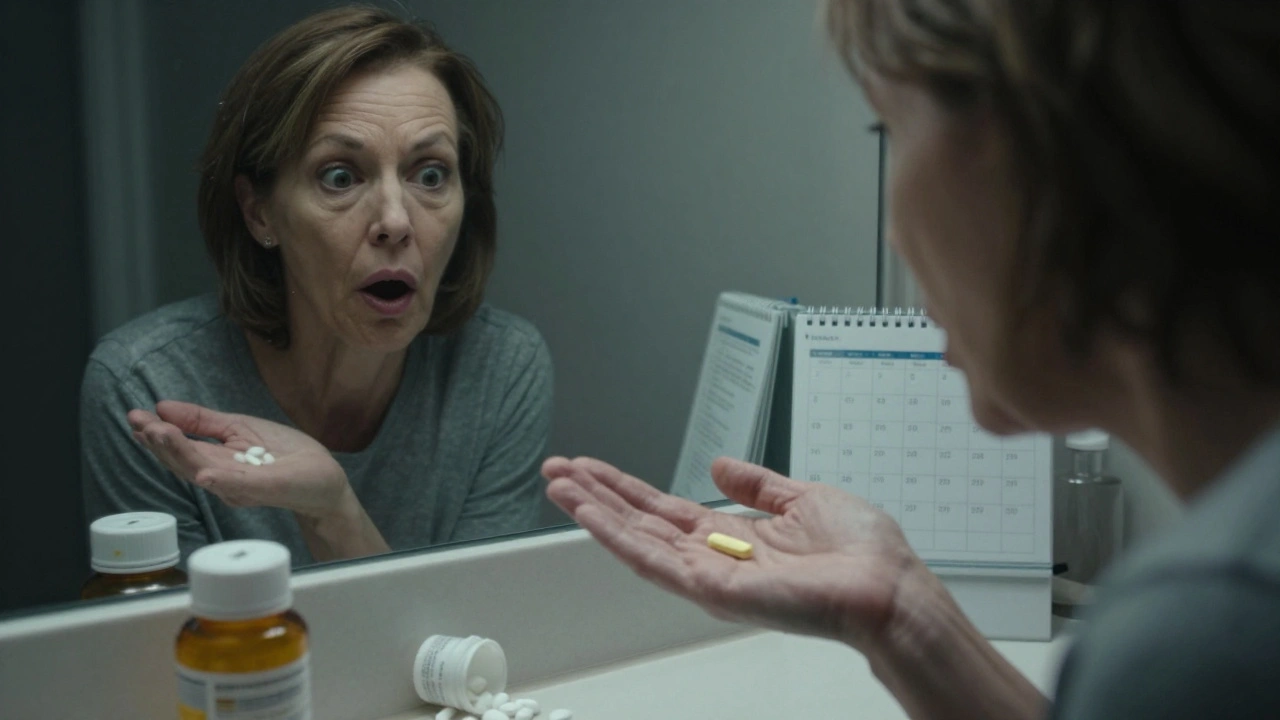
Ever opened your pill bottle and stared at a tablet that looked nothing like the one you took yesterday? It’s not a mistake. It’s not a counterfeit. And it’s not necessarily a problem - but it can be dangerous if you don’t know what’s going on.
Why Do Generic Pills Look Different?
Generic drugs are required by the U.S. Food and Drug Administration (FDA) to work the same way as brand-name drugs. Same active ingredient. Same dose. Same effect. But there’s one big exception: how they look. Under U.S. trademark law, generic manufacturers can’t copy the exact color, shape, or markings of a brand-name pill. This rule dates back to the Hatch-Waxman Act of 1984. It was meant to protect brand identity - not patient safety. But today, that rule is causing real problems. A generic version of Lipitor (atorvastatin), for example, might be a white round tablet. The brand version is pink and oval. Another generic version could be pale yellow and oblong. All three contain the same medicine. But to someone taking it daily, especially if they’re on five or more medications, that visual shift can be terrifying.It’s Not Just Color - Shape, Size, and Marks Matter Too
Pill appearance isn’t just about color. It’s also:- Shape: Round, oval, caplet, capsule, even hexagonal
- Size: Measured in millimeters - some pills are as small as 3mm, others up to 20mm
- Markings: Letters, numbers, or lines embossed on the surface (like “ATV 10” or a score line)
When a Pill Looks Different, People Stop Taking It
This isn’t just about confusion. It’s about danger. Harvard Medical School researchers tracked 38,507 patients on cardiovascular medications. When their pills changed color or shape, the chance they stopped taking the drug jumped by 34%. That’s not a small number. It’s life-threatening. Why? Because the brain relies on visual cues. If your daily blood pressure pill suddenly turns from white oval to blue round, your mind says: “This isn’t right.” Even if you know it’s the same medicine, doubt creeps in. And when you’re tired, stressed, or managing multiple conditions, that doubt turns into skipped doses. A 2023 survey from Healthgrades found that 28.4% of patients were “very concerned” when their generic pill changed appearance. Nearly 15% admitted they skipped one or more doses because they didn’t recognize the pill. Older adults are hit hardest. The AARP reported that 37% of adults 65+ had trouble recognizing their meds after a change - compared to just 22% of younger adults.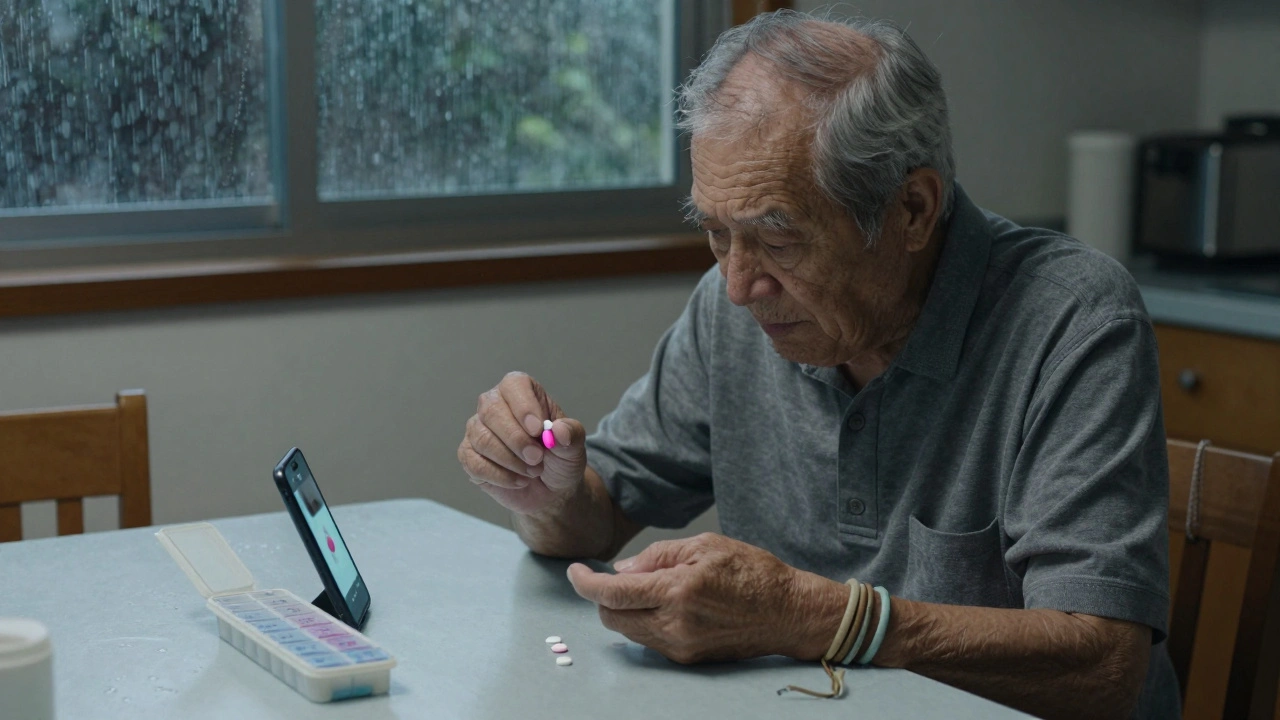
Pharmacists Are Hearing This - Loudly
Pharmacists are on the front lines. The American Pharmacists Association found that 18.3% of generic medication refills trigger complaints from patients about appearance changes. Most of those complaints come from people over 65. One pharmacist in Ohio told me: “I’ve had patients cry because they thought they were given the wrong medicine. They’ve been on the same pill for years - then one day it’s a different color, and they panic.” Many pharmacies now use pill identification tools - printed cards from the FDA’s Division of Drug Information, or digital images from the Surescripts E-prescribing system. But only 42.7% of pharmacies use them consistently.What You Can Do Right Now
You don’t have to accept confusion as normal. Here’s what works:- Take a photo of your pill - right after you get it. Use your phone. Save it in a folder labeled “Medications.” If it changes next time, you’ll know it’s still the same drug.
- Ask your pharmacist every time you refill: “Is this the same pill I got last time?” Don’t be shy. They’re trained to explain this.
- Use a pill organizer with labeled compartments. Even if the pill looks different, putting it in the same spot every day builds muscle memory.
- Request a consistent manufacturer - if your insurance allows it. Some pharmacy benefit managers (PBMs) let you choose which generic maker supplies your drug. About 22% of patients can do this - but you have to ask.
- Keep a written list of every medication: name, dose, appearance, and why you take it. Update it every time your pill changes.

Why Doesn’t the FDA Fix This?
The FDA knows this is a problem. In 2016, they issued guidance asking generic manufacturers to consider appearance when developing new drugs. In 2023, they launched a new initiative called “Visual Medication Equivalence Standards” to explore standardizing looks for high-risk drugs. But they’re stuck. Trademark law still forces generics to look different. In 2022, a court case (Takeda Pharmaceuticals v. Zydus) ruled that brand companies can legally protect their pill designs. So even if the FDA wanted to make all atorvastatin pills look the same, they can’t. The European Union took a different path. They require generic versions of chronic disease drugs to match the brand’s appearance when possible. Result? A 18.3% drop in appearance-related errors.The Future Is Changing - Slowly
The good news? The industry is waking up. By 2028, Evaluate Pharma predicts that 75% of new generic approvals for high-risk drugs (like blood thinners, thyroid meds, or epilepsy drugs) will include voluntary appearance standardization. That’s up from just 32% in 2023. The FDA has also allocated $4.7 million in its 2024 budget to study how pill appearance affects patient outcomes. That’s a signal: this isn’t just a nuisance - it’s a public health issue. Meanwhile, the cost of ignoring it is huge. The Generic Pharmaceutical Association estimates appearance-related non-adherence costs the U.S. healthcare system $1.3 billion every year - from ER visits to hospitalizations.Bottom Line: Don’t Guess. Verify.
A generic pill changing color or shape doesn’t mean it’s weaker, stronger, or fake. It means the manufacturer changed. But your brain doesn’t care about manufacturing details. It cares about safety. So don’t rely on memory. Don’t assume. Don’t skip a dose because something looks off. Take a picture. Ask your pharmacist. Write it down. Keep your meds organized. Your health isn’t just about what’s inside the pill. It’s about whether you trust what’s in your hand. And you deserve to.Why do generic pills look different from brand-name pills?
U.S. trademark law prohibits generic drugs from looking identical to brand-name pills, even if they contain the same active ingredient. This rule, established under the Hatch-Waxman Act of 1984, is meant to protect brand identity, not patient safety. As a result, generics often differ in color, shape, size, or markings.
Are generic pills just as effective as brand-name pills?
Yes. The FDA requires generic drugs to be bioequivalent and pharmaceutically equivalent to their brand-name counterparts. This means they must deliver the same amount of active ingredient into your bloodstream at the same rate. Appearance differences do not affect how the drug works.
What should I do if my generic pill looks different this time?
Don’t stop taking it. Don’t assume it’s wrong. Call your pharmacist and ask: “Is this the same medication?” Show them your old pill or a photo you took. They can confirm it’s the same drug from a different manufacturer. Keep a photo record of each pill you receive.
Can changing pill appearance cause me to miss doses?
Yes. Research from Harvard Medical School found that when pill appearance changed, patients were 34% more likely to stop taking their medication - especially for heart disease, high blood pressure, or diabetes. Visual confusion leads to fear, doubt, and skipped doses - even when the medicine is exactly the same.
Can I ask for the same generic manufacturer every time?
Sometimes. Some insurance plans or pharmacy benefit managers allow you to request a specific generic manufacturer. About 22% of patients can do this, but you need to ask your pharmacist or insurer. If your medication is critical (like warfarin or levothyroxine), it’s worth pushing for consistency.
Are there any tools to help identify pills?
Yes. The FDA provides free printable medication identification cards. Many pharmacies use digital tools like Surescripts’ Medication History feature to show past pill images. You can also use free apps like Epocrates or WebMD Pill Identifier. But the most reliable tool? A photo you take yourself right after filling the prescription.
brenda olvera
December 6, 2025 AT 00:26Been there done that got the t-shirt
Ibrahim Yakubu
December 7, 2025 AT 07:18Let me tell you something they don't want you to know. The pharmaceutical companies are working with the FDA to confuse us on purpose so we'll buy more pills. This isn't about trademarks-it's about control. They want you dependent. Look at the numbers: every time your pill changes color, your pharmacy gets paid again. It's a trap.
And don't even get me started on how they use color psychology to manipulate your brain. White = fear. Blue = calm. Pink = deception. They're engineering your anxiety to keep you compliant.
I once saw a man collapse in the pharmacy because his metformin went from green to yellow. He thought he was dying. The pharmacist just shrugged. That's not healthcare. That's corporate warfare.
And yes, I know what you're thinking: 'It's just a pill.' But you don't understand the depth of the deception. They're not just changing pills-they're changing your identity. You used to know who you were when you held that pill in your hand. Now? You're just a data point.
I've been tracking this since 2017. I've documented over 300 pill changes across 12 medications. The pattern is unmistakable. They're testing your obedience. And guess what? Most of you fail.
It's not about generics. It's about power. And we're all just pawns in their game.
Gwyneth Agnes
December 8, 2025 AT 23:47Take a picture. Ask. Write it down. Done.
Karen Mitchell
December 9, 2025 AT 01:43It's appalling that we've reached a point where patients must become amateur pharmacologists just to avoid accidentally poisoning themselves. The FDA's inaction is not negligence-it's complicity. Trademark law should never override human safety. This isn't a branding issue, it's a moral crisis.
And yet, here we are, told to 'just take a photo' like that somehow fixes a systemic failure. What next? Should we carry a ruler to measure pill diameter? A colorimeter to verify hue? A notary to witness the pill's legitimacy?
My mother took warfarin for 14 years. One day, the pill turned from white to beige. She stopped taking it for three days because she was 'sure it wasn't right.' She ended up in the ER with a pulmonary embolism. The doctor said, 'It's the same drug.' But she didn't believe him. And she shouldn't have had to.
This isn't about convenience. It's about dignity. People deserve to trust their medicine without having to become detectives. The law needs to change. Not just guidance. Not just 'voluntary standards.' Legislation. Now.
And don't get me started on how pharmacies don't even use the FDA's own identification tools. That's not incompetence-that's institutional apathy. They'd rather you figure it out yourself than lift a finger.
If your child's insulin changed color, you'd call the police. Why is it different when you're elderly? Because we've normalized elder neglect. And that's the real scandal here.
Someone needs to sue the FDA. Someone needs to sue the brand manufacturers. Someone needs to sue the PBMs who prioritize cost over compliance. And until that happens, we're all just waiting for the next person to die because their pill looked wrong.
Dan Cole
December 9, 2025 AT 15:36Let’s be clear: this isn’t a regulatory gap-it’s a philosophical failure. The entire American pharmaceutical system is built on the illusion of equivalence. We tell patients, ‘It’s the same drug,’ but we refuse to make it look the same. That’s not science. That’s cognitive dissonance dressed in white coats.
There’s no logical reason why bioequivalence doesn’t include visual equivalence. If two drugs are pharmacologically identical, why are they legally required to be visually distinct? The answer: capitalism. Trademark law is a relic of 19th-century brand protectionism, and we’re still shackled to it in the 21st century.
The EU figured it out. They don’t confuse their citizens. They don’t make old people cry over pill colors. They prioritize patient safety over corporate vanity. Why can’t we? Because we worship profit over people.
And don’t tell me about ‘manufacturing logistics.’ That’s a distraction. The same machines that make a blue pill can make a white one. The same presses can stamp ‘ATV 10’ or ‘ATV 20.’ It’s not a technical problem-it’s a moral one.
The FDA’s $4.7 million study? A PR stunt. A Band-Aid on a severed artery. We need a national standard. Mandatory visual consistency for all chronic medications. Period. No exceptions. No loopholes. No more ‘voluntary’ nonsense.
And if the courts won’t change the law? Then Congress must. Because if we allow corporations to decide how a patient’s life-saving medication looks, then we’ve already lost the war on healthcare.
Priya Ranjan
December 10, 2025 AT 14:01People are so easily manipulated. You think the pill change is random? It's not. The manufacturers rotate generics to keep you off-balance. It's a psychological tactic. You start doubting yourself. You start doubting your doctor. You start doubting your own body. And then you become more dependent on the system.
Look at the data: 34% drop in adherence. That's not an accident. That's a feature. The more confused you are, the more you'll go back to your doctor. The more you go back, the more tests they order. The more tests, the more bills. The more bills, the more you need insurance. The more insurance, the more profits for the middlemen.
And don't think you're clever for taking photos. That's just feeding the machine. You're participating in your own exploitation. The system wants you to be vigilant. It wants you to be anxious. Because anxiety sells.
They don't want you to trust your pills. They want you to trust the system. And the system is rigged.
What you're really seeing isn't a pill change. It's a control mechanism.
Arjun Deva
December 11, 2025 AT 09:39Okay, so let me get this straight: the government lets drug companies change the color of life-saving pills because… they don’t want someone to copy the pink oval? That’s the most ridiculous thing I’ve ever heard. And now you’re telling me I have to take a photo of my pill every time I refill it? Like I’m some kind of… pill-archivist?!
And what’s next? Do I have to memorize the exact texture of the score line? The exact angle of the embossing? The exact shade of blue that’s ‘legally approved’ this week?!
And then you have these so-called experts saying ‘just ask your pharmacist’-like they’re not overwhelmed, understaffed, and paid minimum wage to answer 500 questions a day while you stand there holding your pill like it’s a cursed artifact.
Meanwhile, the FDA’s got a $4.7 million study? That’s enough to buy 470,000 pills. Why not just make them all look the same?!
And don’t even get me started on how the ‘same manufacturer’ option is only available to 22% of people. That’s not choice. That’s privilege. If you’re poor, you get the lottery pill. If you’re rich, you get the consistent one.
This isn’t a health issue. It’s a class war. And the pills are the battlefield.
Annie Gardiner
December 12, 2025 AT 00:42Isn’t it funny how we’ve turned something so simple-taking a pill-into this whole psychological ordeal? Like our brains are wired to need the exact same shape, color, and smell to feel safe. But we don’t think twice when our coffee mug changes or our toothpaste brand switches. Why is this pill so special?
Maybe it’s because we’re scared. We’re scared of dying. We’re scared of forgetting. We’re scared of being powerless. So we cling to the pill like it’s a talisman. And that’s okay. But maybe the real fix isn’t changing the pill… it’s changing how we see it.
What if we stopped treating pills like sacred objects and started treating them like tools? Like a hammer. You don’t need the same hammer every time. You just need it to work.
Still, I get it. I’ve been there. The panic is real. So take the photo. Write it down. Be kind to yourself. But don’t let a color change steal your peace.
Inna Borovik
December 12, 2025 AT 03:25Let’s analyze the data: 32% of refills involve appearance changes. 34% increase in non-adherence. 28.4% of patients are ‘very concerned.’ 15% skip doses. 37% of seniors struggle. 18.3% of pharmacy complaints are appearance-related.
These aren’t anecdotes. These are statistically significant indicators of a public health failure. But here’s the real kicker: the cost of non-adherence is $1.3 billion annually. That’s more than the entire FDA budget for drug safety.
So we’re spending $4.7 million to study a problem that costs over a billion dollars a year to ignore. That’s not policy. That’s fiscal insanity.
And the fact that only 42.7% of pharmacies use identification tools? That’s not negligence. That’s systemic underinvestment. They’re saving pennies on pill cards while losing millions in avoidable hospitalizations.
The solution isn’t complex. Standardize. Educate. Enforce. But nobody wants to pay for it. So we keep asking patients to take photos. And that’s not a solution. That’s a cop-out.
Rashmi Gupta
December 13, 2025 AT 04:24Why does everyone act like this is new? I’ve been on the same meds for 12 years. My pills change every 6 months. I stopped caring. I just take them. If it’s the same active ingredient, it’s the same drug. End of story.
People are too emotional about pills. It’s not a baby. It’s a chemical compound. You don’t cry when your shampoo changes bottles. Why cry over a tablet?
Also, I’m from India. We’ve had generics for decades. No one takes photos. No one asks. We just take what we’re given. And we’re fine.
Stop making this a drama.
Andrew Frazier
December 14, 2025 AT 07:14Uhh yeah so like the FDA is just letting big pharma do whatever they want? That’s so unamerican. I mean, we built this country on freedom and pills should look the same like in the good ol’ days. I don’t care what some law from 1984 says. This is America. We don’t let corporations mess with our medicine.
Also, I heard on Fox News that this is part of a globalist plot to make us dependent on Chinese generics. And they change the color to make us confused so we’ll buy more from them. I’m not joking.
Someone needs to build a wall around our pills.
Mayur Panchamia
December 14, 2025 AT 08:29Oh my GOD this is the most insane thing I’ve ever read. They’re literally weaponizing pill aesthetics to manipulate the elderly. It’s psychological warfare disguised as pharmaceutical policy. I’m not even surprised anymore. Big Pharma has been running this country for decades. Now they’re messing with our brains through color psychology and pill shape. They know we’re conditioned to associate certain hues with safety. So they switch it to induce doubt. It’s brilliant. And evil.
And let’s not forget: the same companies that make these pills also own the insurance companies, the pharmacy benefit managers, the EHR systems. It’s all one giant, incestuous machine. The $1.3 billion in healthcare costs? That’s not a cost-it’s profit. They’re monetizing your fear.
I’ve seen this before. In the 2000s, they changed the color of antidepressants to make people think they were ‘new and improved.’ It worked. Sales went up. Depression rates didn’t.
They’re not just selling pills. They’re selling control. And we’re all just sitting here, taking photos of our tablets like it’s a survival game.
Someone needs to burn the FDA down.
Geraldine Trainer-Cooper
December 16, 2025 AT 02:01My grandma used to say ‘if it fits in your hand and you swallow it, it’s probably fine.’ She never took a photo. Never asked. Just took it. Lived to 98.
Maybe we’re overcomplicating this.
Chris Park
December 16, 2025 AT 12:04Correction: The FDA doesn’t ‘ask’ manufacturers to consider appearance. They’re legally PROHIBITED from requiring it. The trademark law is absolute. And the courts have ruled repeatedly: brand identity trumps patient recognition. That’s not policy. That’s corporate tyranny dressed in legal robes.
And the ‘voluntary standardization’ by 2028? That’s a lie. It’s a distraction. No manufacturer will voluntarily standardize unless forced. Profit is in confusion. Confusion is in sales.
Until the Hatch-Waxman Act is repealed, nothing will change. And that won’t happen until someone dies in a way that makes headlines. Then, and only then, will Congress act.
Until then, keep your photos. Keep your lists. Keep your fear. Because the system isn’t designed to protect you. It’s designed to protect the balance sheet.
brenda olvera
December 17, 2025 AT 13:04Just took a pic of my pill last week. Now I’ve got 37 in my phone. I’m basically a pill historian.