
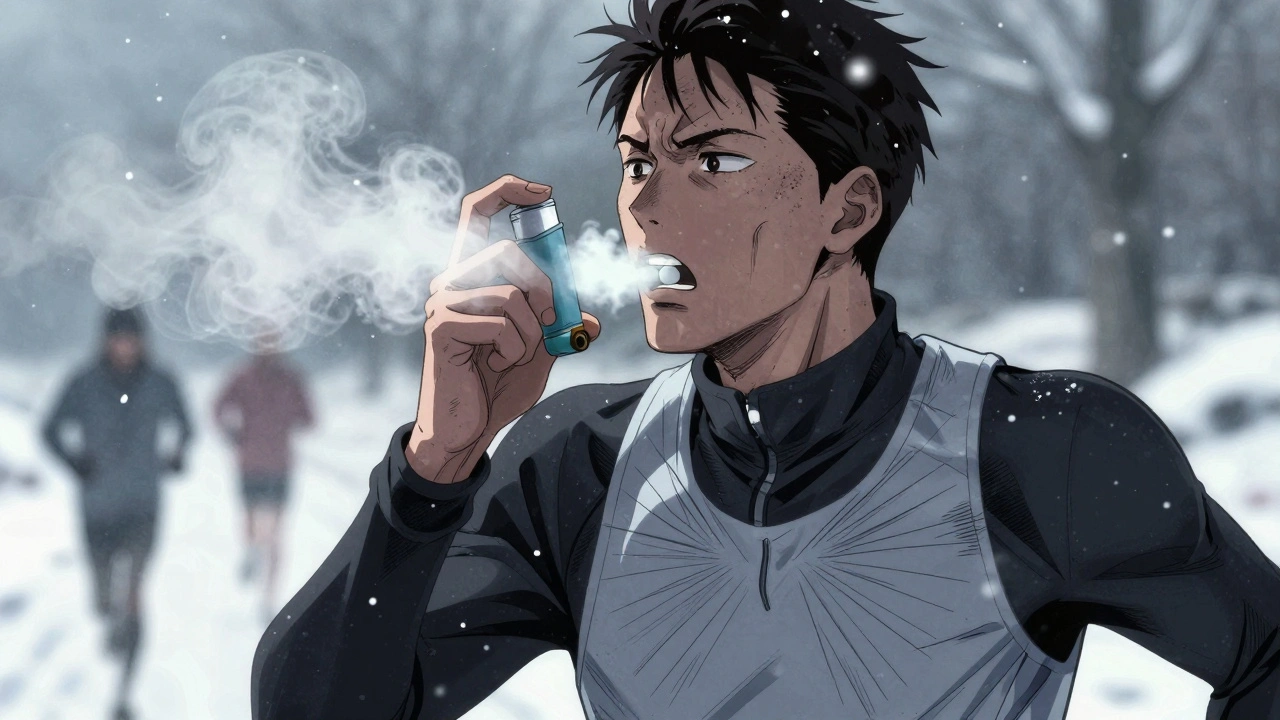
When you push yourself during a run, a game of soccer, or even a brisk walk in cold weather, and suddenly feel like you can’t catch your breath-itchy throat, tight chest, coughing-it’s not just being out of shape. It could be exercise-induced bronchoconstriction (EIB). This isn’t the same as chronic asthma, though many people with asthma have it. Even athletes with no other lung issues can get it. Up to 90% of people with asthma experience EIB, but it also affects 9-30% of the general population, including Olympic-level competitors. The good news? With the right steps, you can keep moving without fear.
What Happens in Your Airways During EIB?
When you exercise hard, you breathe faster and deeper. That means you’re pulling in more cold, dry air-especially if you’re outside in winter or in a dry climate. Your airways lose heat and moisture quickly. That triggers a chain reaction: cells in your airways release chemicals that cause the muscles around them to tighten. Your bronchial tubes narrow. That’s bronchoconstriction. It usually hits 5-20 minutes after you stop exercising and peaks around 30-60 minutes later. Symptoms include shortness of breath, wheezing, chest tightness, and coughing. You might feel like you’re breathing through a straw.
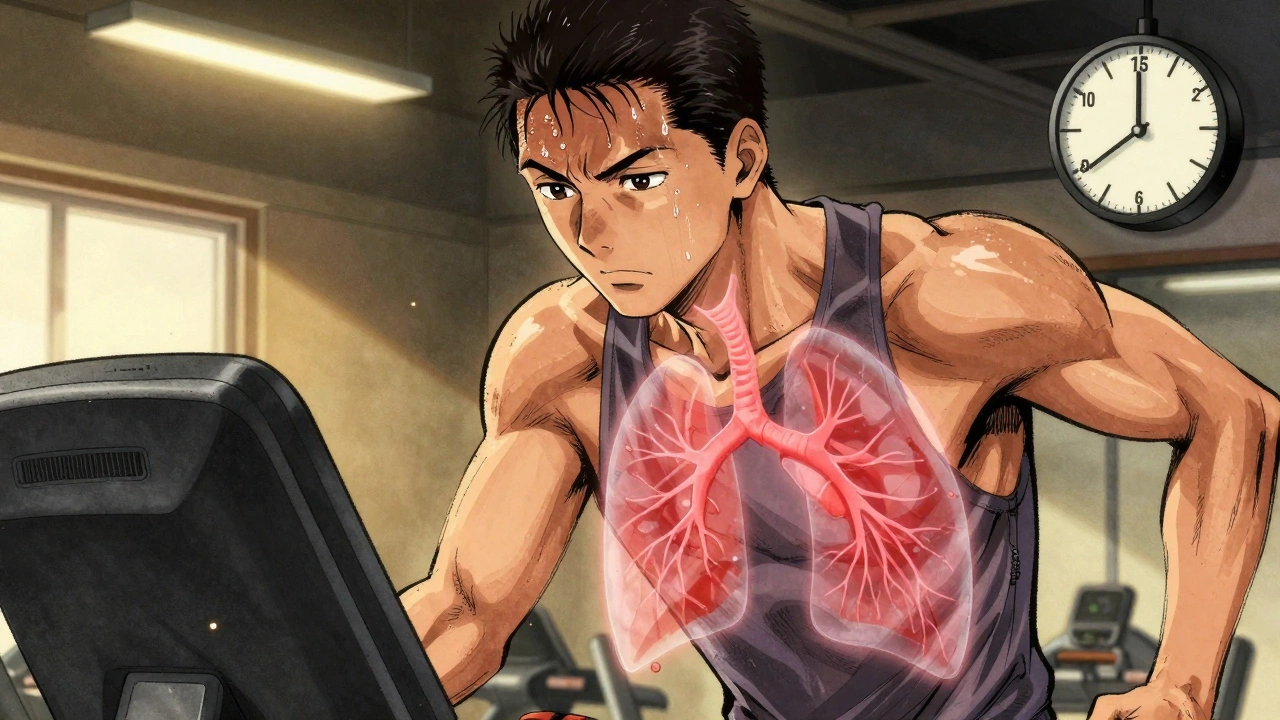
Doctors diagnose EIB with a simple test: you exercise on a treadmill or bike until your heart rate hits 80-90% of your max, then they measure how much air you can force out in one second (FEV1). If your FEV1 drops by 10% or more after exercise, you have EIB. Some clinics use the eucapnic voluntary hyperpnea (EVH) test, which mimics intense breathing without actual exercise. It’s more sensitive and often used for athletes.
Non-Drug Ways to Prevent Symptoms
Before you reach for your inhaler, try these proven, low-cost strategies. They work-especially when combined.
- Warm up properly. Do 10-15 minutes of moderate activity-like brisk walking or light cycling-before your main workout. Then take a 5-minute rest. This triggers something called the “refractory period,” where your airways become temporarily resistant to narrowing. That protection lasts up to two hours. It’s free, and it’s backed by solid science.
- Avoid cold, dry air. If the temperature is below 10°C (50°F) and humidity is under 40%, your risk of EIB jumps by 73%. Exercise indoors on those days. If you must go outside, cover your mouth and nose with a scarf or a heat-exchange mask. But don’t rely on those masks alone-they’re only about 42% effective, compared to 89% for albuterol.
- Choose your sport wisely. Sports with short bursts of effort-like baseball, football, wrestling, or sprinting-trigger EIB in only 22% of people. Endurance sports like cross-country skiing, ice hockey, or long-distance running? Up to 85% of athletes report symptoms. That doesn’t mean you can’t do them. It just means you need better preparation.
- Watch the air quality. Pollen counts above 9.7 grains/m³ or an air quality index over 50 can make EIB worse. Check local forecasts before heading out.
- Stay fit. Every 1-MET improvement in your cardiovascular fitness (VO2 max) reduces EIB severity by 12%. The better your overall fitness, the less your airways react.
How to Use Your Inhaler Correctly
For most people, a short-acting beta-2 agonist (SABA) like albuterol is the first-line treatment. It’s fast, effective, and safe when used correctly.
- When to use it. Take two puffs of albuterol (90 mcg per puff) 5-20 minutes before exercise. That’s the sweet spot. Too early, and it wears off. Too late, and it won’t work.
- How to use it. Shake the inhaler. Breathe out fully. Put it in your mouth. Press down and breathe in slowly and deeply. Then hold your breath for 10 seconds. That’s not optional. Holding your breath increases how much medicine reaches your lungs by 30%.
- Use a spacer. A spacer is a plastic tube that attaches to your inhaler. It holds the medicine so you can breathe it in slowly. Using one boosts lung delivery by 70% compared to using the inhaler alone. If you’re using it without a spacer, you’re probably getting less than half the benefit.
- Store it right. Keep your inhaler between 20-25°C. If it’s colder than 10°C, the propellant doesn’t work well. You might think you’re getting a full dose, but you’re not. That’s why your inhaler might feel like it’s “not working”-it’s not the medicine, it’s the temperature.
Studies show that 63% of EIB treatment failures happen because people don’t use their inhalers correctly-not because the drug doesn’t work. So even if you’re taking it on time, bad technique can ruin everything.
What If Your Inhaler Isn’t Enough?
About 35% of people still have symptoms even after using albuterol before exercise. That doesn’t mean you’re out of options. It means you might need to treat the inflammation underneath.
- Inhaled corticosteroids (ICS). If you have frequent symptoms, using a daily low-dose ICS-like fluticasone at 200-400 mcg-is the next step. It reduces symptoms by 50-60%. It’s not a rescue inhaler. You take it every day, even on days you don’t exercise.
- Leukotriene receptor antagonists (LTRAs). Montelukast (10 mg daily) helps about 30-40% of people. It’s a pill, not an inhaler. Good for people who forget to use inhalers or have trouble with technique.
- Combination therapy. Using both a SABA before exercise and a daily ICS cuts symptom frequency by 78%, compared to just 55% with SABA alone. That’s a big jump. This is especially common in competitive athletes.
- As-needed ICS-formoterol. New guidelines from GINA 2022 suggest using a combination inhaler (like budesonide-formoterol) only when needed-for both daily control and pre-exercise protection. But this is still debated in sports medicine. Many coaches and athletes still prefer the old albuterol-before-exercise method because it’s predictable.
Don’t ignore persistent symptoms. If you’re using your rescue inhaler more than twice a week outside of exercise, you might have underlying asthma that needs daily control. Over-relying on albuterol without treating inflammation can hide worsening disease in 15-20% of cases.
What About Diet and Supplements?
Some people swear by omega-3s or vitamin C. Here’s the truth: the evidence is weak, but not zero.
- Omega-3 fatty acids. Taking 2-4 grams daily for three weeks reduced the need for rescue inhalers by 31% in one study. It’s not a replacement, but it might help as a side support.
- Vitamin C. At 500 mg daily, it reduced EIB symptoms by 48% in people with low baseline levels. But if you’re already eating plenty of citrus, berries, or peppers, it won’t help much.
The Mayo Clinic says there’s not enough proof to recommend these routinely. But if you’re already taking them for other reasons, they’re unlikely to hurt. Don’t spend money on fancy supplements expecting miracles.

What’s New in EIB Management?
Technology is catching up. Smart inhalers now track when you use them and send data to your phone. Propeller Health’s device showed a 47% improvement in adherence in early trials. That’s huge-because if you don’t use your meds right, they won’t work.
Doctors are also starting to use fractional exhaled nitric oxide (FeNO) testing. If your FeNO level is above 25 ppb, you’re more likely to respond well to inhaled steroids. It’s not routine yet, but it’s coming.
The International Olympic Committee dropped restrictions on long-acting beta-agonists in 2022. Athletes can now use them without needing special permission. That’s a big shift from past years.
Don’t Stop Moving
The biggest danger with EIB isn’t the symptoms-it’s what people do to avoid them. A study found that 68% of undiagnosed people stop exercising because they’re scared of getting breathless. That leads to weight gain, lower fitness, and even social isolation. People with unmanaged EIB have 2.3 times higher obesity rates and 37% less cardiovascular fitness than those who manage it well.
But here’s the bottom line: with the right plan, 95% of people with EIB can do any sport they want. Run marathons. Play basketball. Ski downhill. Lift weights. You don’t need to give up. You just need to know how to protect your lungs.
Start with a warm-up. Use your inhaler correctly. Talk to your doctor if symptoms keep happening. Don’t assume it’s just “being out of shape.” It’s a real, treatable condition. And you deserve to breathe easy-no matter how hard you push yourself.
Is exercise-induced bronchoconstriction the same as asthma?
No. EIB is a temporary narrowing of the airways triggered only by physical activity. Many people with asthma have EIB, but you can have EIB without ever having asthma. It’s a physiological response to breathing cold, dry air during exercise-not a chronic lung disease.
Can I use my albuterol inhaler during exercise if I feel symptoms?
It’s not ideal. Albuterol works best when taken before exercise, not during. If you’re using it mid-workout, it means your prevention plan isn’t working. You might need a daily controller like an inhaled corticosteroid, or your technique may need fixing. Relying on rescue inhalers during exercise increases the risk of severe episodes.
Do I need a prescription for my EIB inhaler?
Yes. Short-acting beta-2 agonists like albuterol are prescription medications in most countries, including Australia. Even if you’ve used them before, you need a doctor to confirm EIB and prescribe the right dose and frequency. Never share inhalers or use someone else’s.
Why does my inhaler feel less effective in winter?
Cold temperatures make the propellant inside your inhaler less effective. If your inhaler is stored in a cold car, jacket pocket, or garage, it won’t spray properly. Keep it at room temperature (20-25°C). If it’s been cold, warm it in your hands for a minute before using.
How often should I replace my spacer?
Replace your spacer every 6 months. Plastic spacers get scratched and staticky over time, which traps medication inside instead of letting it reach your lungs. After 12 months, efficiency drops by 25%. Clean it monthly with soapy water-don’t scrub or dry with a towel, as that creates static.
Can kids outgrow exercise-induced bronchoconstriction?
Some children do, especially if their EIB was mild and tied to cold weather. But many don’t. The condition can persist into adulthood. The key is managing it early so kids don’t avoid sports. Undiagnosed EIB affects 41% of adolescents-many think they’re just “slow” or “out of shape.” Proper treatment lets them thrive in school sports and physical activities.
Sophia Lyateva
December 4, 2025 AT 21:59AARON HERNANDEZ ZAVALA
December 6, 2025 AT 13:26Lyn James
December 6, 2025 AT 17:20Craig Ballantyne
December 8, 2025 AT 07:33Victor T. Johnson
December 9, 2025 AT 23:52Nicholas Swiontek
December 11, 2025 AT 23:25Robert Asel
December 12, 2025 AT 15:40Ben Wood
December 13, 2025 AT 22:33Sakthi s
December 15, 2025 AT 03:01Abhi Yadav
December 15, 2025 AT 12:15Bethany Hosier
December 15, 2025 AT 23:23