
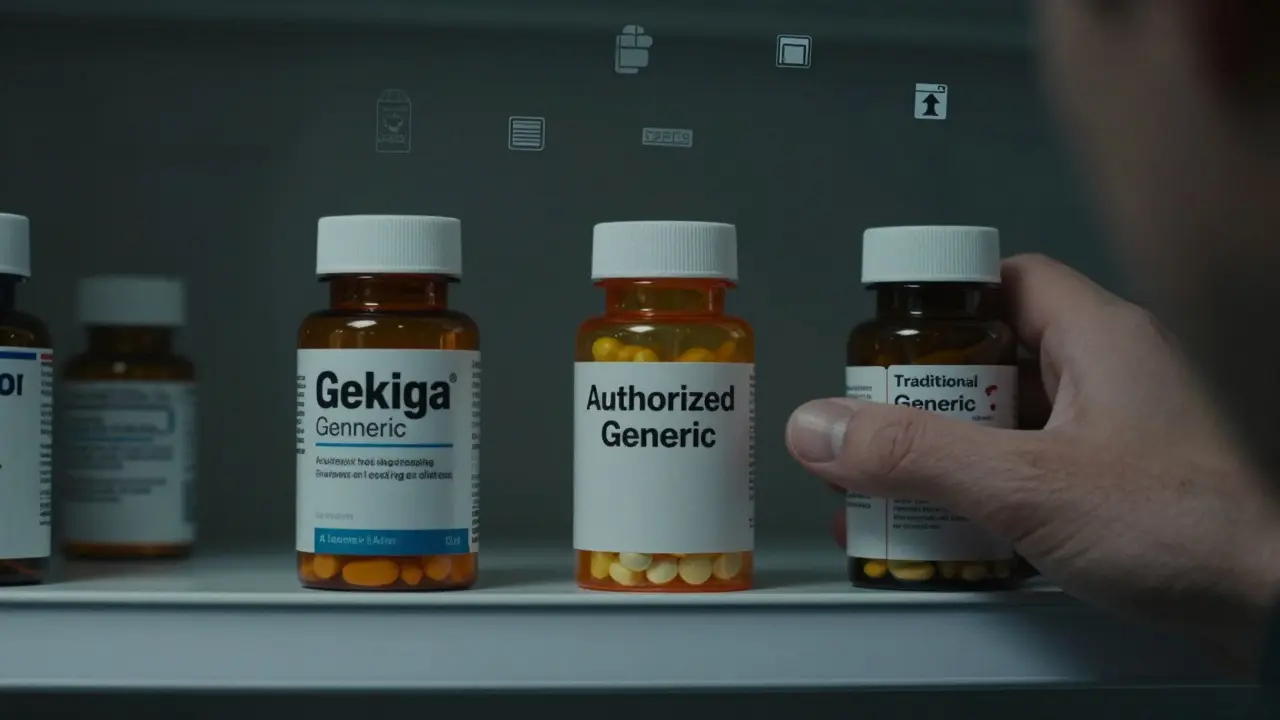
When you pick up a prescription, you might assume the generic version is just a cheaper copy of the brand-name drug. But here’s the truth: authorized generics aren’t available for most drugs - and that’s by design.
Authorized generics are the exact same pill, capsule, or injection as the brand-name drug, but sold under a different label and at a lower price. They’re made by the same company, in the same factory, with the same ingredients and quality controls. The only difference? No brand name on the box. And yet, only about 1 in 10 prescription drugs in the U.S. even has an authorized generic option.
Why? Because brand-name drug makers decide whether to offer them - and they rarely do unless it benefits their bottom line.
What Exactly Is an Authorized Generic?
An authorized generic isn’t a traditional generic. Traditional generics are made by other companies after the brand’s patent expires. They go through a long, expensive process called an ANDA (Abbreviated New Drug Application) to prove they work the same way. That can take years.
Authorized generics skip all that. They’re produced under the original brand’s New Drug Application (NDA). That means they’re identical in every way - same active ingredient, same fillers, same manufacturing line. Teva made its own authorized generic of Protonix using the same factory that made the brand version. Mylan made its EpiPen authorized generic on the same machines that made the branded auto-injector.
The FDA tracks them. As of late 2019, there were 1,215 authorized generics listed. That sounds like a lot - until you realize there are over 20,000 prescription drugs on the market. Less than 6% have this option.
Why Don’t More Drugs Have Authorized Generics?
It’s not about science. It’s about strategy.
Brand manufacturers only launch authorized generics when it helps them control the market. The most common reason? To block real generic competitors.
Here’s how it works: When a generic company files to launch a drug after patent expiry, they get 180 days of exclusive rights to be the first generic on the market. That’s a huge financial advantage - they can charge more than other generics during that window.
But if the brand company launches its own authorized generic during those 180 days, it crushes that exclusivity. The first generic’s sales drop by 40-52% during that time, according to the Federal Trade Commission. Retail prices fall 4-8%. Wholesale prices drop 7-14%. The generic company loses its advantage. And the brand company keeps market share.
That’s why you’ll see authorized generics pop up on drugs like Lyrica, EpiPen, and Protonix - all drugs with annual sales over $500 million. For drugs that make less than $100 million a year, only 22% of manufacturers even bother with authorized generics. Why waste the effort on a small market?
Who Benefits? Who Gets Left Out?
At first glance, authorized generics look like a win for patients. In 2019, AARP found people saved an average of $18.75 per prescription when an authorized generic was available. That’s real money.
But the savings are temporary. Once the 180-day exclusivity period ends, prices often rise again - not because the authorized generic disappears, but because no other generic companies are left to compete. The brand company has already scared off the challengers.
And here’s the catch: patients don’t know they’re getting an authorized generic. The packaging looks different. The label says something else. Pharmacists report a 27% increase in prescription errors when both brand and authorized generic versions are available. One patient might get the brand version. The next gets the authorized generic. The third gets a traditional generic - all chemically identical, but billed differently.
Doctors are confused too. A 2018 survey of 1,200 physicians found 63% said authorized generics made it harder to choose the right substitute. Patients on Medicare Part D reported 72% confusion when their “generic” suddenly changed packaging - and they didn’t know why.
The Bigger Problem: Killing Real Generic Competition
Authorized generics aren’t just a pricing trick. They’re a barrier to entry for independent generic manufacturers.
Imagine you’re a small generic company. You spend millions to develop a drug, file your ANDA, and wait years for approval. Then, just as you’re about to launch, the brand company drops its own version - identical to the original - at a lower price. You can’t compete. You lose your investment. Your company folds.
That’s not speculation. The FTC modeled this scenario. For a drug with $130 million in brand sales, a generic company would need at least a 10% chance of winning a patent lawsuit to justify the cost - if an authorized generic is coming. Without an authorized generic, they’d only need a 4% chance. That’s a 2.5x increase in risk.
Harvard’s Aaron Kesselheim wrote in Health Affairs that while authorized generics offer short-term savings, they “may hinder generic competition in the long run.”
That’s why groups like the Association for Accessible Medicines have spent years pushing Congress to ban them during the 180-day exclusivity window. Bills like H.R. 1270 and S. 147 have been reintroduced multiple times with bipartisan support - but they keep failing.
How the System Is Changing - Slowly
The FDA finally updated its system in January 2022 to list authorized generics quarterly instead of once a year. That’s progress - but it doesn’t fix the core problem.
The FTC is watching. In 2023, they filed a legal brief arguing that authorized generics during exclusivity periods unfairly reduce competition. They’re not calling for a ban, but they’re pushing for tighter rules.
Meanwhile, drug companies are getting smarter. In 78% of patent settlement deals between 2018 and 2022, brand companies promised not to launch an authorized generic - in exchange for the generic company dropping its challenge. These “no-AG” clauses are now standard. That means fewer authorized generics overall - but also fewer generic challengers.
It’s a cycle: fewer generics → less pressure on prices → less incentive for brand companies to launch authorized generics → even fewer generics.
What You Can Do
You can’t force a drug company to make an authorized generic. But you can take control of your prescriptions:
- Ask your pharmacist: “Is there a traditional generic available for this drug?”
- Check your insurance formulary. Sometimes the brand and authorized generic are coded differently - and one might be cheaper.
- If your prescription switches from brand to “generic” and the pill looks different, ask if it’s an authorized generic. It’s still the same drug, but you deserve to know.
- Use tools like GoodRx or SingleCare to compare prices across all versions - brand, authorized generic, and traditional generic.
Don’t assume “generic” means cheaper. Sometimes the authorized generic is the cheapest. Sometimes the traditional generic is. Sometimes the brand is on discount.
Knowledge is your best tool. The system is designed to confuse you. Don’t let it.
Why This Matters Beyond Your Prescription
This isn’t just about one drug. It’s about how the entire system works.
Drug pricing in the U.S. isn’t broken because of greedy companies - though some are. It’s broken because the rules let them play the game however they want. Authorized generics are a perfect example: legal, FDA-approved, and yet used to suppress competition.
When you pay more for a drug, you’re not just paying for the pill. You’re paying for the legal strategy, the patent delays, the market manipulation.
And until we demand transparency - and real competition - the only thing that changes is the label on the bottle.
Are authorized generics the same as regular generics?
Yes and no. Authorized generics are chemically identical to the brand-name drug - same manufacturer, same formula, same factory. Regular generics are made by other companies and must prove they work the same way through testing. Authorized generics skip that step because they’re made under the brand’s original approval.
Why aren’t authorized generics available for more drugs?
Because brand-name manufacturers only launch them when it helps them control the market. They’re most common for high-revenue drugs ($500M+ a year) and rarely used for cheaper medications. It’s a business decision, not a medical one.
Do authorized generics lower drug prices long-term?
Not usually. They create short-term savings - often during the first 180 days after a patent expires. But they also discourage other generic companies from entering the market. Once the authorized generic is in place, prices often stabilize or rise again because there’s no real competition left.
Can I ask my doctor to prescribe an authorized generic?
You can ask, but your doctor won’t know which version you’re getting. Authorized generics aren’t coded differently in prescriptions - they’re just another version of the same drug. The best move is to ask your pharmacist: “Is this an authorized generic or a traditional generic?”
Are authorized generics safe?
Yes. They’re made under the same FDA-approved conditions as the brand-name drug. The only difference is the label. If your brand drug is safe, so is its authorized generic. But confusion over packaging can lead to errors - so always check with your pharmacist if something looks different.
Is there a list of all authorized generics?
Yes. The FDA maintains a public list of authorized generics, updated quarterly since 2022. But it’s hard to navigate. The list includes the brand name, the authorized generic name, and the manufacturer - but doesn’t explain why some drugs have them and others don’t.
Jessie Ann Lambrecht
January 6, 2026 AT 15:05Okay but let’s be real - if you’re paying $400 for a pill that’s literally the same as the $12 generic, you’re not being ripped off, you’re being played by a system that treats healthcare like a poker game. I’ve had my meds switch from brand to authorized generic and back again like a slot machine. My pharmacist just shrugs. Knowledge is power, but damn if it doesn’t feel like a rigged game.
Anastasia Novak
January 7, 2026 AT 23:15Oh sweet mercy. Another ‘pharma evil’ sob story. Let me guess - you think if we just banned authorized generics, prices would magically drop? No. It’s not about ‘manipulation,’ it’s about ROI. Companies don’t launch these because they’re nice - they do it because it’s the *least* evil option. Without them, you’d get zero generics for years. The real villain? Patent law. Not the manufacturers.
Jonathan Larson
January 8, 2026 AT 12:12The ethical architecture of pharmaceutical pricing reveals a deeper tension between market efficiency and public health. Authorized generics, while legally permissible, function as a form of regulatory arbitrage - exploiting the very mechanisms designed to foster competition. The FDA’s transparency improvements are commendable, yet insufficient. What is required is a structural recalibration: perhaps mandatory disclosure protocols, or even a public patent buyout model that decouples innovation incentives from monopolistic control. This is not merely a pricing issue - it is a crisis of fiduciary trust in institutional governance.
Alex Danner
January 9, 2026 AT 21:27Authorized generics are the ultimate bait-and-switch. You think you’re getting a cheap generic, but it’s still the same company - just wearing a different hat. I used to trust ‘generic’ labels. Now I check the manufacturer code on the bottle. If it’s the same as the brand? That’s an authorized generic. And yeah, it’s cheaper - but only until the real generics get scared off. Then prices creep back up. It’s a trap.
Elen Pihlap
January 10, 2026 AT 08:09why do they even make different labels?? i just want my medicine to be cheap and not make me cry every time i open my bill
Katrina Morris
January 10, 2026 AT 10:39so like... if i get the same pill but different color and it says something else on it... is it still the same thing?? i just want to know if i'm getting ripped off or not lol
Rachel Steward
January 12, 2026 AT 08:24Let me break this down for the people still confused: authorized generics aren’t generics at all. They’re brand drugs with a fake label. The FDA doesn’t regulate this because it’s *technically* legal. But it’s a loophole so obvious even a toddler could see it. The only reason they exist is to scare off competitors. And yes, it’s a scam. No, Congress won’t fix it because they get campaign cash from Big Pharma. And yes, your pharmacist knows this. They just don’t care enough to tell you.
Sai Ganesh
January 12, 2026 AT 16:36In India, we don’t have this problem. Generics are everywhere and cheap because the law doesn’t allow brand companies to make their own copies. We have over 200 generic makers for one drug. Here, it feels like the system is designed to keep you guessing. I’ve seen this play out in my own family - my sister pays 10x more for the same pill just because the label says ‘Protonix’ instead of ‘pantoprazole.’ It’s not healthcare. It’s branding.
Andrew N
January 14, 2026 AT 02:12Everyone’s mad but nobody’s looking at the real issue: patents. If you want cheaper drugs, fix patent law. Stop letting companies extend them with tiny tweaks. Stop letting them pay generics to stay off the market. Stop letting them use authorized generics as a weapon. This isn’t about labels. It’s about power.
LALITA KUDIYA
January 14, 2026 AT 23:05so if the pill is the same why do they even do this?? like i get that they want money but why make it confusing?? 🤷♀️
Poppy Newman
January 16, 2026 AT 08:13So basically... pharma is playing chess while we’re playing checkers 😩💸
Aparna karwande
January 17, 2026 AT 17:01USA thinks it’s special but this is just another proof that your system is broken. In India, generics are regulated to be affordable and transparent. No fake labels. No tricks. No corporate theater. You pay for the medicine, not the marketing. If you want real change, stop blaming the companies - blame the system that lets them do this. Shame on you for accepting this as normal.