

Why Timing Matters When You're on Immunosuppressants
If you're taking medication to calm down your immune system-whether for rheumatoid arthritis, lupus, cancer, or an organ transplant-getting vaccinated isn't as simple as walking into a clinic and saying "give me the shot." The timing between your meds and your vaccines can make the difference between full protection and no protection at all. Some people wait months after stopping a drug like rituximab before getting a vaccine, only to catch shingles anyway. Others get their flu shot right before chemo and stay healthy for years. It’s not luck. It’s science.
Immunosuppressants don’t just reduce inflammation. They weaken your body’s ability to respond to vaccines. If you get a shot while your immune system is suppressed, your body might not build enough antibodies. That means you could think you’re protected, but you’re not. And if you delay the vaccine too long after stopping the drug, you’re left vulnerable during the waiting period. The goal isn’t just to avoid side effects-it’s to make sure the vaccine actually works.
When to Get Vaccinated Before Starting Immunosuppressants
The best time to get vaccinated is before you start taking immunosuppressants. That’s the golden rule. Most guidelines agree: get your shots at least 14 days before beginning treatment. The CDC recommends this window for all non-live vaccines, and it’s based on real data showing how long it takes your body to build a solid immune response.
But 14 days isn’t always enough. For stronger drugs like rituximab or cyclophosphamide, experts suggest waiting 2 to 4 weeks. Why? Because some vaccines, especially those for shingles or pneumococcus, need more time to trigger a strong reaction. If you’re about to start biologic therapy for arthritis, talk to your doctor about getting your vaccines done early-ideally, during a stable phase of your disease, not during a flare.
For people preparing for cancer treatment, timing matters even more. A 2023 study from Memorial Sloan Kettering found that patients who got their vaccines 3 to 4 weeks before chemo had antibody levels nearly double those who got them just 7 days before. That’s not a small difference-it’s the difference between needing a booster and needing to avoid crowds entirely.
What Happens After You Stop Taking Immunosuppressants?
Stopping your meds doesn’t mean you can run right out and get vaccinated. Your immune system needs time to recover. And that recovery time varies wildly depending on what you were taking.
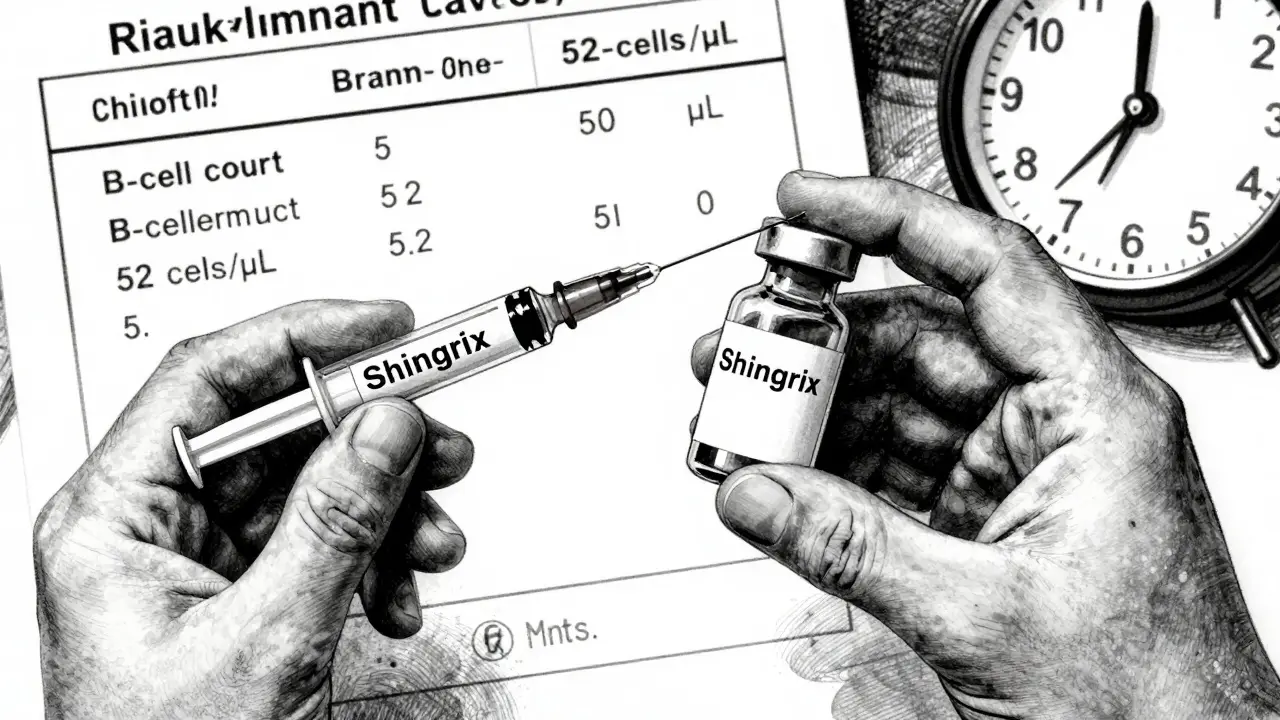
Take rituximab, for example. This drug wipes out B-cells-the very cells that make antibodies. After a single infusion, it can take 6 to 12 months for your body to rebuild them. The American College of Rheumatology says you should wait at least 6 months after your last rituximab dose before getting any vaccine except the flu shot. But the Infectious Diseases Society of America says 3 to 6 months is enough if your B-cell count is above 50 cells/μL. That’s a big gap. One doctor might say wait 6 months. Another might say test your blood and go ahead if your numbers look good.
For drugs like methotrexate or azathioprine, you don’t need to wait as long. In fact, some doctors recommend holding these for just 2 weeks after a flu shot. A 2022 clinical trial showed that patients who paused methotrexate for two weeks after their flu shot had a 27% higher chance of developing protective antibodies. That’s one of the clearest, most proven timing rules we have.
But here’s the catch: stopping your meds can cause your disease to flare. For someone with severe lupus, even a 2-week break could mean hospitalization. That’s why decisions aren’t made in a vacuum. Your doctor has to weigh the risk of a flare against the risk of getting sick from a preventable disease.
Which Vaccines Are Safe? Which Ones Are Risky?
Not all vaccines are created equal. There are two main types: live and non-live. Live vaccines use a weakened version of the virus to trigger immunity. Non-live vaccines use pieces of the virus or inactivated material.
For people on immunosuppressants, live vaccines are dangerous. That includes the old shingles vaccine (Zostavax), the nasal flu spray, and the MMR shot. These can actually cause infection in people with weak immune systems. The newer shingles vaccine, Shingrix, is non-live and safe-even for those on strong immunosuppressants. That’s why doctors now push Shingrix over Zostavax for everyone over 50, especially if they’re on meds like prednisone or TNF inhibitors.
For non-live vaccines-like the flu shot, COVID-19 mRNA shots, hepatitis B, and pneumococcal vaccines-timing is the only concern. You can get them while on most immunosuppressants, but the response will be weaker. That’s why some patients need extra doses. The CDC recommends a third dose of the COVID-19 vaccine for people on certain immunosuppressants, and a fourth if they’re still not protected.
IVIG therapy is a special case. If you’ve had high-dose IVIG (like 2 grams per kilogram), you need to wait 11 months before getting a live vaccine. Why? Because the antibodies in the IVIG can neutralize the vaccine before your body even has a chance to respond. That’s not a guess-it’s based on how long those antibodies stick around in your blood.
Why Do Guidelines Conflict? And What Should You Do?
You might notice that different doctors give you different advice. That’s because the guidelines aren’t all the same. The CDC says 14 days before. ASH says 2 to 4 weeks. ACR says hold methotrexate for 2 weeks after the flu shot. IDSA says wait 3 months after rituximab. EULAR in Europe says 7 to 10 days is fine.
These differences aren’t mistakes. They’re based on different studies, different patient populations, and different risk tolerances. A rheumatologist treating a 40-year-old with mild arthritis might be more willing to take a risk than an oncologist treating a 70-year-old with lymphoma. But here’s the real problem: most patients don’t know which guideline their doctor is following.
That’s why a 2023 survey found that 68% of rheumatologists struggle to apply the ACR guidelines consistently. Patients get confused. Some wait 6 months for a shingles shot, only to get shingles anyway. Others get vaccinated too soon and have no protection. The solution? Ask your doctor: "Which guidelines are you using? Can we check my immune markers?"
There’s a new tool making this easier. The University of California San Francisco developed a free online calculator that asks for your meds, your last dose, and your vaccine type-and gives you a personalized window. It cut timing errors by 68% in their clinic. If your doctor doesn’t use it, ask if they can.

What’s Changing in 2025 and Beyond
The future of vaccine timing isn’t about fixed dates. It’s about your body’s actual immune status.
The IDSA 2025 draft guidelines are already moving in this direction. Instead of saying "wait 6 months," they now say: "Check your B-cell count. If it’s above 50 cells/μL, you’re ready." That’s a game-changer. Some patients recover faster. Others take longer. Fixed timelines don’t fit everyone.
Researchers are now running trials like VAXIMMUNE, which is tracking 2,500 immunosuppressed patients to see if antibody levels, T-cell counts, and other biomarkers can predict the best time to vaccinate. Early results suggest we’ll soon have blood tests that tell you exactly when you’re ready-not just based on when you stopped a drug, but on how your immune system is recovering.
Even tech companies are jumping in. Epic Systems, the giant behind most hospital electronic records, is rolling out a vaccine timing module in 2025. It’ll automatically flag when a patient on rituximab is due for a vaccine, check their last dose date, and suggest the safest window based on the latest guidelines. No more manual calculations. No more missed windows.
For now, the best thing you can do is stay informed. Keep a list of every medication you’re on, including doses and dates. Ask your doctor: "When should I get my next vaccine?" and "What’s my plan if I need to delay it?" Don’t assume they know your full history. Bring your meds list to every appointment. And if you’ve waited months for a vaccine and still got sick-talk to someone. You’re not alone, and there are better ways to manage this.
Real Stories, Real Consequences
One patient in Melbourne, on methotrexate for psoriatic arthritis, got her flu shot 10 days before her next dose. She didn’t get the flu. Another, on rituximab for MS, waited 6 months for the shingles vaccine. She got shingles in month 5. Her doctor said it was unavoidable. She didn’t believe it.
On Reddit, someone wrote: "I waited 6 months after my last rituximab for the shingles shot. Got it. Got shingles anyway. My immune system was still shot." That’s not rare. Studies show up to 18% of patients on long-term B-cell depleting drugs still get vaccine-preventable illnesses during the waiting period.
But there are wins too. A cancer survivor in Sydney got her flu shot 3 weeks before chemo. She’s been flu-free for 3 years. Her oncologist used a calculator. She didn’t have to guess.
The takeaway? Timing isn’t just a recommendation. It’s a critical part of your treatment plan. Treat it like your medication schedule. Write it down. Ask questions. Push for clarity. Your immune system is counting on it.
Can I get vaccinated while taking methotrexate?
Yes, you can get most vaccines-including flu, COVID-19, and pneumococcal shots-while taking methotrexate. But research shows your body makes more antibodies if you pause methotrexate for two weeks after the shot. For non-live vaccines, this small break can boost protection by nearly 30%. Talk to your doctor about whether holding it temporarily is safe for your condition.
How long after rituximab should I wait for a vaccine?
For non-influenza vaccines like shingles or pneumococcal, wait at least 6 months after your last rituximab dose, according to the American College of Rheumatology. The Infectious Diseases Society of America says 3 to 6 months is acceptable if your B-cell count is above 50 cells/μL. For the flu shot, some experts say you can get it as early as 3 months after, especially during flu season. Blood tests to check your immune recovery are the best way to decide.
Are live vaccines ever safe for people on immunosuppressants?
Generally, no. Live vaccines like Zostavax (old shingles), MMR, and the nasal flu spray can cause infection in people with weakened immune systems. The newer Shingrix vaccine is non-live and safe. Always confirm with your doctor whether a vaccine is live or not. If you’re unsure, assume it’s risky until proven otherwise.
What if I need a vaccine but my disease is flaring?
If your condition is active, your doctor may delay vaccination to avoid triggering a worse flare. But that puts you at risk of infection. In these cases, the priority is balancing disease control with infection prevention. Some doctors will give vaccines during mild flares if the vaccine is critical-like a flu shot during an outbreak. Always discuss your specific situation. There’s no one-size-fits-all answer.
Do I need extra doses of vaccines if I’m immunosuppressed?
Yes. The CDC recommends an additional primary dose of the COVID-19 mRNA vaccine for most immunosuppressed people. You may also need a second booster, depending on your meds and immune response. For pneumococcal vaccines, you might need both PCV20 and PPSV23. Always ask your doctor if you’ve had all the doses you need. Many people think one shot is enough-but for you, it’s not.
Sami Sahil
February 2, 2026 AT 02:09franklin hillary
February 2, 2026 AT 22:56Ishmael brown
February 3, 2026 AT 23:27Jaden Green
February 4, 2026 AT 04:36Lu Gao
February 5, 2026 AT 07:31Angel Fitzpatrick
February 5, 2026 AT 09:09Melissa Melville
February 6, 2026 AT 17:03Bryan Coleman
February 8, 2026 AT 17:02Naresh L
February 8, 2026 AT 18:30Nancy Nino
February 10, 2026 AT 13:06June Richards
February 11, 2026 AT 15:28Aditya Gupta
February 13, 2026 AT 15:18