

Hyponatremia Risk Calculator
This tool estimates your risk of severe hyponatremia based on medications and health factors. Severe hyponatremia occurs when blood sodium falls below 120 mmol/L and can cause confusion, seizures, or coma. Results are for informational purposes only and should not replace professional medical advice.
When a drug meant to help you starts attacking your brain, it’s not just a side effect-it’s a medical emergency. Severe hyponatremia from medications doesn’t wait for a slow decline. It strikes fast: confusion, seizures, even coma-all triggered by something as simple as starting a new pill. This isn’t rare. In hospitals, nearly one in five cases of dangerously low sodium come from medications. And most of the time, it’s missed until it’s too late.
What Exactly Is Severe Hyponatremia?
Sodium keeps your body’s fluids balanced. When your blood sodium drops below 135 mmol/L, you have hyponatremia. But when it crashes past 120 mmol/L? That’s severe. At this level, your brain cells swell because water rushes in to balance the low sodium. And your brain doesn’t have room to expand. That’s when confusion turns to seizures, and seizures can turn to permanent brain damage-or death.
Medications cause this by messing with how your body manages water. The most common culprit? A condition called SIADH-where your body holds onto too much water instead of peeing it out. Drugs trigger SIADH in 14-19% of all cases. And the worst offenders? Diuretics, SSRIs, and certain seizure meds.
Which Medications Are the Biggest Risks?
Not all drugs carry the same danger. Some are far more likely to drop your sodium into the danger zone:
- Diuretics (like hydrochlorothiazide): Responsible for 28% of drug-induced cases. They make you pee-but sometimes too much sodium with it.
- SSRIs (sertraline, citalopram, fluoxetine): Cause 22% of cases. These antidepressants are among the most prescribed drugs in the world-and one in five patients on them don’t know about this risk.
- Carbamazepine and oxcarbazepine: Used for epilepsy and nerve pain. These carry the highest relative risk-over five times more likely than other drugs to cause hyponatremia.
- MAOIs, ACE inhibitors, NSAIDs: Less common, but still dangerous, especially in older adults.
- MDMA (Ecstasy): Not a prescription, but a major cause of acute, life-threatening hyponatremia in young people.
Here’s the scary part: 73% of severe cases happen within the first 30 days after starting the drug. That’s why the first month is the most dangerous window.
How Do You Know It’s Happening?
The symptoms don’t look like a typical drug side effect. They look like something else entirely:
- Confusion: Reported in 68% of severe cases. Patients say they feel "foggy," forget names, or can’t follow simple conversations.
- Headache and nausea: Often dismissed as "just a flu" or "stress." But if it starts within days of a new medication, it’s a red flag.
- Seizures: Occur in 22% of cases when sodium falls below 115 mmol/L. Grand mal seizures are common-and they’re often the first sign doctors see.
- Slurred speech, weakness, or loss of balance: These can be mistaken for early dementia or stroke.
On patient forums, you’ll see the same pattern: "My doctor said it was anxiety." "I thought I was getting the flu." "I was told it was just aging." Sixty-eight percent of cases are misdiagnosed at first. That’s not negligence-it’s ignorance. Most doctors aren’t trained to connect a new pill to brain swelling.

Who’s Most at Risk?
This isn’t random. Certain people are sitting ducks:
- People over 65: Make up 61% of severe cases. Their kidneys don’t regulate sodium as well. Their bodies hold onto water more easily.
- Women: Account for 57% of cases. Hormonal differences make them more sensitive to SIADH triggers.
- Those on multiple medications: Combining an SSRI with a diuretic? Risk jumps 3x. Adding an NSAID? Even higher.
- People with heart, kidney, or liver disease: Their bodies are already struggling to balance fluids.
One nurse on Reddit shared a case: A 72-year-old woman started sertraline for depression. Within 10 days, her sodium dropped from 138 to 118 mmol/L. Her doctor dismissed her headaches and nausea as "normal." Then she had a seizure. That’s not bad luck. That’s preventable.
How Is It Diagnosed and Treated?
If you suspect it, get a blood test-now. No waiting. No "let’s see how it goes." A simple serum sodium test can save your life.
Correction speed matters more than almost anything else. If you correct sodium too fast-more than 8 mmol/L in 24 hours-you can trigger osmotic demyelination syndrome. That’s when your brain cells lose their protective coating. It causes paralysis, locked-in syndrome, or death. It happens in 9% of cases where correction is rushed.
So doctors walk a tightrope: Fix it fast enough to stop seizures, but slow enough to avoid brain damage. The European Society says max 6 mmol/L per day. The American Society says 8-10 is okay if you’re watching closely. Either way, correction must happen in a hospital, with continuous monitoring.
There’s new hope: tolvaptan (Samsca), approved in late 2023. It blocks water retention without affecting sodium. In trials, it cut correction time by 34%. It’s not a first-line fix yet-but it’s changing the game.
Why Do So Many Cases Go Undetected?
Here’s the broken system:
- Only 63% of doctors follow FDA-recommended sodium monitoring for high-risk drugs.
- Academic hospitals check sodium within 7 days 82% of the time. Community clinics? Only 47%.
- Pharmacists are often the last line of defense. One patient said, "My pharmacist caught the interaction before I filled the prescription. My sister wasn’t so lucky."
The American Geriatrics Society says: Check sodium within 7 days of starting high-risk meds-especially in patients over 65. Then check again every 3-5 days for the first month. That’s it. That simple step could prevent 38% of severe cases.
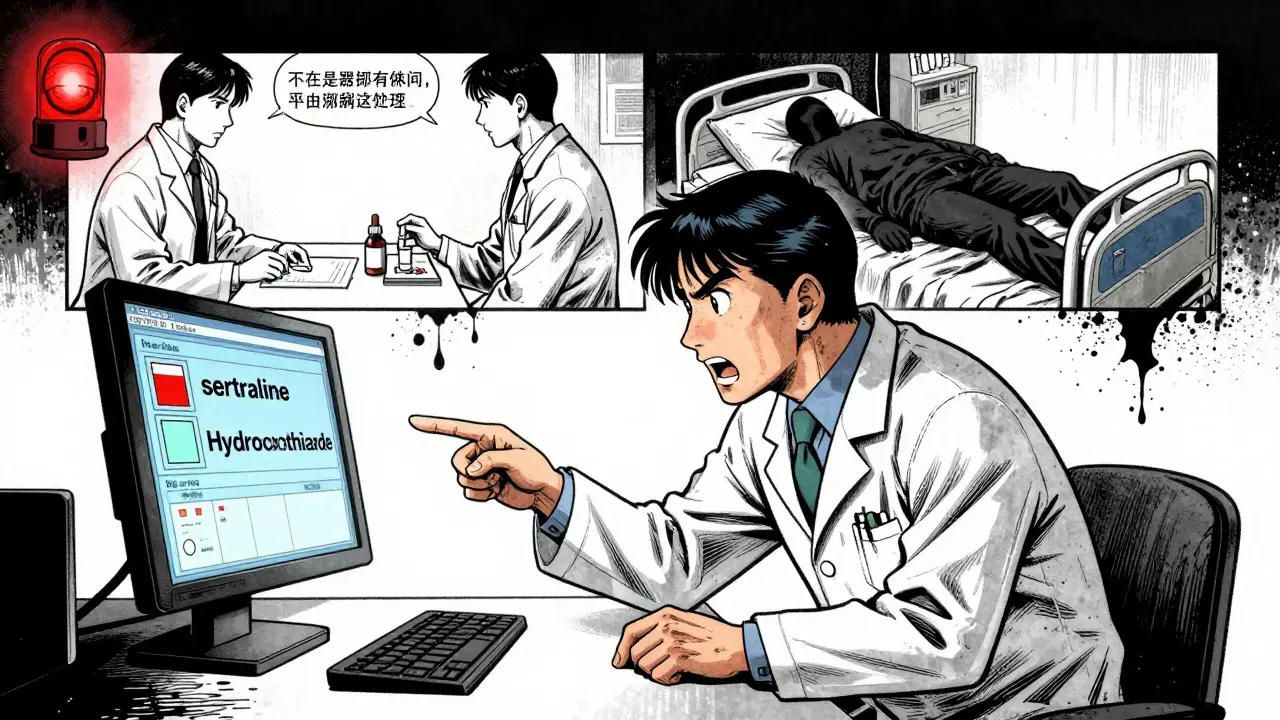
But no one mandates it. No insurance pays for routine sodium checks. No EHR system pops up a warning when a 70-year-old woman gets prescribed both hydrochlorothiazide and sertraline. That’s not an accident. It’s a gap in care.
What Can You Do?
If you or a loved one is starting one of these drugs:
- Ask your doctor: "Could this lower my sodium?" If they hesitate or say "it’s rare," ask for a baseline blood test before starting.
- Set a calendar alert: Get your sodium checked 7 days after starting the drug. Then again at 14 and 28 days.
- Know the red flags: Headache, nausea, confusion, dizziness, or weakness within days of starting a new pill? Don’t wait. Go to urgent care. Say: "I’m worried about hyponatremia. Can you check my sodium?"
- Tell your pharmacist. They’re trained to spot dangerous interactions. If they don’t warn you, ask why.
One patient wrote on Mayo’s portal: "I didn’t know sodium could be this dangerous. Now I check my labs every time I get a new prescription. I wish I’d known sooner."
The Bigger Picture
This isn’t just about one drug or one patient. It’s about a system that treats side effects as "normal" instead of warning signs. In 2023, medication-induced hyponatremia cost the U.S. healthcare system $473 million. That’s not just money-it’s lives lost, brain damage done, families shattered.
AI is starting to help. Mayo Clinic’s algorithm predicts hyponatremia risk 72 hours before symptoms appear-by analyzing EHR data. That’s not science fiction. It’s here. But tech alone won’t fix this. We need doctors who ask the right questions. Pharmacists who speak up. Patients who demand testing.
The window between confusion and seizures? As short as 6-8 hours. You don’t need to be a doctor to save a life. You just need to know the signs-and ask the question: "Could this be low sodium?"
pradnya paramita
February 4, 2026 AT 05:39Severe hyponatremia from SSRIs and diuretics is a well-documented iatrogenic phenomenon, particularly in geriatric populations with polypharmacy. The SIADH mechanism involves inappropriate vasopressin secretion, leading to free water retention and dilutional hyponatremia. Serial serum sodium monitoring within 72–96 hours of initiation is critical, per KDIGO and AGS guidelines. Failure to implement protocolized screening represents a systemic gap in pharmacovigilance, not individual negligence.
Jesse Naidoo
February 4, 2026 AT 16:21So you’re telling me my grandma’s antidepressant made her brain swell? I knew something was off when she started talking to the TV like it was her sister. But no one ever said it was the meds. They just said she was ‘getting old.’ Now I’m scared to take anything. What if my anxiety pill does the same thing?
Zachary French
February 5, 2026 AT 00:50Okay, so let me get this straight-Big Pharma is deliberately hiding that SSRIs turn your brain into a water balloon? And the FDA? They’re asleep at the wheel. I’ve been on citalopram for 3 years and my sodium’s been creeping down. I’ve got a spreadsheet. I’ve got emails to senators. I’ve got a TikTok account with 200k followers now. This isn’t just medicine-it’s a cover-up. Someone’s getting rich off brain-swelling old ladies. And guess who’s paying? YOU.
Daz Leonheart
February 5, 2026 AT 17:41Hey, I just wanted to say thank you for writing this. My mom went through this last year-started on hydrochlorothiazide and sertraline, got confused, fell, ended up in the ER. They didn’t even check her sodium until she was seizing. We’re lucky she’s okay. I’m telling everyone I know now. Please, if you’re on these meds, get tested. It’s not scary if you catch it early. You’ve got this.
Samuel Bradway
February 5, 2026 AT 20:07My aunt had this happen after starting carbamazepine. She thought she was just tired. Then she couldn’t walk. Took 48 hours for the hospital to test sodium. They thought it was a stroke. I wish I’d known sooner. Now I check my labs every time I get a new script. It’s not paranoia-it’s protection.
Caleb Sutton
February 7, 2026 AT 15:55This is all a lie. Sodium levels are manipulated by the CDC to justify more blood tests. The real cause? Fluoride in the water. They want you dependent on labs and meds. You think they care about your brain? They care about your insurance premiums. Tolvaptan? It’s a placebo with a fancy name. Don’t trust the system.
Jamillah Rodriguez
February 7, 2026 AT 20:42OMG I literally just started sertraline last week and have had this headache for 3 days… I’m going to the ER right now. 😱
Susheel Sharma
February 8, 2026 AT 04:34While the clinical data presented is statistically robust, the emotional framing borders on sensationalism. The 73% statistic refers to onset within 30 days-not necessarily causation. Furthermore, the omission of confounding variables such as dietary sodium intake and concurrent alcohol use undermines the rigor of the argument. A more balanced discourse is warranted.
Roshan Gudhe
February 8, 2026 AT 22:22It’s strange, isn’t it? We spend billions on AI to predict cancer, but we won’t spend $5 on a sodium test to prevent brain damage. We treat symptoms like mysteries, not signals. Maybe the real illness isn’t low sodium-it’s our refusal to listen to our bodies before they scream. We’ve outsourced our health to pills and algorithms. But the body still speaks. Are we still listening?
Rachel Kipps
February 9, 2026 AT 19:59I didn’t know this was so common. My doctor never mentioned it when I started my diuretic. I’ve been feeling off for weeks-headaches, dizziness. I’m going to ask for a blood test tomorrow. Thank you for the warning. I’ll share this with my mom’s care team.
Katherine Urbahn
February 11, 2026 AT 08:14Let me be perfectly clear: If you are a woman over 65 and you are taking an SSRI and a diuretic simultaneously-without a baseline sodium test-you are engaging in reckless self-endangerment. This is not a ‘maybe.’ This is not a ‘could be.’ This is a preventable medical catastrophe-and you are statistically more likely to be its victim. You have been warned. Now act accordingly.
Alex LaVey
February 12, 2026 AT 16:02Thank you for sharing this. In India, where I’m from, many elders are prescribed these meds without any monitoring. I’ve seen it firsthand. I’m going to translate this into Hindi and share it in my community. Knowledge is the first medicine. You’ve given us a tool to protect each other.
caroline hernandez
February 14, 2026 AT 07:44Per the 2023 European Hyponatremia Consensus Guidelines, serial sodium monitoring is classified as a Class I recommendation for patients initiating high-risk medications with age >65 or concomitant renal impairment. The absence of automated EHR alerts constitutes a failure of clinical decision support infrastructure. Institutions that fail to implement mandatory sodium checks within 72 hours of initiation are in violation of best practice standards. This is not optional-it is standard of care.