
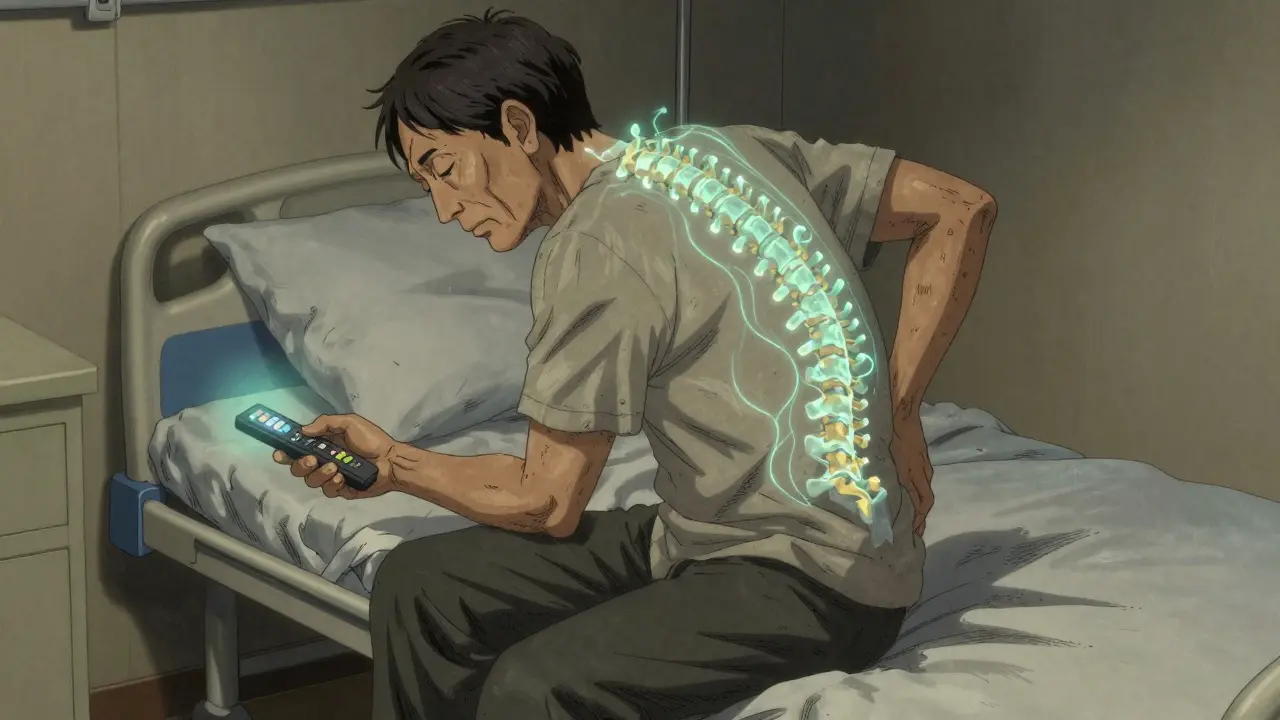
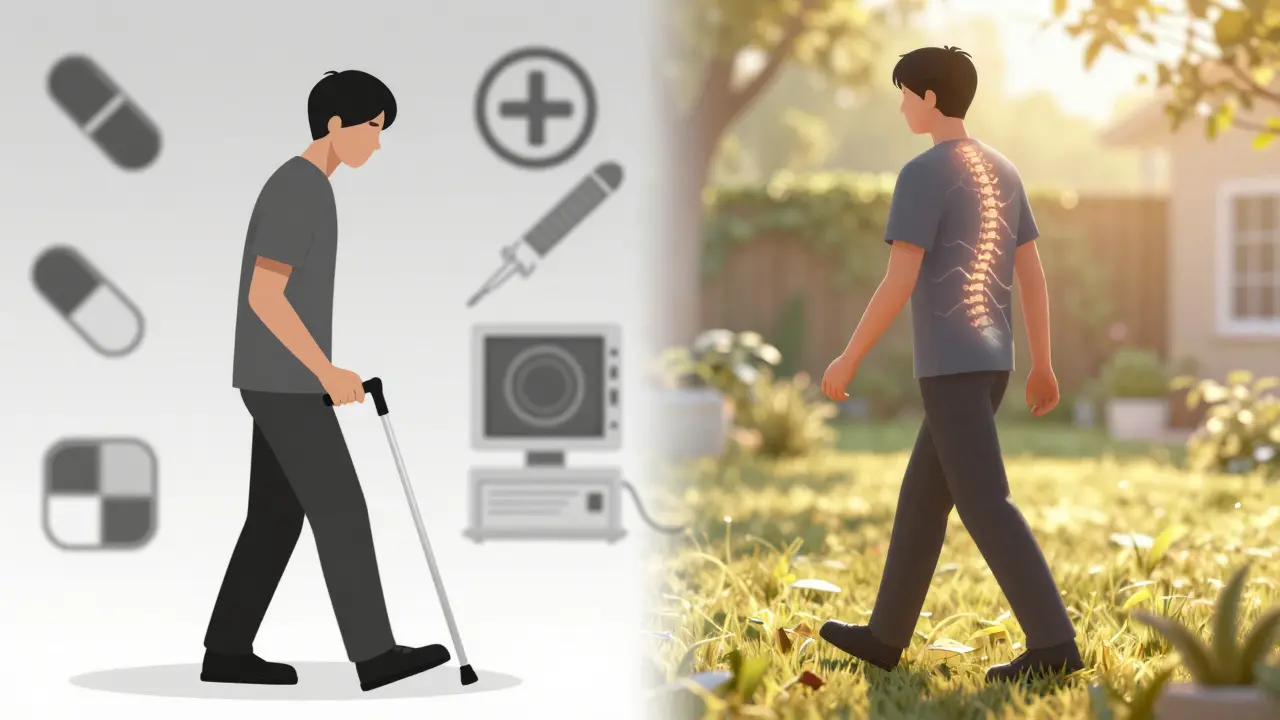
When your back or legs hurt every day, and pills, physical therapy, and injections haven’t helped, you start wondering if there’s anything left to try. For many people with chronic pain that won’t quit, spinal cord stimulation (SCS) becomes a real option-not a cure, but a way to take back control. It’s not for everyone. But for the right person, it can mean walking again without opioids, sleeping through the night, and finally feeling like yourself.
What Spinal Cord Stimulation Actually Does
Spinal cord stimulation isn’t magic. It doesn’t fix damaged nerves or heal a slipped disc. Instead, it interrupts the pain signals before they reach your brain. Tiny wires, called leads, are placed in the space around your spinal cord. These wires send mild electrical pulses that replace the feeling of pain with a gentle tingling-or, in newer systems, no sensation at all.
This technique started in 1967, but today’s devices are light-years ahead. Modern systems use three key settings: frequency (how often the pulses fire), amplitude (how strong they are), and pulse width (how long each pulse lasts). Traditional systems use 50 Hz, which creates a tingling feeling you can feel. But newer ones like Boston Scientific’s WaveWriter Alpha™ Prime or Medtronic’s Intellis™ can use frequencies up to 10,000 Hz. These don’t cause tingling. They just quiet the pain.
The two main types of current delivery are constant voltage and constant current. Studies show 68% of patients prefer constant current because it feels smoother and works better when your body’s resistance changes-like when you move or sweat.
Who Is a Good Candidate for SCS?
Not everyone with chronic pain qualifies. The best candidates have tried everything else first. That means months, sometimes years, of physical therapy, nerve blocks, medications, and maybe even surgery that didn’t work. Most people who get SCS have had pain for at least 12 to 24 months without relief.
The most common reasons doctors recommend SCS are:
- Failed back surgery syndrome (pain that sticks around after spine surgery)
- Complex regional pain syndrome (CRPS), especially in the legs or arms
- Chronic leg or back pain that hasn’t responded to other treatments
According to the International Neuromodulation Society, 52% of SCS patients have failed back surgery syndrome. Another 24% have CRPS. The rest have other nerve-related pain conditions.
But here’s the part no one talks about enough: your mental health matters as much as your spine. Patients with untreated depression or anxiety are 35% less likely to have good results. If you’re struggling emotionally, your doctor should refer you to a psychologist before you even consider the trial. It’s not about being “strong enough”-it’s about making sure your brain is ready to respond to the device.
The Trial: What to Expect Before the Implant
You don’t jump straight into surgery. First, there’s a trial. It’s a 5- to 7-day test run. Percutaneous leads are inserted through a needle under light sedation. They’re connected to an external device you carry on your belt or wear like a fanny pack. You go about your normal day-walking, sitting, lying down-and see if your pain drops by at least 50%.
If it does, you move forward. If it doesn’t, you stop. No implant. No big surgery. This step is critical. Studies show that skipping the trial leads to failure in over 40% of cases. That’s why top clinics won’t even schedule the permanent implant without a successful trial.
During the trial, you’ll log your pain levels, how much you move, and whether the stimulation feels right. Some people feel the tingling too strongly. Others don’t feel anything at all. That’s normal. Your doctor will adjust the settings until it clicks.
The Implant: What Happens During Surgery
If the trial works, the permanent system goes in. It’s an outpatient procedure that takes about an hour. The leads are placed in the epidural space-just like the trial-but now they’re secured with tiny anchors. Then, a small battery-powered pulse generator is placed under your skin, usually in your lower abdomen or upper buttock.
There are two kinds of generators: rechargeable and non-rechargeable. Non-rechargeable ones last 5 to 9 years. Rechargeable ones can last 10 to 25 years but need charging every few days. Boston Scientific’s WaveWriter Alpha™ Prime has a 24-month battery life and supports multiple stimulation patterns. Medtronic’s Intellis™ 2, released in early 2023, can adjust automatically when you stand up or lie down-no manual tweaking needed.
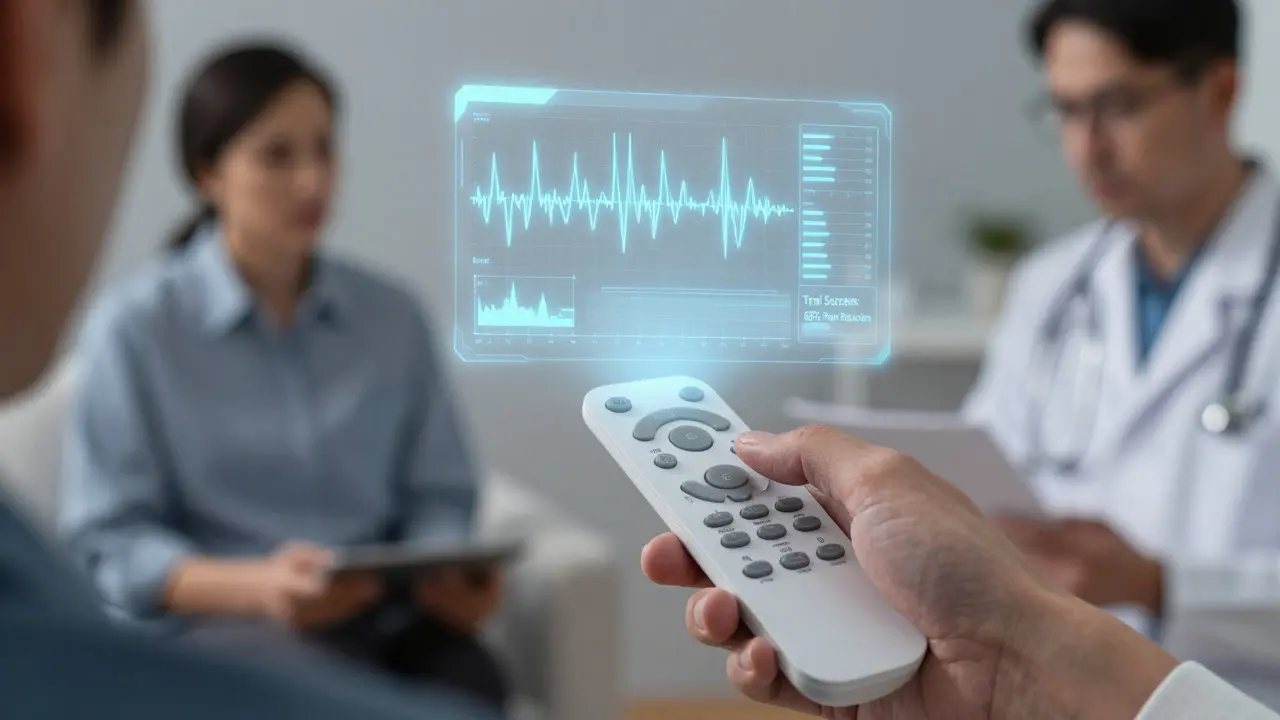
Recovery is quick. Most people are walking the same day. You’ll avoid heavy lifting for 4 to 6 weeks. But the real adjustment period is learning to use the device. About 89% of patients need at least one follow-up visit to fine-tune the settings. It takes 2 to 4 weeks to get comfortable with the remote control and understand how different activities affect your pain.
How It Compares to Other Pain Treatments
Let’s say you’re stuck between pills, TENS units, and surgery. Here’s how SCS stacks up:
- vs. Opioids: A 2021 JAMA study showed SCS patients cut their opioid use by 57% in a year and 63% by year two. They also had better pain relief-72% got over 50% reduction versus 41% with meds alone.
- vs. TENS: TENS units cost $50-$200 and are safe, but they don’t work for deep, chronic pain. SCS reaches nerves the TENS pads can’t touch.
- vs. Peripheral Nerve Stimulation: If your pain is only in your foot or hand, peripheral stimulation might be better. But if it’s in your lower back or radiating down your leg, SCS wins. Cleveland Clinic data shows 78% success with SCS for back pain versus 62% for peripheral.
But SCS isn’t perfect. About 18.7% of patients need a revision surgery within two years. The most common reasons? Lead migration (the wires shift), infection (3.8-7.2% of cases), or battery failure. On Reddit’s r/ChronicPain, 41% of negative reviews mention sudden pain return because the leads moved. That’s why you learn to recognize when your stimulation feels off-it could be a sign of movement.
Cost, Insurance, and Real-World Expenses
Medicare covers SCS for approved conditions like failed back surgery syndrome and CRPS. Private insurers usually follow suit. But coverage doesn’t mean free.
The total cost of the system-device, surgery, hospital stay-ranges from $25,000 to $45,000 in the U.S. Even with insurance, patients often pay $5,000 to $10,000 out of pocket. That’s a big hit. Some people delay the procedure because they can’t afford the deductible.
And it’s not just the implant. You’ll need follow-ups. Programming sessions. Maybe a battery replacement. Some patients report $800 monthly savings on pain meds after SCS, but that doesn’t help if you’re stuck with a $7,000 bill upfront.
Long-Term Results: Does It Last?
Here’s the hard truth: not everyone keeps getting relief for years. A 2022 meta-analysis found only 52% of patients still had meaningful pain relief after five years. That doesn’t mean the device stopped working-it means the brain adapts, or the pain changes.
At six months, 76% of patients report good results. At 36 months, that drops to 58%. That’s why experts now stress patient selection even more. It’s not enough to have bad back pain. You need to be physically and mentally ready for a long-term commitment.
Still, the real win isn’t always the number on a pain scale. On Healthgrades, 82% of 4+ star reviews say SCS helped them walk without opioids. 65% say they saved hundreds a month on meds. That’s quality of life. That’s getting back to your grandkids. That’s sleeping through the night.
What’s Next? The Future of Spinal Cord Stimulation
The field is moving fast. Boston Scientific’s Evoke® system, still in trials, uses closed-loop feedback-it senses your nerve activity and adjusts stimulation in real time. Early results show 83% of patients had meaningful relief at 12 months.
Devices are getting smarter. More precise. Longer-lasting. And with the opioid crisis still raging, SCS is gaining ground as a non-addictive, non-surgical alternative. The global market is expected to hit $4 billion by 2029.
But the biggest advancement isn’t the tech. It’s the mindset. Doctors are finally treating SCS like a tool for the right patient-not a last resort for everyone.
Is Spinal Cord Stimulation Right for You?
If you’ve been living with chronic pain for over a year, and nothing else has helped, SCS might be worth exploring. But here’s what you need to do:
- See a pain specialist who has experience with neuromodulation-not just a general pain clinic.
- Get a psychological screening. Depression and anxiety can sabotage results.
- Ask about the trial. Don’t skip it.
- Understand the costs. Talk to your insurance. Know your out-of-pocket.
- Talk to other patients. Reddit, Healthgrades, and patient forums are full of real stories-not marketing.
SCS won’t fix your spine. But for thousands of people, it’s the thing that finally lets them live again.
Is spinal cord stimulation the same as a pacemaker?
They work similarly-both use implanted devices that send electrical signals-but they target different systems. A pacemaker regulates your heart rhythm. Spinal cord stimulation targets nerve pathways in your spine to block pain signals. The device looks similar, but the programming, placement, and purpose are completely different.
Can I get an MRI with a spinal cord stimulator?
It depends on the device. Older models are not MRI-safe. Newer ones like Boston Scientific’s Precision Montage™ MRI and Medtronic’s Intellis™ are designed to be compatible with full-body 1.5T and 3.0T MRI machines. But you must always check with your doctor and the device manufacturer before scheduling an MRI. Never assume it’s safe.
Does spinal cord stimulation hurt after the implant?
The implant site may be sore for a few days, but the stimulation itself shouldn’t hurt. If you feel sharp pain, burning, or sudden changes in sensation, it could mean the leads have moved. Contact your doctor right away. Most patients report the stimulation feels like a gentle buzz or nothing at all-especially with newer high-frequency systems.
How long does the battery last?
Non-rechargeable batteries last 5 to 9 years. Rechargeable ones can last 10 to 25 years but need charging every few days-usually 30 minutes to an hour. Boston Scientific’s WaveWriter Alpha™ Prime has a 24-month battery life and is rechargeable. You’ll know when the battery is low because the device will alert you, and your pain control may start to fade.
Can I drive with a spinal cord stimulator?
Yes, but only after your doctor clears you. Most people can drive once they’ve recovered from surgery and are no longer on strong pain meds. However, you should avoid turning the device on while driving if it causes tingling that distracts you. Always follow your doctor’s advice and check local laws-some states have restrictions.
What if the spinal cord stimulator doesn’t work?
If the trial doesn’t reduce your pain by at least 50%, you won’t get the permanent implant. If you already have the device and it stops working, the first step is a programming adjustment. Sometimes, a simple tweak fixes it. If the leads have moved or broken, you may need a revision surgery. In rare cases, the device is removed. But most people who fail SCS didn’t meet the right criteria to begin with-especially if they skipped the trial or had untreated mental health issues.
Angel Tiestos lopez
January 12, 2026 AT 22:50Pankaj Singh
January 13, 2026 AT 18:28Scottie Baker
January 14, 2026 AT 08:49John Tran
January 16, 2026 AT 00:08Angel Molano
January 17, 2026 AT 19:11Milla Masliy
January 18, 2026 AT 05:44Avneet Singh
January 18, 2026 AT 13:41Nelly Oruko
January 20, 2026 AT 00:07vishnu priyanka
January 20, 2026 AT 15:57Trevor Davis
January 22, 2026 AT 10:46Anny Kaettano
January 23, 2026 AT 07:58Lance Nickie
January 25, 2026 AT 06:34sam abas
January 26, 2026 AT 05:54