
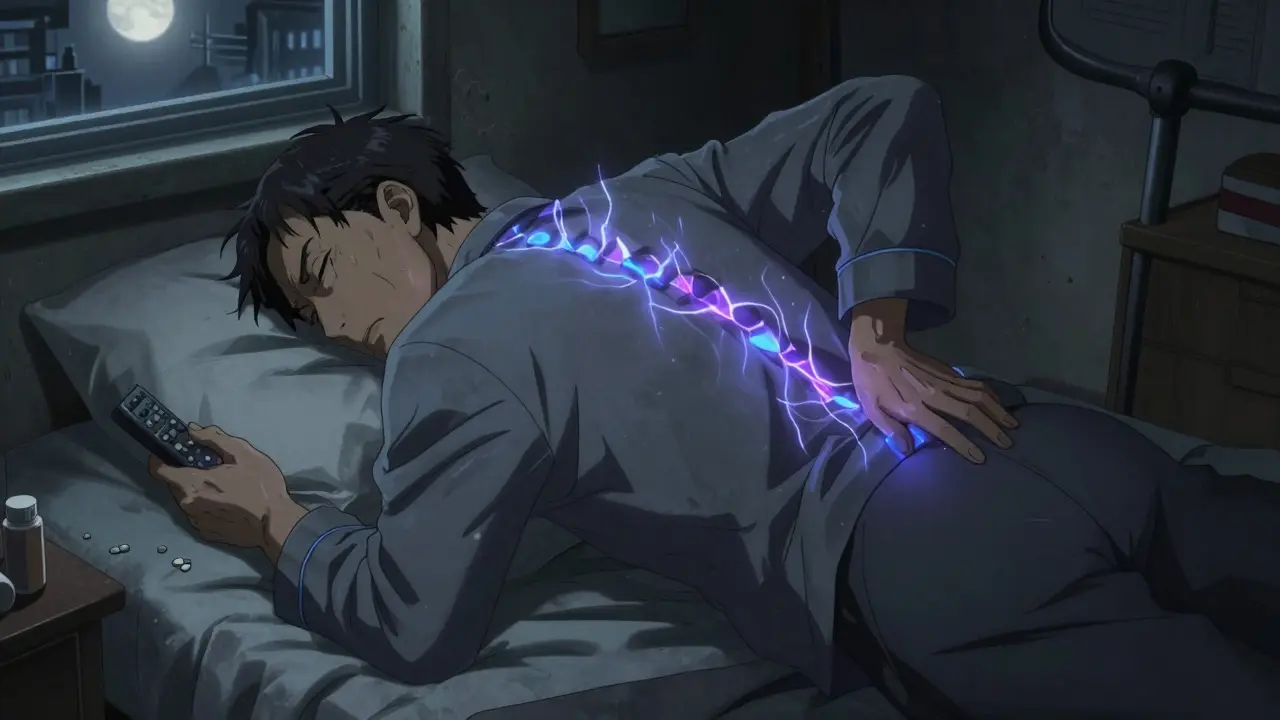
Chronic pain doesn’t just hurt-it steals your life. You can’t sleep. You can’t walk. You can’t work. And after years of pills, injections, and physical therapy, nothing seems to stick. That’s where spinal cord stimulation comes in. It’s not a cure, but for many, it’s the first real chance at getting back some control.
What Is Spinal Cord Stimulation?
Spinal cord stimulation (SCS) is a medical device that sends mild electrical pulses to your spinal cord. These pulses don’t fix the source of your pain-like a herniated disc or nerve damage-but they interrupt the pain signals before they reach your brain. Think of it like static on a radio: the signal is still there, but you can’t hear the music clearly anymore.
The idea isn’t new. Dr. C. Norman Shealy first tried it in 1967. Back then, electrodes went inside the spinal fluid. Today, thin wires (called leads) sit safely in the epidural space-just outside the spinal cord-and connect to a small battery pack implanted under your skin, usually near your hip or belly. Modern systems let you adjust the intensity, timing, and pattern of the pulses using a handheld remote.
There are three main types of stimulation:
- Tonic (traditional): 30-120 Hz pulses. You feel a tingling sensation (paresthesia) that covers your pain. Works well, but some people hate the buzz.
- High-frequency (10,000 Hz): No tingling at all. Just pain relief. Boston Scientific’s WaveWriter Alpha™ Prime uses this and gets 89% of users pain-free without paresthesia.
- Burst: Short bursts of five pulses, 40 times a second. Mimics how nerves naturally fire. Feels more natural to many patients.
Most systems now use constant current (CC) instead of constant voltage. Why? CC keeps the pulse steady even if your body’s resistance changes. In a 2019 Mayo Clinic study, 68% of patients preferred CC because it felt smoother and worked better.
Who Is a Good Candidate for SCS?
Not everyone qualifies. SCS isn’t for people who just want to avoid surgery or skip meds. It’s for those who’ve tried everything else-and lost.
Doctors look for four key things:
- Chronic pain lasting 12-24 months. If your pain is new, wait. Try physical therapy, meds, or injections first.
- Clear pain source. Failed back surgery syndrome, complex regional pain syndrome (CRPS), or persistent leg pain after spine surgery? These are the top reasons SCS works.
- Failed conservative treatments. You’ve done physical therapy, taken NSAIDs, tried nerve blocks, maybe even opioids. Nothing stuck.
- Positive trial response. Before implant, you get a temporary trial. Leads go in for 5-7 days. If your pain drops by 50% or more, you’re likely a good fit.
But here’s what most people miss: your mental health matters as much as your back.
Studies show patients with untreated depression or anxiety have a 35% lower chance of success. If you’re struggling emotionally, get help before the implant. Therapy, counseling, or even medication can make the difference between a life-changing device and a disappointing one.
How It Compares to Other Pain Treatments
Let’s be honest-SCS is expensive and invasive. So why choose it over cheaper, simpler options?
VS Opioids: A 2021 JAMA study tracked 2,181 chronic pain patients. Those with SCS cut their opioid use by 57% in a year and 63% by year two. Plus, 72% got over 50% pain relief. Only 41% did with meds alone.
VS TENS Units: A $100 TENS machine? Great for a sore shoulder. Useless for chronic back or leg pain. SCS works deeper, longer, and more reliably.
VS Peripheral Nerve Stimulation: If your pain is only in your foot or hand, peripheral stimulation might be better. But if it’s your lower back, hips, or radiating down your leg? SCS wins. Cleveland Clinic data shows 78% success for axial back pain with SCS vs. 62% for peripheral.
VS Surgery: Spinal fusion? Discectomy? These carry high risks-infection, failed fusion, adjacent segment disease. SCS is reversible. If it doesn’t work, you take it out. No permanent damage.

The Two-Step Process: Trial and Implant
Getting SCS isn’t a one-and-done deal. It’s a two-phase process.
Phase 1: The Trial
You’re sedated. A doctor inserts thin leads through a needle into your epidural space, guided by X-ray. The leads connect to an external battery you wear on a belt. You go home for 5-7 days. Use it. Track your pain. Can you walk? Sleep? Do chores? If your pain drops by half or more, you move forward.
Phase 2: Permanent Implant
If the trial works, you schedule surgery. It takes 60-90 minutes. The leads are secured. The battery (called an IPG) is placed under your skin-usually in your abdomen or buttock. You’re usually home the same day or next morning.
Recovery? A few days of rest. No heavy lifting for 6 weeks. You’ll need at least one programming session with your pain specialist. It takes 2-4 weeks to get used to adjusting the settings. Most people need help fine-tuning it.
What Can Go Wrong?
SCS isn’t risk-free. About 1 in 5 patients need a second surgery within two years. Here’s what happens most often:
- Lead migration: The wires shift. You feel pain in a new spot, or stimulation stops. Happens in 15-18% of cases. Reddit users call this the #1 complaint.
- Infection: 3.8-7.2% get infected. Sometimes the whole system has to come out.
- Battery replacement: Most batteries last 5-9 years. Replacing them means another surgery.
- Device failure: Rare, but it happens. A wire breaks. The battery dies early.
- Insurance hurdles: Even with Medicare coverage, you might pay $5,000-$10,000 out of pocket. Some insurers deny it unless you’ve tried every other option first.
And yes-some people just don’t respond. About 1 in 3 don’t get meaningful relief. That’s why the trial is non-negotiable. Never skip it.
Real People, Real Results
On Healthgrades, SCS has a 3.9/5 rating. On Reddit’s r/ChronicPain, people share both miracles and nightmares.
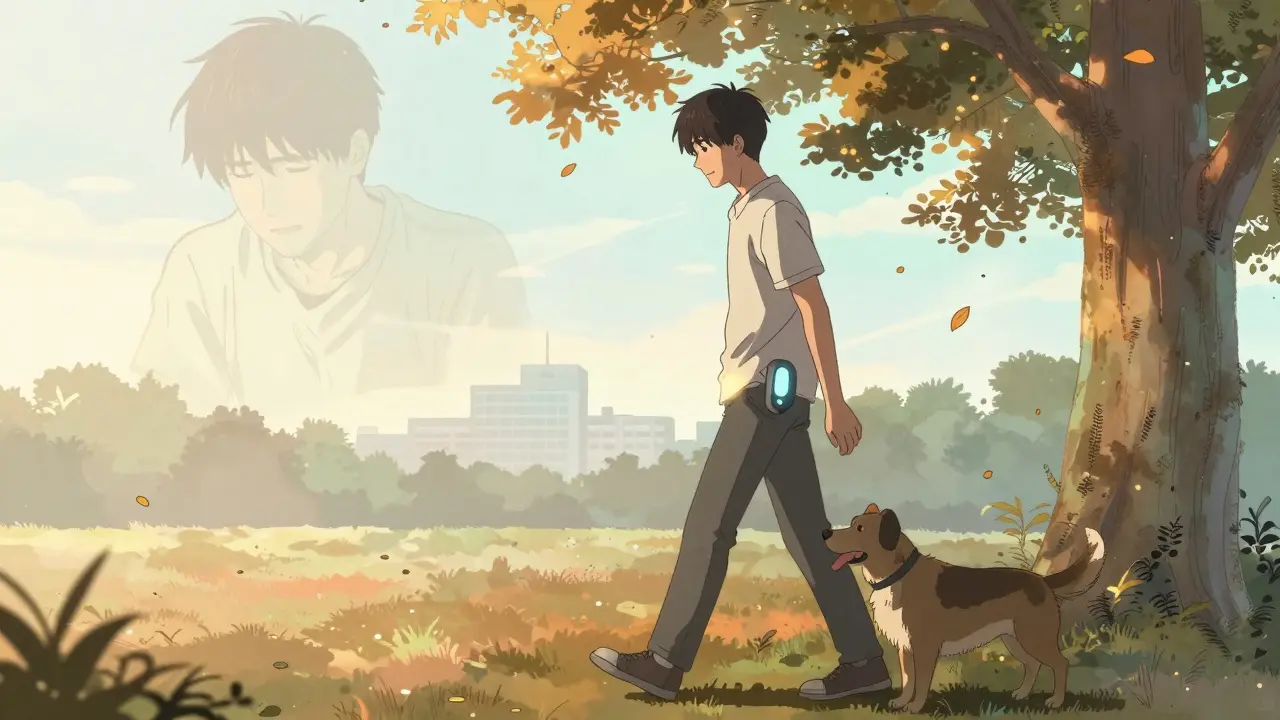
One user, ‘PainWarrior89’, had failed back surgery syndrome. After getting a Boston Scientific Spectra WaveWriter™ system, his pain dropped 78%. He could walk his dog again. But he needed two revision surgeries within 18 months because the leads moved.
Another told Healthgrades: “I went from 8 opioids a day to zero. I’m sleeping through the night. My kids say I’m back.”
But the same forum has posts like: “Stimulation cuts out randomly. I can’t trust it. Now I’m scared to leave the house.”
Success isn’t guaranteed. But for the right person? It’s life-changing.
What’s New in 2026?
The tech is getting smarter.
Medtronic’s Intellis™ 2 (launched Jan 2023) adjusts stimulation automatically when you stand up, sit down, or walk. No more fumbling with the remote.
Boston Scientific’s Evoke® system-still in trials-uses feedback from your nerves to adjust the pulse in real time. Early results? 83% of users had meaningful pain relief at 12 months.
And battery life? Up from 5 years to 8-9 years in newer models. That means fewer surgeries.
But the biggest advance isn’t the device-it’s the selection. Doctors now use psychological screening, pain mapping, and trial response data more rigorously than ever. That’s why success rates have climbed from 50% to 60-85% in the last decade.
Cost, Coverage, and What to Expect
Full system cost? $25,000-$45,000 in the U.S. That includes device, surgery, hospital stay, and follow-ups.
Medicare covers it for:
- Failed back surgery syndrome
- Complex regional pain syndrome (CRPS)
- Intractable low back and leg pain
Private insurers vary. Many require a 12-month trial of conservative care before approving SCS.
Even with coverage, you’ll likely pay $5,000-$10,000 out of pocket. That’s why some patients delay or drop out. But think about this: if you’re spending $800 a month on opioids, physical therapy, and doctor visits? SCS can pay for itself in under two years.
Final Thoughts
Spinal cord stimulation isn’t magic. It’s not for everyone. But if you’ve been told there’s nothing else you can do, it’s worth exploring.
It won’t fix your spine. It won’t erase your pain forever. But it can give you back the things you lost-sleep, movement, independence.
Start with a trial. Talk to your pain specialist. Get your mental health checked. Don’t rush. And if it works? You might just get your life back.
Angel Tiestos lopez
January 13, 2026 AT 08:37Pankaj Singh
January 14, 2026 AT 08:57Scottie Baker
January 16, 2026 AT 03:51John Tran
January 17, 2026 AT 16:40Angel Molano
January 18, 2026 AT 21:24Milla Masliy
January 19, 2026 AT 09:44Avneet Singh
January 19, 2026 AT 16:13Nelly Oruko
January 19, 2026 AT 21:15