
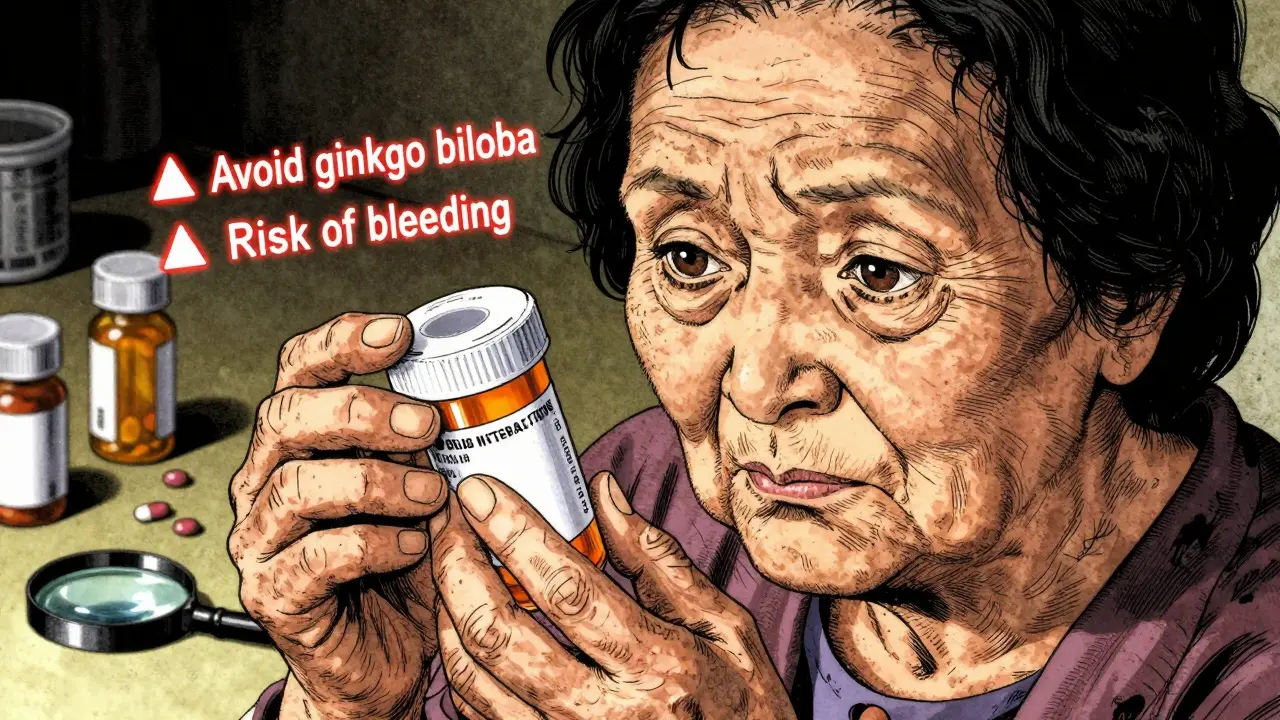
Every time you pick up a prescription, there’s a label on that bottle with critical information you might be ignoring. Not reading it could put your life at risk. According to the CDC, more than 100,000 people in the U.S. end up in the hospital every year because of drug interactions - and most of them were preventable. The answer isn’t just trusting your doctor or pharmacist. It’s learning how to read your own prescription label.
What’s on the label - and what you’re missing
Your prescription label isn’t just a reminder to take your pill. It’s a legal document with specific sections the FDA requires every pharmacy to include. The most important part for avoiding dangerous interactions is the Drug Interactions section, usually labeled as Section 7. This isn’t filler text. It’s the part that tells you what other drugs, supplements, or even foods could make your medication dangerous. For example, if you’re on warfarin (a blood thinner), the label might say: Avoid concomitant use with ginkgo biloba. Increased risk of bleeding. That’s not a suggestion. That’s a warning. And yet, a 2023 Harvard study found that 147 people were hospitalized for severe bleeding after taking ginkgo biloba with warfarin - because they didn’t realize the supplement was listed as a risk. Don’t skip the Warnings and Precautions section either. That’s where the FDA requires manufacturers to highlight the most serious interactions. Look for phrases like:- Avoid concomitant use with [drug name]
- Reduce dosage when used with [drug name]
- Monitor for [symptom] - contact your doctor immediately
OTC meds and supplements are just as dangerous
You might think only prescription drugs matter. But over-the-counter (OTC) medications and supplements are responsible for a huge portion of interactions. The BeMedWise Foundation found that 98% of OTC products list interaction warnings - but only 57% of people actually read them. Take ibuprofen. It’s fine for most people. But if you’re on a blood pressure medication like lisinopril, taking ibuprofen regularly can make your blood pressure worse - and damage your kidneys. The warning is right there on the OTC box: Do not use if you have high blood pressure or kidney disease. Supplements are even trickier. Many people don’t tell their doctor they’re taking fish oil, vitamin E, or St. John’s wort. But these can interfere with antidepressants, blood thinners, and even chemotherapy. In fact, 32% of serious drug interactions involve supplements - yet only 17% of prescription labels even mention them.How to actually read the label - step by step
Reading a label isn’t about skimming. It’s about checking for three things:- What’s the problem? Look for the drug name you’re taking and what else it interacts with.
- How bad is it? Words like “avoid,” “contraindicated,” or “life-threatening” mean high risk. “Use with caution” means monitor closely.
- What do you do? The label should tell you: stop taking it, reduce the dose, or call your doctor.
What to do when you’re on five or more medications
If you’re taking five or more drugs - which 67% of seniors do - your risk of interaction skyrockets. A CDC survey found that 68% of people on five or more meds couldn’t identify potential interactions from their labels alone. Here’s what works:- Make a complete list of everything you take: prescriptions, OTC drugs, vitamins, herbs, even CBD or melatonin.
- Bring that list to every doctor and pharmacist visit - not just your main doctor.
- When you pick up a new prescription, ask the pharmacist: “Does this interact with anything on my list?”
Don’t rely on apps - use them as a backup
Apps like Drugs.com are popular. They’re convenient. But they’re not a replacement. The FDA says prescription labels are the only legally required source with 100% coverage of your medications. Apps only cover 92% of prescription drugs and often miss supplement interactions. Use apps to double-check - not to replace. Enter every medication you take into the Drugs.com checker. But if the app says “no interactions,” and your label says “avoid,” trust the label. The label is based on clinical trials and FDA review. The app is a database.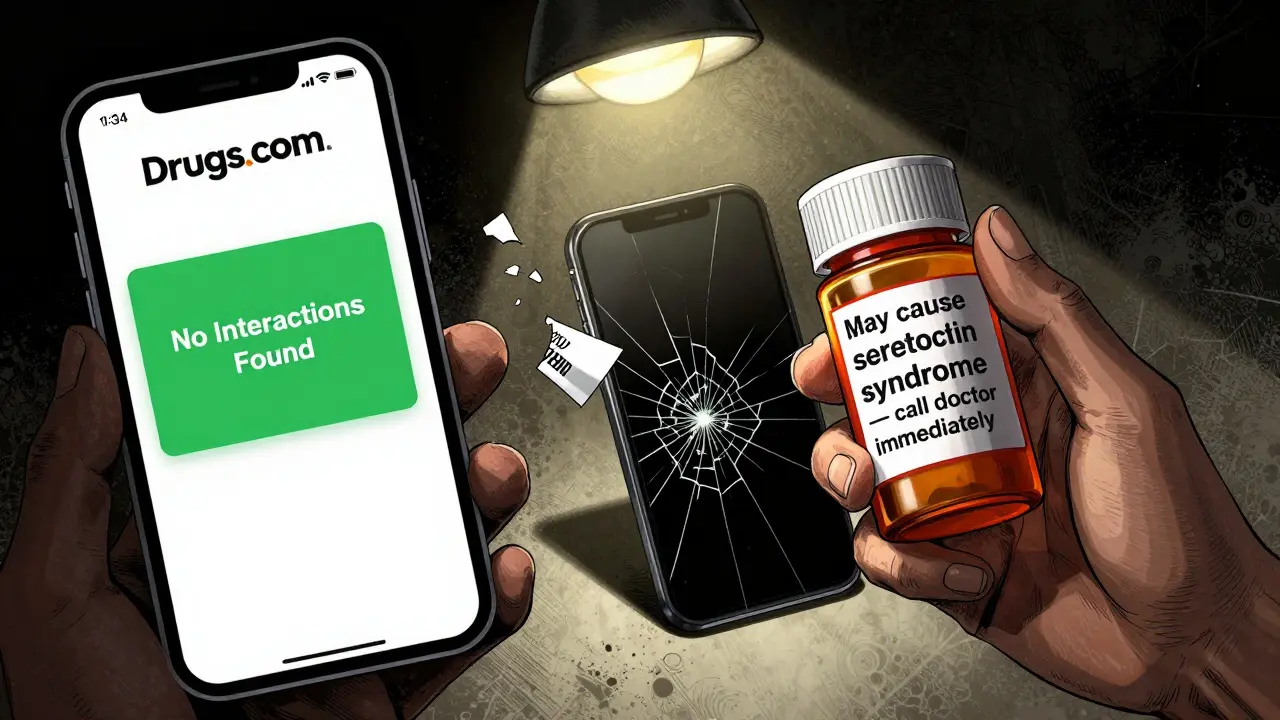
Special cases: kids, seniors, and language barriers
For children, dosing errors are the biggest danger. The CDC found that 67% of pediatric dosing mistakes happen because parents misread the label. The fix? Use the Check the Label method: read the label, follow directions, measure with the device that came with the medicine - never a kitchen spoon. Seniors face two problems: too many meds and hard-to-read labels. Many labels are printed in tiny font at a 10th-grade reading level - which is too high for 45 million American adults. If you can’t read it, ask for a large-print version. Pharmacies are required to provide it. If English isn’t your first language, ask for a translated label. Many pharmacies offer multilingual inserts. Or bring someone who speaks English to help you read it.The future: QR codes and smarter labels
The FDA is testing something new: QR codes on prescription bottles. By Q1 2025, 150 pharmacies across the U.S. will start putting them on bottles. Scan the code with your phone, and you’ll get a clear, plain-language summary of interactions, side effects, and what to do if something goes wrong. This is a big step. Right now, labels are written for doctors. In the future, they’ll be written for patients.What to do today
You don’t need to wait for better labels. Start now:- Take out every prescription and OTC bottle you have.
- Find the Drug Interactions section (or Warnings for OTC).
- Write down every drug, supplement, or food that’s listed as a risk.
- Ask your pharmacist: “Which of these are most dangerous?”
- Keep your list updated - and bring it to every appointment.
What should I do if my prescription label doesn’t mention an interaction I found online?
Always trust the label first. Online sources can be outdated or inaccurate. The FDA requires manufacturers to include only interactions backed by clinical data. If you’re unsure, call your pharmacist. They can check the official prescribing information and tell you if the online warning is legitimate.
Can I stop taking a drug if the label says to avoid it with something else?
Never stop a prescription medication without talking to your doctor. If the label says to avoid a combination, your doctor might adjust your dose, switch you to a different drug, or monitor you more closely. Stopping suddenly can be dangerous - especially for blood pressure, seizure, or mental health meds.
Why don’t labels mention all supplements?
Supplements aren’t regulated the same way as prescription drugs. Manufacturers don’t have to prove safety before selling them. That’s why only 17% of prescription labels mention herbal supplements - even though they cause 32% of serious interactions. The only way to protect yourself is to tell your doctor and pharmacist every supplement you take, even if it’s not on the label.
Are generic drugs safer than brand-name ones for interactions?
Yes and no. Generic drugs contain the same active ingredient as brand-name ones, so the interaction risks are identical. The label for a generic version of lisinopril will have the same interaction warnings as the brand-name version. The difference is only in the inactive ingredients - which rarely cause interactions. Don’t assume generics are safer - read the label the same way.
What if I can’t read the small print on my prescription label?
You have the right to ask for a large-print version. Pharmacies are required to provide it. You can also ask for a verbal explanation - write down what they say. Or use a magnifying glass or phone camera zoom. Don’t guess. If you can’t read it, you can’t stay safe.
lisa Bajram
January 11, 2026 AT 03:48OMG, I just checked my warfarin bottle and saw GINKGO BILBAO WARNING-I’ve been taking it for ‘heart health’ since 2020. YIKES. I’m calling my pharmacist tomorrow. This post literally saved me from a bleed-out. THANK YOU.
Also, side note: I now use a tiny sticky note on my pill organizer that says ‘READ THE LABEL OR DIE.’ It’s my new mantra.
Ted Conerly
January 13, 2026 AT 00:47This is exactly the kind of practical, life-saving info that gets buried under fluff online. I work in a pharmacy and see people ignore labels every single day. The FDA requires those warnings for a reason. Don’t be the person who says, ‘But my cousin took it with turmeric and he’s fine.’ Your cousin might be lucky. You might not be.
Faith Edwards
January 13, 2026 AT 22:13It is, frankly, an abysmal failure of public health literacy that individuals must be compelled to engage in the rudimentary act of reading legally mandated pharmaceutical disclosures. The fact that 98% of OTC products contain interaction warnings, yet less than 60% of consumers bother to parse them, speaks volumes about the erosion of intellectual discipline in contemporary society. One cannot outsource one’s survival to algorithms or physicians. The onus is on the individual to cultivate the discipline of textual scrutiny. I, for one, keep a laminated copy of the FDA’s labeling guidelines in my wallet.
Jay Amparo
January 14, 2026 AT 22:21As someone from India where people mix Ayurvedic herbs with Western meds all the time, I’ve seen too many friends end up in ERs because they thought ‘natural’ means ‘safe.’ I showed my aunt how to read her blood pressure med label-she was using ashwagandha and didn’t know it could spike her BP. Now she carries her list to every appointment. Small steps, big saves.
Thank you for writing this. It’s not just American advice-it’s global lifesaving info.
Lisa Cozad
January 15, 2026 AT 17:08Just wanted to add-I started using the ‘Check the Label’ method after my mom had a bad reaction to ibuprofen and lisinopril. Now I do it for my whole family. I even made a printable checklist. If anyone wants it, DM me. Free. No ads. Just saving lives one label at a time.
Saumya Roy Chaudhuri
January 16, 2026 AT 20:45Oh please. You think reading labels is enough? Most people can’t even pronounce ‘concomitant.’ And let’s be real-pharmacies print labels in font sizes meant for owls with cataracts. The real problem is the system. The FDA doesn’t enforce readability standards. The labels are designed to protect the manufacturers, not the patients. You want to prevent interactions? Make labels readable. Make pharmacists spend 10 minutes explaining them. Not just slap a warning on a 6pt font and call it a day.
anthony martinez
January 17, 2026 AT 16:07So let me get this straight. You’re telling me I should spend three minutes reading a label instead of scrolling TikTok? Wow. What a revolutionary concept. Next you’ll tell me to floss. I’m sure the CDC will give me a medal.
Mario Bros
January 18, 2026 AT 03:37Bro, I used to skip the label until my buddy went to the hospital after mixing Adderall and pre-workout. Now I read every single line-even the tiny ones. I even screenshot the interactions and save them in a folder called ‘DON’T DIE.’
Also, QR codes are coming? YES. I’m ready. 🙌
Jake Nunez
January 18, 2026 AT 23:56My grandma in Texas didn’t speak English well and just trusted the pharmacist. She ended up on blood thinners with garlic supplements-no one told her it was risky. She’s fine now, but it took three ER visits. If you’re not fluent, ask for help. Don’t pretend you understand. Your life isn’t a game of charades.
Michael Marchio
January 20, 2026 AT 05:31It’s fascinating how the public continues to treat pharmaceutical warnings as optional reading material, as if they were the fine print on a warranty for a toaster. The fact that 32% of serious drug interactions involve unregulated supplements-a category that operates with zero pre-market safety testing-should be a national scandal, not a casual footnote in a Reddit post. One wonders whether the erosion of medical literacy is a symptom of broader cultural decline, or merely its inevitable consequence. The FDA’s QR code initiative, while welcome, is a Band-Aid on a hemorrhage. What we need is mandatory patient education modules tied to prescription refills, enforced by law, with penalties for pharmacies that fail to comply. Until then, we are all just gambling with our biology, one unlabeled pill at a time.
Dwayne Dickson
January 21, 2026 AT 08:25Let me offer a more nuanced perspective: while the label is legally binding, it is not always clinically exhaustive. Pharmacists have access to the full prescribing information (PI) database, which includes interactions not listed on the label due to space or regulatory thresholds. For polypharmacy patients, relying solely on the bottle is akin to navigating a highway using only a single mile marker. The label is the minimum. The PI is the map. Always ask for the PI summary. I’ve seen interactions missed on labels that were flagged in the PI. Don’t stop at the bottle. Ask for the full dossier.
Ian Cheung
January 21, 2026 AT 09:35I used to think supplements were harmless until I got a panic attack after taking St. John’s wort with my antidepressant. No one told me. The label didn’t say a word. Now I list every single thing I take-even melatonin-and I hand it to every doctor. I’ve saved two friends already. Don’t be shy. Your life isn’t a secret.
Bradford Beardall
January 22, 2026 AT 20:36Wait-so if I scan a QR code and it says ‘avoid ginkgo,’ but my supplement bottle says ‘natural brain booster,’ who do I believe? The FDA or the guy who made the bottle? This is why I’m confused. Why aren’t supplements regulated like drugs? Why do we even have this mess?
Ritwik Bose
January 23, 2026 AT 20:08Thank you for this thoughtful and essential guide. 🙏 In my country, many people assume that if a medicine is prescribed, it is automatically safe with everything else. I have shared this with my elderly uncle who takes seven medications. He now carries a printed copy of his list to every visit. Small change, profound impact. Let us continue to educate with kindness and clarity.