
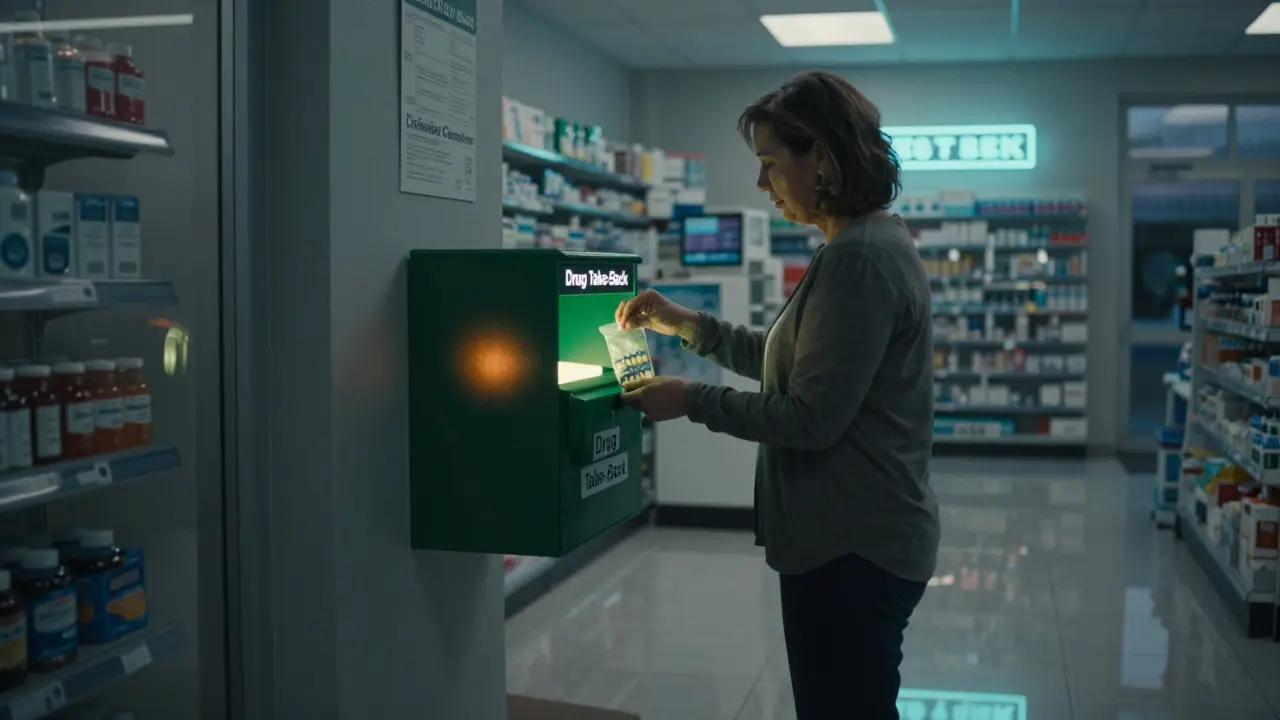
Every year, millions of unused or expired medications sit in bathroom cabinets, kitchen drawers, and medicine chests across the country. Some people flush them down the toilet. Others throw them in the trash. Both methods are risky-and neither is necessary. There’s a safer, smarter way: drug take-back programs.
What Exactly Are Drug Take-Back Programs?
Drug take-back programs are official, government-approved ways to drop off unused, expired, or unwanted medications so they can be destroyed safely. These programs exist because flushing or tossing pills can poison water supplies, harm wildlife, and make drugs available to kids, teens, or people who shouldn’t have them. The DEA launched the first National Prescription Drug Take Back Day in 2010, and since then, more than 19.8 million pounds of medications have been collected and destroyed.Today, these programs aren’t just one-day events. There are now over 16,500 permanent drop-off locations across the U.S.-mostly in pharmacies, hospitals, and police stations. These sites accept medications year-round, making it easy to dispose of pills when you’re ready, not just during an annual event.
What Can You Drop Off?
Not everything goes in the drop-box. The rules are clear, and they’re designed to keep everyone safe.You can safely leave:
- Prescription pills and liquids
- Over-the-counter medicines like ibuprofen or cold syrup
- Patch medications (like fentanyl or nicotine patches)
- Topical ointments and creams
- Vitamins and supplements
- Pet medications
But don’t bring:
- Asthma inhalers or other aerosols
- Thermometers (especially mercury ones)
- Hydrogen peroxide
- Iodine-based medicines
- Alcohol or liquids in glass bottles
- Illicit drugs like heroin or cocaine
Why the restrictions? Some items can explode under heat, leak chemicals, or interfere with the incineration process. Even if it seems harmless, if it’s not on the approved list, leave it out.
How to Prepare Your Medications
You don’t need to empty bottles or sort pills by type. Just follow these simple steps:- Keep medications in their original containers if you can. The labels help staff identify what’s inside.
- If the container is missing, put pills in a sealed plastic bag or empty pill bottle.
- Remove or black out your name, address, and prescription number with a marker. You’re protecting your privacy-not hiding the drugs.
- Don’t mix different pills in one container. Keep them separate if possible.
- Don’t remove pills from blister packs. Just drop the whole pack in.
That’s it. No need to crush, dissolve, or mix with coffee grounds. That’s only for at-home disposal when no drop-off site is nearby-and even then, it’s a last resort.
Where to Find a Drop-Off Location
The easiest way to find a location near you is to visit the DEA’s official website. They maintain a real-time, searchable map of all 16,500+ authorized collection sites. Just enter your zip code, and it shows you the nearest pharmacies, hospitals, or police stations that accept medications.Major pharmacy chains are big players in this space. Walgreens alone has over 1,600 drop-boxes in 49 states. CVS, Rite Aid, and Kroger pharmacies also offer them in most locations. Many local police departments have secure drop boxes in their lobbies-often with extended hours, including weekends.
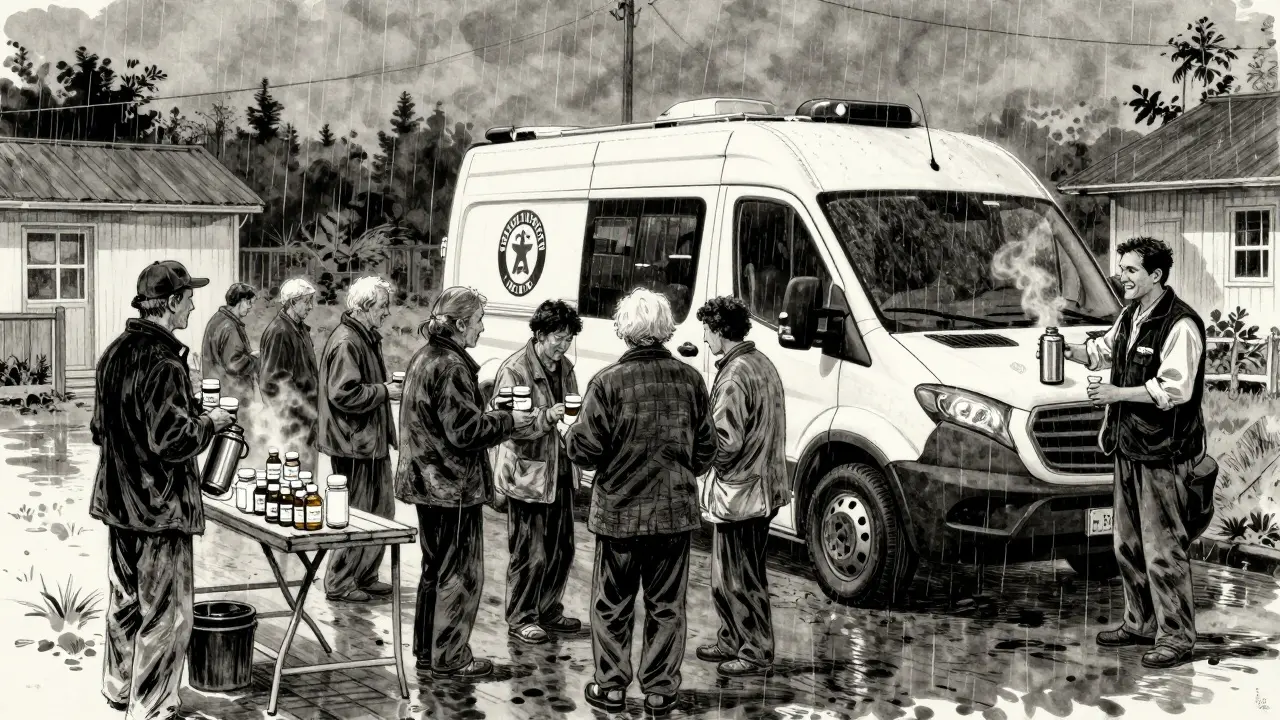
If you live in a rural area, options may be limited. Only 63% of rural communities have a permanent drop-off site, compared to 89% of urban ones. That’s why some places, like Broward County in Florida, use mobile units that visit libraries, community centers, and senior housing. Ask your local health department if they run a mobile collection program.
Mail-Back Programs: A Convenient Alternative
If you can’t get to a drop-off site, mail-back programs are a solid option. You order a pre-paid, tamper-proof envelope from your pharmacy or local health agency. Put your meds inside, seal it, and drop it in any mailbox. The envelope goes straight to a DEA-authorized facility for incineration.The catch? These aren’t free everywhere. Some states offer them at no cost. Others charge $5-$10. And availability is uneven-rural residents are less likely to have access than urban ones. Still, for people without cars, elderly individuals, or those with mobility issues, it’s often the only realistic choice.
There’s even legislation under consideration to require Medicare Part D plans to cover the cost of these envelopes. If passed, it could make mail-backs free for 48 million seniors.
Why Permanent Drop Boxes Beat One-Day Events
National Take Back Day happens twice a year-in April and October. It’s a big deal. In April 2025 alone, nearly 4,500 sites collected over 620,000 pounds of medication.But permanent drop boxes are more effective. Communities with year-round access see 25% higher participation. Why? Because people don’t wait. They dispose of old meds right away-before they pile up, before kids find them, before someone steals them.
There’s another reason permanent sites win: trust. When police stations are the only drop-off point, some people avoid them out of fear or discomfort. Studies show participation drops 32% in those areas. Pharmacies? No stigma. No questions asked. Just a quiet box in the lobby. And participation jumps 41%.
What Happens to the Medications After You Drop Them Off?
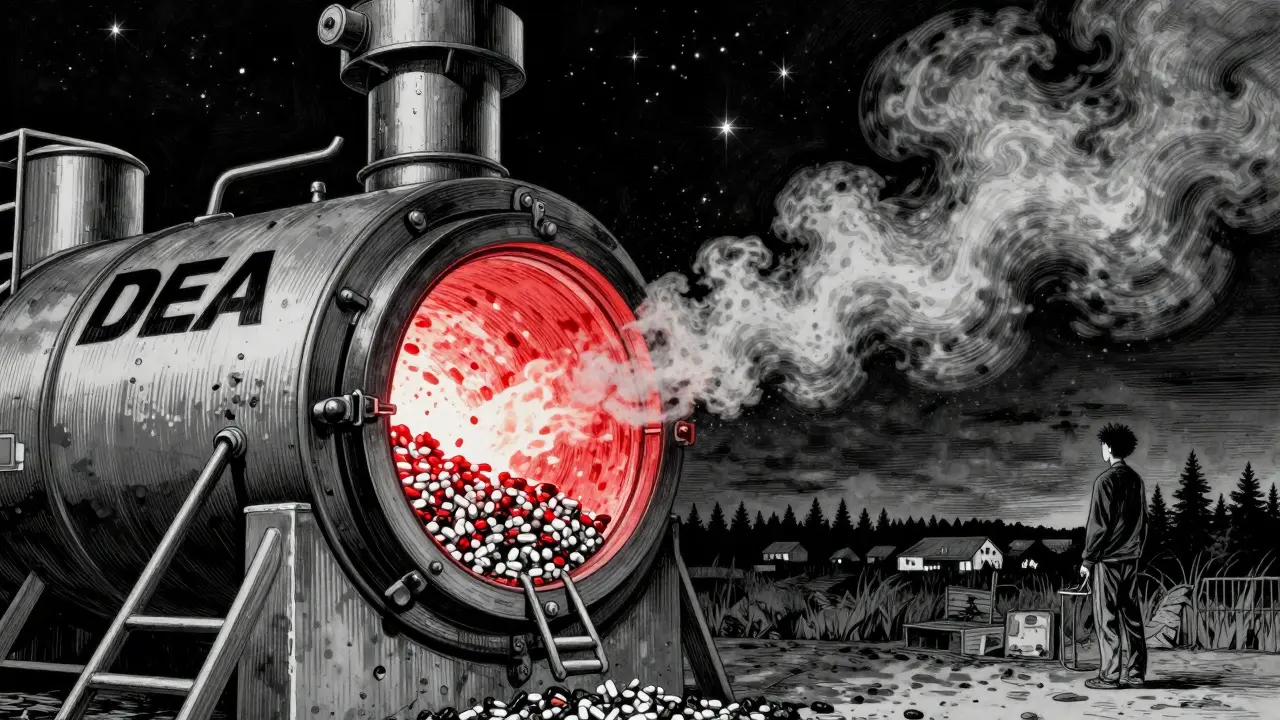
Once collected, the drugs are shipped to specialized incineration facilities. These aren’t regular trash burners. They’re high-temperature, EPA-certified systems that destroy pharmaceuticals completely-leaving no toxic residue. The ash is then disposed of in secure landfills.This process prevents drugs from entering waterways, soil, or the food chain. Flushing meds contributes to pharmaceutical pollution in rivers and lakes. Incineration doesn’t.
It’s also the only way to ensure drugs don’t get diverted. A single stolen opioid pill can lead to addiction-or death. Take-back programs eliminate that risk.
What If There’s No Program Near You?
If you’re in a remote area with no drop-off sites or mail-back options, the FDA gives specific at-home disposal instructions:- Remove pills from their original containers.
- Crush tablets or open capsules.
- Mix them with something unappetizing-used coffee grounds, kitty litter, or dirt.
- Put the mixture in a sealed plastic bag or container.
- Throw it in the trash.
Never flush unless the FDA explicitly says to. Only about 15 medications-mostly powerful opioids like fentanyl patches-are safe to flush because of their high abuse potential. You can find the full list on the FDA’s website.
Even then, take-back is still better. At-home disposal is messy, risky, and not environmentally ideal. Use it only when nothing else is available.
Why These Programs Matter
Drug take-back programs aren’t just about cleaning out your medicine cabinet. They’re a public health tool.Over 100,000 Americans die each year from drug overdoses. Many start with pills taken from a family member’s cabinet. Studies show communities with take-back programs see a 17% drop in accidental poisonings and a 19% reduction in teen prescription drug misuse within three years.
The EPA says these programs are the only truly safe and environmentally sound way to dispose of medications. The FDA agrees. So do doctors, pharmacists, and law enforcement.
They’re not perfect. Rural access is still too low. Funding is tight-many programs struggle with $18,500 per site in annual costs. And many people still don’t know they exist. Only 28% of Americans know about year-round drop-off options.
But they’re working. And they’re getting better.
What’s Next for Drug Take-Back Programs?
The future is moving toward integration. Instead of standalone drop boxes, we’re seeing them built into pharmacies, clinics, and even vending machines in hospitals. Some states are testing automated kiosks that accept meds and print a receipt.There’s also talk of linking take-back programs to electronic prescriptions. Imagine: when your doctor e-prescribes a new medication, you get a reminder to return old ones. Simple. Smart. Effective.
For now, the best thing you can do is use what’s already available. Check your local pharmacy. Call your police station. Visit the DEA’s website. Take a few minutes to clear out your medicine cabinet.
It’s not just about cleaning up old pills. It’s about protecting your family, your community, and the environment.
Can I drop off expired vitamins and supplements?
Yes. Vitamins, minerals, and dietary supplements are accepted at all DEA-authorized take-back locations. You can drop them off in their original bottles or sealed containers. Just remove or black out your personal information before dropping them in.
Do I need to bring ID to drop off medications?
No. You don’t need to show ID, sign anything, or explain why you’re dropping off meds. The process is anonymous. The goal is to make it easy and stigma-free so more people participate.
Are drug take-back programs free?
Yes. All DEA-authorized drop-off locations, including pharmacies and police stations, offer free disposal. Mail-back envelopes may cost $5-$10 if not provided by your state or pharmacy, but in-person drop-offs are always free.
Can I drop off insulin or other injectables?
Yes, but with a caveat. You can drop off unused insulin pens, prefilled syringes, or vials-just make sure they’re capped and stored safely. Don’t bring loose needles or sharps. Those require special medical waste handling. If you’re unsure, call the location first.
What about pet medications?
Yes, pet medications are accepted. Whether it’s flea treatment, antibiotics, or pain meds for your dog or cat, you can drop them off the same way you would human prescriptions. Just keep them in their original containers and remove personal info.
Is it safe to throw away meds in the trash if I can’t find a drop-off?
It’s not ideal, but it’s better than flushing. Mix crushed pills with kitty litter or coffee grounds, seal them in a plastic bag, and put them in the trash. Never leave pills loose in the bin. This reduces the chance someone-or a pet-will find and ingest them.
How often do drug take-back events happen?
The DEA holds two National Prescription Drug Take Back Days each year-in April and October. But permanent drop-off locations are open every day of the year. You don’t have to wait for an event.
Can I drop off controlled substances like opioids?
Yes. All controlled substances-including oxycodone, hydrocodone, fentanyl patches, and Adderall-are accepted at authorized take-back locations. These programs are specifically designed to safely collect and destroy high-risk medications.
Jason Xin
January 31, 2026 AT 07:49Used to flush my old pain meds until I learned about these programs. Now I just toss them in the drop box at my local CVS. No big deal, no guilt. Simple solution to a quiet problem.
Also, pet meds are accepted? Good to know. My cat’s thyroid pills were gathering dust for two years.
Yanaton Whittaker
February 2, 2026 AT 00:06AMERICA STILL HAS THE BEST SYSTEM IN THE WORLD. 16,500 DROP BOXES?! THAT’S MORE THAN SOME COUNTRIES HAVE PUBLIC TOILETS. WHY DON’T YOU GUYS JUST LEARN TO BE RESPONSIBLE LIKE US? #MAKEAMERICA SAFE AGAIN
Kathleen Riley
February 2, 2026 AT 04:09One cannot help but observe the profound sociological implications of pharmaceutical stewardship in a post-industrial democracy. The institutionalization of medication return mechanisms reflects a maturation of civic responsibility, wherein the individual surrenders not merely the physical object, but the psychological attachment to control over one’s own pharmacological destiny.
It is, in essence, a quiet act of humility - a recognition that the body, like the state, requires boundaries to remain intact.
Beth Cooper
February 3, 2026 AT 20:40Wait… so you’re telling me the government doesn’t want us to flush pills… but they’re totally fine with burning them? That’s just smoke and mirrors. Incineration = air pollution. They’re just replacing one poison with another.
And don’t get me started on the DEA. They’re the same people who arrested people for weed while letting Purdue Pharma roll in cash. This is a distraction. The real problem? Pharma companies pushing pills like candy.
Also, I heard they put tracking chips in the ash. Just saying.
PS: My neighbor says the police station box is actually a secret data collector. I didn’t drop mine off. I hid it under my porch.
Donna Fleetwood
February 4, 2026 AT 09:14This is such a beautiful thing. So many of us carry guilt about old meds - like we’re hoarding danger. But this? This is clean, simple, and kind.
My grandma finally cleared out her cabinet last month after reading this. She said it felt like letting go of ghosts. And now? She’s proud.
If you’ve been putting it off - just go. It’s not a chore. It’s a gift to your family, your community, your planet. You’re not cleaning out a cabinet. You’re healing a little piece of the world.
And if you’re in a rural area? Call your library. They might be running a mobile drop-off. I promise, someone will answer. They want to help.
Melissa Cogswell
February 5, 2026 AT 10:37Just a quick note: if you’re dropping off patches (fentanyl, nicotine, etc.), make sure they’re still in the sealed foil packet. Some sites won’t take them if they’ve been peeled open - the adhesive can mess with the collection bins.
Also, don’t forget to check if your pharmacy has a drop box before you drive across town. Some Walgreens have them in the back, near the pharmacy counter - not always visible from the front.
Diana Dougan
February 6, 2026 AT 21:23So let me get this straigh… you can drop off insulin but not inhalers? Why? Because the canister might pop? That’s the dumbest thing I’ve ever heard. Also, why do they care if I mix pills? I’m not a chemist. Just burn the damn stuff. And why do I have to black out my name? Like they don’t already know who I am. #GovernmentOverreach
Bobbi Van Riet
February 7, 2026 AT 21:36I’ve been using these programs for years, and honestly, the biggest hurdle isn’t knowing where to go - it’s remembering to do it. I’ve got a little sticky note on my bathroom mirror: ‘Check meds every 6 months.’
And yeah, vitamins count? I always thought they were ‘harmless,’ but now I know they’re still chemicals in the water if flushed. Who knew?
Also, I used to think mail-back was too expensive, but my local health dept gave me a free envelope last year. Just call them. They’re usually happy to help. No shame in asking.
And if you’re worried about privacy - they don’t care why you’re dropping it off. It’s not an interrogation. It’s a quiet, anonymous act of care. I love that.
My mom used to hoard pills like they were gold. She’d say, ‘What if I need it again?’ Now she says, ‘What if my grandkid finds it?’ That’s the real shift.
Also, pet meds are accepted? That’s huge. My dog’s arthritis meds were piling up. Now I just toss them in with the rest. No guilt. No mess.
And if you live in the boonies? Don’t give up. Ask your vet. Ask your county extension office. Someone knows. Someone always knows.
Holly Robin
February 9, 2026 AT 07:11THIS IS A TRAP. The DEA doesn’t care about your pills - they care about your data. Every time you drop something off, they log your name, your zip, your prescription history. They’re building a database to control who gets pain meds. And the pharmacies? They’re complicit. They get paid by Big Pharma to make you feel safe while they track you.
And don’t get me started on the ‘mail-back envelopes’ - those are RFID-tagged. You think they’re just going to incinerate? No. They’re scanning them. They’re collecting your fingerprints. They’re watching.
And why do they say ‘no ID needed’? Because they don’t need it. They already have it.
Also, fentanyl patches? They’re not destroying those. They’re harvesting the active ingredient and selling it to China. I saw it on a dark web forum. Don’t be fooled.
Shubham Dixit
February 10, 2026 AT 14:12In India, we have no such programs. People flush everything. The rivers are full of pills. The fish are sick. The children drink from them. But you Americans? You have 16,500 drop boxes and still you complain? You have clean water, clean air, clean disposal - and you act like it’s a burden? We would give anything for this system. You are spoiled. You have the privilege of responsibility and you treat it like an inconvenience. Shame on you.
My cousin in Delhi died last year from a fake painkiller. He bought it online. He didn’t know it was laced. He thought it was just a pill. Now his wife cries every night. And you? You have a box in your pharmacy. You just need to walk there. That’s it. That’s all.
Stop making excuses. Walk. Drop. Be grateful.
KATHRYN JOHNSON
February 11, 2026 AT 17:37Correct. All authorized take-back locations are free. Mail-back programs are not. This is a matter of public policy and fiscal accountability. Do not conflate convenience with cost. The taxpayer subsidizes drop-off infrastructure. Mail-back is a private service offering. Clarification is necessary.
Jason Xin
February 13, 2026 AT 16:43Actually, I just called my local police station. They said they’ll take insulin pens too - as long as they’re capped. No needles, no sharps. Just the pen itself. They even gave me a sticker to put on my fridge: ‘Medicine Drop Box: CVS, 2 blocks.’
Thanks for the reminder, Melissa. I’d forgotten about the foil packets. Good catch.