

Warfarin Bleeding Risk Calculator
Your Warfarin Bleeding Risk Assessment
This tool calculates your HAS-BLED score based on key risk factors. The HAS-BLED score helps identify patients at higher risk of bleeding while on warfarin. Scores of 3 or more indicate high risk.
Warfarin has been used for over 70 years to prevent dangerous blood clots - but it’s not a drug you can take lightly. If you’re on warfarin, you’re managing a powerful medicine that can save your life… or cause serious harm if not handled correctly. The biggest danger? Bleeding. It’s not rare. It’s not rare. About 1 in 10 people on warfarin will have a major bleeding event each year. That’s not a small risk. That’s something you need to know before you start, and every day after.
What Warfarin Does - And Why It’s Still Used
Warfarin works by blocking vitamin K, which your body needs to make clotting factors. Less clotting = fewer dangerous clots in your legs, lungs, or brain. It’s prescribed for atrial fibrillation, deep vein thrombosis, pulmonary embolism, and mechanical heart valves. Even though newer blood thinners (DOACs) exist, warfarin is still the go-to for some people - especially those with mechanical mitral valves or severe kidney disease. It’s cheap - often under $10 a month - and it can be reversed quickly if something goes wrong. That’s why doctors still reach for it.
The Real Danger: Bleeding That Won’t Stop
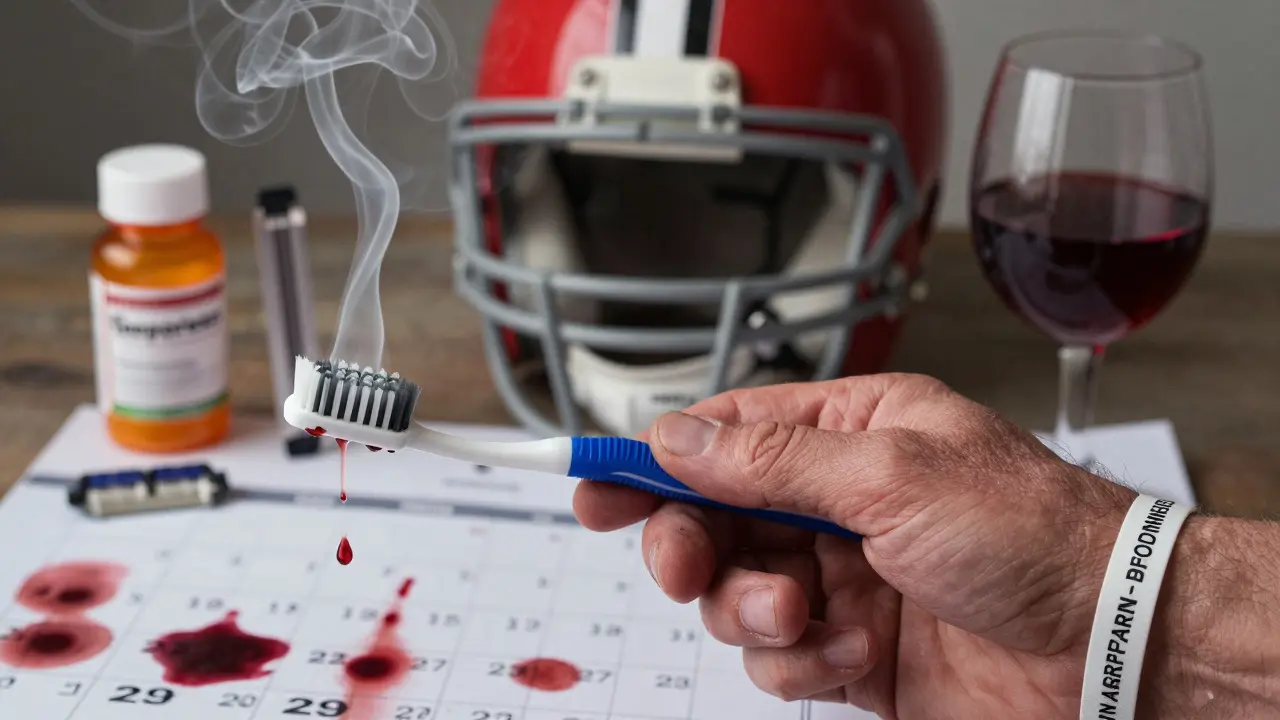
Bleeding is the #1 reason people end up in the ER on warfarin. And it doesn’t always come from a cut or injury. Sometimes, it just… happens. Minor bleeding includes nosebleeds that last more than 5 minutes, bleeding gums when brushing your teeth, or unexplained bruises. These aren’t normal. They’re warning signs.
Major bleeding is life-threatening. It means:
- Bloody or black, tarry stools
- Pink, red, or brown urine
- Vomiting blood or material that looks like coffee grounds
- Sudden, severe headache or dizziness (could be brain bleeding)
- Severe back or abdominal pain
- Heavy vaginal bleeding outside your period
- Swelling or pain in a joint (like a knee or ankle) - that’s internal bleeding into the joint
One in every 200 people on warfarin will have a brain bleed each year. That’s 0.2% to 0.5%. It sounds small - until it happens to you. And once it does, you have less than an hour to reverse it. Time matters.
Your INR Is Your Lifeline
Warfarin’s effect is measured by a blood test called INR. For most people, the target is 2.0 to 3.0. If your INR is below 2.0, you’re not protected enough. If it’s above 3.0, your bleeding risk jumps sharply. Every point above 3.0 doubles your chance of major bleeding. At INR 4.0 or higher? Your risk is 4 to 8 times greater than normal.
That’s why testing matters. If you’re new to warfarin, you might need blood tests every week. Once you’re stable, monthly is usually enough. But if you get sick, start a new medicine, or change your diet, you’re back to weekly checks. Don’t skip them. Your INR is the only thing telling you if you’re safe.
What Makes Bleeding Worse?
Some risks you can’t change - like being over 65, having high blood pressure, or a history of stomach bleeding. But others? You can control them.
- Age 65+: 2.5 times higher bleeding risk
- High blood pressure: 2.8 times higher risk
- History of GI bleeding: 3.1 times higher risk
- INR above 3.0: Risk doubles per point
- Using NSAIDs like ibuprofen: 2 to 4 times higher stomach bleeding risk
If you have three or more of these, your annual bleeding risk can hit 20%. That’s not a guess. That’s from the HAS-BLED score - a tool doctors use to predict danger. If you score high, your doctor should be extra careful.

Other Rare but Serious Side Effects
Bleeding isn’t the only problem. Warfarin can cause rare but scary side effects:
- Warfarin-induced skin necrosis: Dead skin patches, usually on the legs or breasts, appearing 2-5 days after starting. It’s linked to low protein C levels and can be devastating. If you see dark, painful patches, get help immediately.
- Purple toe syndrome: Toes turn purple or blue 3 to 8 weeks after starting. It’s caused by tiny cholesterol clots breaking off. Painful, but often resolves if you stop warfarin.
- Calciphylaxis: Calcium builds up in blood vessels, causing painful skin ulcers. Mostly affects people with kidney failure. Very rare - about 4 cases per 10,000 patient-years - but deadly if not treated.
And yes, you might feel nauseous, bloated, or notice your taste has changed. These are common but mild. Still - if anything new pops up, tell your doctor.
What You Can Do to Stay Safe
You’re not helpless. There are real, practical steps you can take to lower your risk:
- Keep your vitamin K intake steady. Leafy greens like spinach, kale, and broccoli are high in vitamin K. You don’t have to avoid them - just eat about the same amount every day. A swing of 100 mcg or more in a day can throw your INR off by 0.5 to 1.0. That’s enough to make you unsafe.
- Avoid NSAIDs. No ibuprofen. No naproxen. Use acetaminophen (Tylenol) for pain instead - but don’t go over 3,000 mg a day. It’s safer for your stomach and liver.
- Use an electric razor. Blade razors cut. Even a tiny nick can bleed longer than you expect.
- Use a soft-bristle toothbrush and waxed floss. Gum bleeding is common. You can reduce it.
- Avoid contact sports. No football, rugby, boxing, skiing, or mountain biking. Falls and collisions are too risky.
- Wear a medical alert bracelet. If you’re found unconscious, the first thing emergency responders need to know is that you’re on warfarin. Write it clearly: “ON WARFARIN - BLOOD THINNER.”
What to Do If You Bleed
If you have minor bleeding - a nosebleed that stops in 5 minutes, or a little gum bleeding - call your doctor. Don’t panic. But if you have any major signs - black stools, vomiting blood, severe headache - go to the ER immediately. Don’t wait. Don’t call your GP first. Go.
In the hospital, they’ll check your INR. If it’s too high, they’ll reverse it. For life-threatening bleeding, they’ll give you vitamin K (injected) and PCC - a concentrated clotting factor product. It works fast. Fresh frozen plasma is used if PCC isn’t available. Time is everything. For brain bleeds, reversal must happen within 30 to 60 minutes.
When to Consider Switching
Newer blood thinners - like apixaban, rivaroxaban, dabigatran - have lower bleeding risks. Studies show about 30% fewer major bleeds compared to warfarin. They don’t need regular blood tests. You don’t have to watch your diet. But they’re not for everyone. If you have a mechanical heart valve - especially in the mitral position - warfarin is still the only option. If your kidneys are failing, DOACs may not work. And if cost is a barrier, warfarin is still the most affordable.
Ask your doctor: “Is warfarin still the best choice for me?” If you’re stable, have no side effects, and your INR is in range - maybe yes. But if you’re struggling with frequent tests, diet changes, or bleeding scares - it might be time to talk about alternatives.
Final Reality Check
Warfarin isn’t dangerous because it’s bad. It’s dangerous because it’s powerful. And power needs respect. People live long, healthy lives on warfarin - but only if they treat it like the serious medicine it is. You need to know your INR. You need to know your signs of bleeding. You need to know what to avoid. You need to be proactive.
It’s not about fear. It’s about control. The more you know, the safer you are. The more you ignore, the more you risk. This isn’t a drug you take and forget. It’s a daily responsibility. And if you handle it right, it can keep you alive for decades.
Can I take aspirin while on warfarin?
Only if your doctor specifically tells you to. Aspirin increases bleeding risk, especially in the stomach. Even low-dose aspirin (81 mg) can raise your chance of a GI bleed by 2 to 3 times when combined with warfarin. Never start or stop aspirin without talking to your prescriber.
Do I have to avoid all green vegetables?
No. You don’t need to avoid leafy greens - you need to eat them consistently. If you normally eat a big spinach salad every day, keep doing it. If you rarely eat greens, don’t suddenly start eating them every day. Sudden changes in vitamin K intake cause your INR to swing. Aim for 60-80 mcg of vitamin K daily - and keep it steady.
Can I drink alcohol while on warfarin?
Moderation is key. One drink a day is usually okay. More than that can raise your INR and increase bleeding risk. Alcohol affects how your liver processes warfarin. If you drink heavily, your risk of liver damage and bleeding goes up. Talk to your doctor about your habits - don’t hide them.
What should I do before dental work?
For routine cleanings or fillings, keep taking warfarin. Dentists can manage bleeding with gauze, sutures, or special rinses. For major surgery like extractions or implants, your doctor may temporarily pause warfarin - but only if your clotting risk is low. Never stop warfarin on your own. Always coordinate with both your doctor and dentist.
Is there a test to know if I’m more likely to bleed on warfarin?
Yes - but it’s not routine. Genetic tests for CYP2C9 and VKORC1 genes can show how your body metabolizes warfarin. Some people need much lower doses. These tests are used in research and specialized clinics, but not everywhere. Your doctor may still start you on a standard dose and adjust based on your INR. If you’ve had trouble getting stable, ask if genetic testing is an option.
Can I use a home INR monitor?
Yes - if your doctor approves it. Devices like the CoaguChek Pro II let you test your INR at home. Studies show patients who use them spend more time in the safe range - up to 20% better than those who only go to labs. It’s not for everyone, but if you travel often, have trouble getting to clinics, or want more control, it’s a great tool. Insurance often covers it if you’re stable.
What’s Next?
If you’re on warfarin, your next step isn’t to panic - it’s to get organized. Write down your INR targets. Keep a log of your diet and medications. Set phone reminders for blood tests. Talk to your doctor about your bleeding risks. Ask if a home monitor makes sense for you. If you’re unsure about any supplement, herb, or new medicine - check with your pharmacist. There are over 300 drugs and supplements that interact with warfarin.
Warfarin isn’t going away. But the people who do best on it? They’re the ones who treat it like a partnership - not a prescription they just pick up and forget.
Jessica Salgado
December 16, 2025 AT 14:45My grandma was on warfarin for 12 years. She never had a bleed. But she also never skipped a test, ate the same salad every Tuesday, and had a little notebook where she wrote down every pill she took-even the gummy vitamins. People think it’s scary, but it’s just a job. Do the job right, and it works.
And yes, I still tease her about her ‘INR calendar’-but honestly? I’m stealing it for myself when I turn 60.
Linda Caldwell
December 17, 2025 AT 03:22You got this. Warfarin isn’t your enemy-it’s your bodyguard. Stay consistent, stay aware, and you’ll outlive half the people who think they’re too cool to check their INR.
Anna Giakoumakatou
December 18, 2025 AT 12:47Oh wow, a 70-year-old drug that requires a PhD in nutrition and a blood test every other Tuesday? How quaint. Meanwhile, the DOACs are out there living their best lives-no spinach spreadsheets required. But sure, let’s keep pretending warfarin is ‘cheap’ while we all pay for the ER visits it causes.
CAROL MUTISO
December 20, 2025 AT 01:44There’s something almost poetic about warfarin-it’s the last holdout of medicine as a ritual. You don’t just swallow a pill; you negotiate with your liver, your kale, your INR, your fear. It’s not just anticoagulation-it’s existential anticoagulation.
And yet, the people who thrive on it? They’re the ones who treat it like a dance, not a dictatorship. The ones who don’t rage against the vitamin K-they waltz with it.
Also, purple toe syndrome? That’s not a side effect. That’s a gothic horror story your toes wrote in blood and cholesterol.
And yes, I’ve seen it. It’s real. And it’s ugly. And it’s avoidable. So please. Don’t be the person who Googles ‘why are my toes purple’ at 2 a.m. after skipping your test for a week.
Erik J
December 21, 2025 AT 04:10Home INR monitor changed everything for me. Used to drive 45 minutes each way. Now I prick my finger while my coffee brews. My time in range went from 62% to 84%. Worth every penny. Insurance covered it after three months of stable results.
Just… don’t forget to calibrate the device. I did once. Got an INR of 8.2. Turned out the test strip was expired. Lesson learned.
BETH VON KAUFFMANN
December 21, 2025 AT 13:51Warfarin? More like Warfarin-adjacent medicine. The entire protocol is archaic. INR targets are arbitrary, vitamin K ‘stability’ is a myth, and the drug interaction list is longer than the U.S. tax code. DOACs aren’t just better-they’re the only rational choice for 90% of patients. Why are we still teaching this like it’s 1954?
Martin Spedding
December 22, 2025 AT 23:14INR 3.0? Pfft. My cousin’s doc had him at 2.5. He bled out on the toilet. 2.5 is a death sentence. Go 2.0 or GTFO. Also, kale? Nah. Just take the DOAC. Stop being a martyr for a drug that’s been obsolete since the Nixon administration.
Raven C
December 23, 2025 AT 23:52It is, indeed, profoundly concerning that the medical establishment continues to endorse a medication whose pharmacokinetic profile is so inherently volatile, particularly when more predictable alternatives are not only available but statistically superior in terms of hemorrhagic risk mitigation. One cannot help but wonder whether this persistence stems from institutional inertia, economic incentive, or a fundamental disregard for patient autonomy and safety.
Moreover, the notion that ‘eating the same amount of spinach’ constitutes a viable therapeutic strategy is, frankly, laughable. Are we now prescribing dietary mindfulness as a substitute for pharmacological precision?
Donna Packard
December 25, 2025 AT 07:37I was terrified at first. But I started setting phone alarms for my blood tests and writing down everything I ate. Now it’s just part of my routine. I even made a little chart with stickers. It’s weirdly satisfying. You can do this. You’re stronger than you think.
Patrick A. Ck. Trip
December 26, 2025 AT 17:40While I acknowledge the efficacy and historical significance of warfarin as an anticoagulant agent, I must respectfully posit that the current clinical paradigm may benefit from a paradigmatic shift toward agent selection predicated upon individualized risk-benefit profiles, particularly in light of the demonstrated superiority of direct oral anticoagulants in terms of hemorrhagic event reduction.
That said, I remain deeply appreciative of the diligence demonstrated by patients who adhere to the rigorous monitoring protocols associated with warfarin therapy. Your commitment is commendable.
Salome Perez
December 27, 2025 AT 05:56As someone who’s worked with elderly patients in rural clinics, I’ve seen warfarin save lives when nothing else could. One woman, 84, with a mechanical valve, no insurance, lived 15 years on warfarin because her daughter drove her to the clinic every week. They didn’t have fancy apps or home monitors-but they had each other.
Don’t underestimate the power of routine, community, and someone who remembers to call you on test day.
Also-yes, the purple toe thing is real. I saw it once. Never forget it.
Kent Peterson
December 27, 2025 AT 06:35Oh please. Warfarin is a relic. The only reason it’s still used is because Big Pharma doesn’t want to lose the $10-a-month cash cow. DOACs cost more? Fine. But they don’t turn your life into a blood test roulette game. This article reads like a 1980s medical brochure. Wake up. The world moved on.
Also, ‘eat the same kale’? That’s not medicine. That’s cult behavior.
Sam Clark
December 27, 2025 AT 11:26I appreciate the depth of this post. It’s rare to see such a balanced, evidence-based overview that doesn’t minimize risk or oversimplify management. I’d add one thing: if you’re on warfarin and have a caregiver-whether family or professional-include them in the INR discussions. Two sets of eyes on bleeding signs make a huge difference.
And for those frustrated by the regimen: you’re not failing. The system is. But your awareness? That’s your superpower.