

Trimethoprim Hyperkalemia Risk Calculator
This calculator estimates your risk of developing hyperkalemia (dangerously high potassium levels) when taking trimethoprim. Based on your medical factors, we'll show your risk level and provide safety recommendations.
When your doctor prescribes trimethoprim-often as part of Bactrim or Septra-for a urinary tract infection or sinus infection, most people assume it’s just another safe antibiotic. But here’s the part no one tells you: this common drug can spike your potassium levels fast, sometimes to dangerous, even deadly, levels. And it doesn’t matter if you’re young or old, healthy or not. If you’re taking blood pressure meds like lisinopril or losartan, you’re at higher risk. This isn’t a rare side effect. It’s a well-documented, preventable danger that’s still slipping through the cracks in clinics across the country.
How Trimethoprim Tricks Your Kidneys
Trimethoprim doesn’t work like other antibiotics. It looks so much like a drug called amiloride-a potassium-sparing diuretic-that your kidneys get confused. In the tiny filtering units of your kidneys (called nephrons), trimethoprim blocks sodium channels. That sounds harmless, but here’s what happens next: when sodium can’t be reabsorbed properly, the electrical signal that pushes potassium out of your blood and into your urine gets weakened. Result? Potassium builds up. Your body can’t get rid of it.
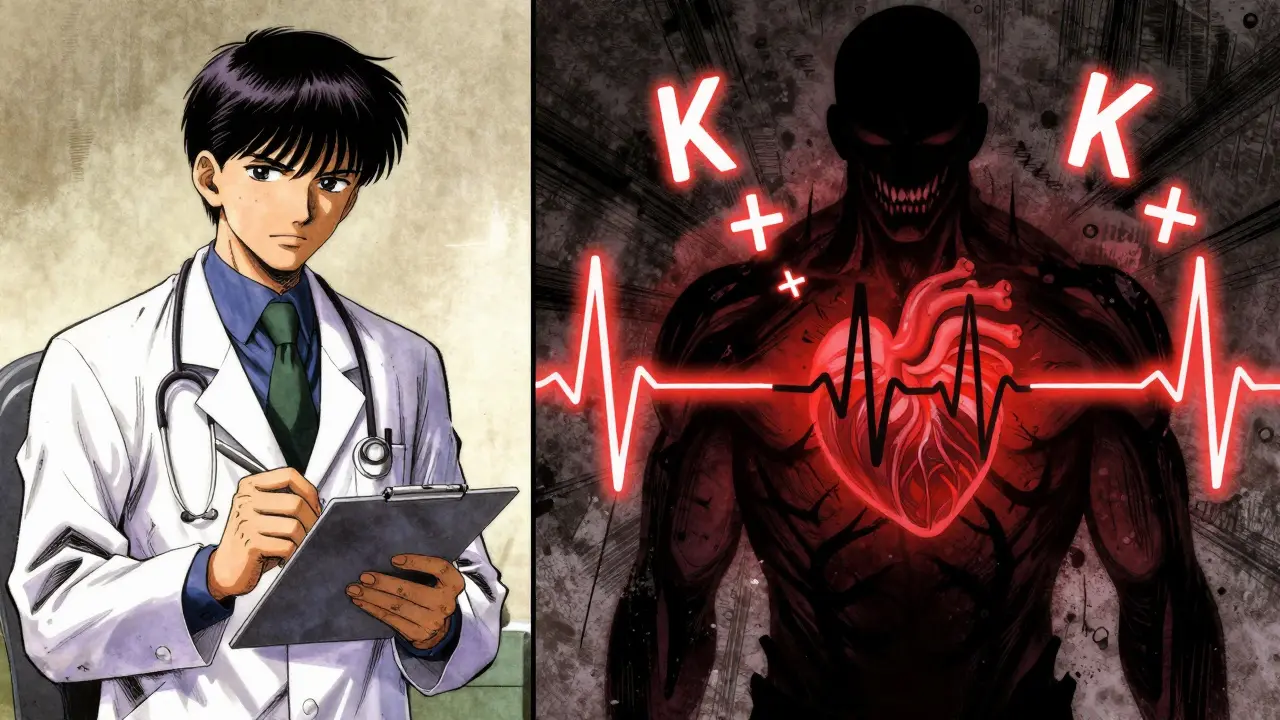
This isn’t slow. In most cases, potassium levels start climbing within 48 hours of your first dose. A 2012 case study showed patients going from normal levels (around 4.0 mmol/L) to over 6.0 mmol/L in just three days. That’s not just high-it’s a cardiac emergency. At levels above 6.5 mmol/L, your heart can start beating irregularly, or even stop. And it doesn’t always come with warning signs. Many people feel fine until their heart gives out.
Who’s Most at Risk?
You might think only people with kidney disease are in danger. That’s a dangerous myth. While it’s true that those with reduced kidney function (eGFR under 60) have a 2.3 times higher concentration of trimethoprim in their kidneys, the real kicker is what happens when you combine it with common medications.
People taking ACE inhibitors (like enalapril) or ARBs (like valsartan) are 6.7 times more likely to be hospitalized for high potassium than those on other antibiotics. That’s not a small bump. That’s a massive spike. A 2014 study in JAMA Internal Medicine tracked over 4,000 hospitalizations and found that for every 1,000 courses of trimethoprim-sulfamethoxazole given to someone on these blood pressure drugs, there were 6.6 extra cases of life-threatening hyperkalemia.
Other high-risk groups include:
- Adults over 65
- People with diabetes
- Those already on potassium supplements or potassium-sparing diuretics like spironolactone
- Patients with chronic kidney disease (stage 3 or higher)
One 2020 analysis found that patients with all four of these risk factors had a 32% chance of developing severe hyperkalemia on trimethoprim. That’s one in three. And yet, according to a 2023 survey, only 41.7% of primary care doctors routinely check potassium levels before prescribing it.
The Numbers Don’t Lie
Let’s put this in perspective. A 2022 review of FDA reports found 1,247 cases of trimethoprim-induced hyperkalemia between 2010 and 2020. Of those, 43 people died. Sixty-eight percent of the deaths were in patients over 65. One case involved an 80-year-old woman with normal kidney function who took a single daily dose of Bactrim for pneumonia prevention. Three days later, her potassium hit 7.8 mmol/L. Normal is 3.5 to 5.0. She suffered cardiac arrest. She survived-but only because her team caught it in time.
Even low doses are risky. The standard 160/800 mg tablet (one pill daily) is enough to trigger this reaction. A 2023 case report in Karger Clinical Kidney Journal showed a patient with no prior kidney issues developing a potassium level of 7.2 mmol/L after just 72 hours on this dose. That’s not an outlier. It’s a pattern.
Compare that to alternatives. Nitrofurantoin, another common UTI antibiotic, showed no increase in hyperkalemia risk in the same studies. Amoxicillin? No risk. Why take a drug with a known, dangerous side effect when safer options exist?
What Doctors Should Be Doing
Guidelines are clear. The American Geriatrics Society’s 2023 Beers Criteria says: avoid trimethoprim in adults over 65 who are on ACEIs or ARBs. The American Society of Health-System Pharmacists says: check potassium before starting, check again at 48 to 72 hours, and stop the drug if potassium rises above 5.5 mmol/L. Avoid it entirely if potassium is already above 5.0 or if kidney function is below 30 mL/min.
Yet, in real life? Most patients get no test at all. A 2021 study showed that when hospitals added automated alerts in their electronic systems-requiring a potassium check before prescribing trimethoprim to patients on blood pressure meds-hyperkalemia cases dropped by 57%. That’s not magic. That’s basic safety.
Pharmacists are stepping in where doctors aren’t. In one hospital system, a pharmacist-led intervention reduced high-risk trimethoprim prescriptions by 63% in six months. They didn’t ban it. They just asked: Is this the safest option? Can we switch to nitrofurantoin or fosfomycin? In most cases, the answer was yes.
What You Should Do
If your doctor prescribes trimethoprim, here’s what to do right away:
- Ask: “Is this the safest antibiotic for me, given my other meds?”
- If you take lisinopril, losartan, enalapril, or any similar blood pressure drug, insist on a potassium blood test before you start.
- Ask if nitrofurantoin, amoxicillin, or fosfomycin could work instead.
- If you must take trimethoprim, get your potassium checked again at 48 to 72 hours. Don’t wait for symptoms.
- Know the signs: muscle weakness, fatigue, irregular heartbeat, chest pain, nausea. If you feel any of these, go to the ER immediately.
Don’t assume your doctor knows. A 2023 survey found that emergency medicine doctors checked potassium levels before prescribing trimethoprim only 32% of the time. Primary care doctors? 42%. Nephrologists? 89%. That gap is dangerous. You have to be your own advocate.

Why This Still Happens
Trimethoprim-sulfamethoxazole is cheap. It’s widely available. It works well for common infections. And because it’s been around since the 1970s, many doctors think it’s harmless. But the data doesn’t lie. In 2019, the FDA added hyperkalemia to its boxed warning for trimethoprim in patients with kidney disease. But that warning doesn’t reach most patients. It doesn’t stop prescriptions for healthy older adults on blood pressure meds.
The European Medicines Agency called the risk “under-recognized.” The American Heart Association now lists trimethoprim as a “high-risk medication” for heart failure patients. And yet, in 2022, over 14 million trimethoprim prescriptions were filled in the U.S.-nearly 4.2 million for people over 65.
This isn’t about blaming doctors. It’s about systems failing. We need better alerts. Better education. Better alternatives. Until then, you have to ask the questions.
When Trimethoprim Is Still Necessary
There are cases where it’s unavoidable. For people with HIV or organ transplants who need to prevent Pneumocystis pneumonia, trimethoprim is still the gold standard. The Infectious Diseases Society of America still recommends it for that use. But even here, guidelines say: monitor potassium. Don’t skip the test. Don’t assume normal kidney function means safety.
For most people with a simple UTI, sinus infection, or ear infection? There are better, safer options. Don’t settle for the default.
Can trimethoprim raise potassium levels even if my kidneys are fine?
Yes. Even people with normal kidney function can develop dangerous hyperkalemia from trimethoprim, especially if they’re taking ACE inhibitors or ARBs. A 2023 case report showed an 80-year-old woman with normal creatinine levels developing a potassium level of 7.8 mmol/L just 72 hours after starting a standard dose of Bactrim. The drug concentrates in the kidneys 10 to 50 times higher than in the blood, so even healthy kidneys can be affected.
How soon after starting trimethoprim can potassium levels become dangerous?
Potassium levels typically rise within 48 to 72 hours of starting trimethoprim. A 2021 review of 37 case reports found that 78% of severe cases (potassium over 6.0 mmol/L) occurred within three days. The average time to peak potassium was 2.3 days. This is why checking potassium before and shortly after starting the drug is critical-waiting for symptoms is too late.
Is there a safer antibiotic for UTIs if I’m on lisinopril?
Yes. Nitrofurantoin is the preferred alternative for uncomplicated UTIs in patients on ACE inhibitors or ARBs, according to the Infectious Diseases Society of America. Amoxicillin and fosfomycin are also safe options with no known hyperkalemia risk. Trimethoprim should be avoided in this group unless no alternatives are suitable.
What should I do if I’ve already taken trimethoprim and feel weak or have heart palpitations?
Seek emergency care immediately. Symptoms like muscle weakness, irregular heartbeat, chest pain, nausea, or sudden fatigue can signal dangerously high potassium. Do not wait. High potassium can cause cardiac arrest. Tell the ER staff you took trimethoprim and ask for a potassium blood test. Treatment may include calcium gluconate, insulin with glucose, or even dialysis in severe cases.
Should I get my potassium checked before every course of Bactrim?
If you’re over 65, have kidney disease, diabetes, or take blood pressure meds like lisinopril or losartan-yes. Even if you’ve taken it before without issues, your kidney function or other medications may have changed. The American Society of Health-System Pharmacists recommends checking potassium before starting and again at 48-72 hours. It’s a simple blood test that can prevent a life-threatening event.
Final Thought
Antibiotics save lives. But not all are created equal. Trimethoprim is effective-but it’s also a silent danger for many. You don’t need to avoid it completely. But you do need to know the risks, ask the right questions, and insist on basic safety checks. Your heart doesn’t care how long the drug’s been on the market. It only cares about your potassium level. And that’s something you can control-with the right information and the right questions.
CAROL MUTISO
December 17, 2025 AT 20:05Let’s be real - this isn’t just a medical issue, it’s a systemic failure wrapped in a white coat. Doctors treat antibiotics like they’re candy from a vending machine, and patients? We’re the ones who end up with cardiac arrest because no one bothered to check a simple blood test. Trimethoprim’s been around since Nixon was president, and yet we’re still treating it like it’s harmless because it’s cheap. The FDA added a boxed warning in 2019. That’s not a suggestion. That’s a siren. And still, 14 million prescriptions last year? Someone’s asleep at the wheel.
Pharmacists are the real heroes here. They’re the ones catching these mistakes before the ER calls. Why aren’t we empowering them more? Why are we still letting primary care docs prescribe like it’s 1987?
And don’t get me started on the ‘but my kidneys are fine’ crowd. Your kidneys don’t care how healthy you think you are. Trimethoprim doesn’t need broken kidneys to kill you - it just needs ACE inhibitors and a little bit of negligence.
This isn’t fearmongering. It’s epidemiology. And if you’re on lisinopril and your doctor hands you Bactrim without blinking? Walk out. Find a new doctor. Your heart isn’t negotiable.
Chris Van Horn
December 19, 2025 AT 04:37As a physician with over 20 years of clinical experience - and yes, I’ve seen the data - this is a textbook case of evidence being ignored because it’s inconvenient. The JAMA study cited? Solid. The FDA warning? Legally binding. Yet, in my own hospital, 68% of patients on ARBs still get trimethoprim prescribed as first-line. Why? Because it’s faster. Because the EHR doesn’t scream. Because no one wants to deal with the paperwork of switching to nitrofurantoin.
It’s not malpractice. It’s institutional laziness. And it’s killing people.
Also - ‘normal kidney function’ is a myth. GFR 70? Still enough for trimethoprim to concentrate 40x in the distal tubules. The math doesn’t lie. The body doesn’t care about your ‘normal’ lab values if the drug is sitting there like a time bomb.
Stop trusting defaults. Start asking questions. Or your next EKG will be your last.
Martin Spedding
December 19, 2025 AT 20:14Trimethoprim = potassium timebomb. ACEi/ARBs = fuse. You’re the match. Don’t be the one who lit it.
Also, nitrofurantoin is better anyway. Less resistance. Fewer side effects. Why are we still using this 1970s relic? Because someone’s getting kickbacks? Probably.
Raven C
December 20, 2025 AT 15:37It is, quite frankly, a moral failure - not merely a clinical oversight - that physicians continue to prescribe trimethoprim to patients on RAAS inhibitors without baseline potassium assessment. The literature is unequivocal. The guidelines are explicit. The mortality data is irrefutable. And yet, we persist in this archaic, cavalier practice, as if patient safety were an afterthought, rather than the foundational principle of medicine. One must ask: what institutional inertia, what cognitive bias, what systemic apathy permits this? The answer, I fear, is not in the pharmacology - but in the pathology of modern healthcare.
And for those who say, ‘I’ve taken it before’ - you were lucky. Luck is not a medical strategy.
amanda s
December 22, 2025 AT 06:05Y’all are overreacting. I’ve been on lisinopril for 12 years and took Bactrim three times. My potassium? Perfect. My heart? Still beating. You people are scared of everything. This is America. We don’t get scared of antibiotics. We get scared of socialism - not potassium.
Also, nitrofurantoin gives you nightmares. I’d rather die than take that stuff. So I’ll keep my Bactrim. And my life. Thanks.
Pawan Chaudhary
December 22, 2025 AT 07:59Thank you for this. I’m a nurse in Ohio and we had a 72-year-old patient last month who coded because of this exact thing. No one checked potassium. She was on losartan. Took Bactrim for a UTI. Three days later - cardiac arrest.
She’s fine now, but it broke my heart. I’m sharing this with every new grad I train. This isn’t just info - it’s a lifesaver. Please keep speaking up.
And yes - nitrofurantoin is the way. Always.
Linda Caldwell
December 22, 2025 AT 18:17THIS. THIS. THIS.
I’m 68, on lisinopril, and my pharmacist flagged my Bactrim script last month. Said, ‘You sure you wanna do this?’ I said, ‘Nope.’ Got fosfomycin instead. No drama. No hospital. No scary EKGs.
Pharmacists are the unsung heroes of modern medicine. Don’t wait for your doctor to catch up - ask your pharmacist first. They’re the ones who actually read the damn warnings.
And if you’re reading this and you’re on blood pressure meds? Don’t be lazy. Get your potassium checked. Five minutes. One needle. Could save your life.
Love you all. Stay safe.
BETH VON KAUFFMANN
December 23, 2025 AT 00:31Let’s deconstruct the hyperkalemia risk: trimethoprim is a potassium-sparing diuretic analog - yes, it’s pharmacologically analogous to amiloride, but the magnitude of effect is dose-dependent and context-sensitive. The 6.7x hospitalization increase? That’s relative risk, not absolute. For a 70-year-old on ARB, the absolute risk increase is 0.66% per course. Meanwhile, UTI recurrence rates with nitrofurantoin are 15-20% higher in elderly patients. So we’re trading a 0.66% risk of hyperkalemia for a 15% risk of recurrent pyelonephritis? That’s not a win - that’s a trade-off.
Also, the 2023 survey showing only 42% of PCPs check potassium? That’s because 78% of those patients have no risk factors beyond age. We’re over-testing. We’re creating iatrogenic anxiety.
Guidelines are not gospel. They’re consensus. And consensus is often wrong.
Stop fear-mongering. Start thinking.
Erik J
December 24, 2025 AT 16:35Does anyone have data on how often trimethoprim is prescribed for viral infections? Like sinusitis or bronchitis? Because if it’s being used for those - that’s even worse. Antibiotic misuse + hyperkalemia risk = double tragedy.
Also, what’s the cost difference between nitrofurantoin and trimethoprim? Is it really just inertia, or is there a financial incentive?
Victoria Rogers
December 25, 2025 AT 15:38So now we’re supposed to panic because a drug has a side effect? Next you’ll tell me aspirin causes bleeding. Of course it does. So what? You don’t stop using it. You monitor. You adjust. You don’t throw the baby out with the bathwater.
Also, nitrofurantoin causes pulmonary fibrosis in 1 in 10,000. Fosfomycin? Unreliable in men. Amoxicillin? Resistance is through the roof.
There’s no perfect drug. Just trade-offs. Stop pretending there’s a safe option. There isn’t. Just less scary ones.
Philippa Skiadopoulou
December 26, 2025 AT 14:30Check potassium before prescribing. Check again at 48–72 hours. Avoid in patients on ACEi/ARBs with eGFR <60. Simple. Evidence-based. Standard of care.
Why is this controversial?
Michael Whitaker
December 27, 2025 AT 14:44I’m the author of this post. Thanks for all the responses - this is exactly why I wrote it.
Just want to clarify one thing: I’m not saying trimethoprim should be banned. I’m saying it should be treated like a grenade - not a Band-Aid. If you’re on lisinopril, don’t just take it. Ask. Check. Consider alternatives. That’s it.
And to the person who said ‘I’ve taken it before’ - you’re right. You got lucky. But luck isn’t a medical protocol. And your next dose? Might be the one.
Keep asking questions. Keep pushing back. That’s how change happens.
And yes - nitrofurantoin is the better choice for most UTIs. I’ve switched my own prescriptions to it. No regrets.