
Every year, over 1.5 million people in the U.S. are harmed by medication errors. Many of these mistakes never reach patients-not because doctors got it right, but because a pharmacist caught it.
Think about it: a doctor writes a prescription. A nurse transcribes it. A pharmacy technician fills it. And then, just before it leaves the counter, a pharmacist stops everything. They’re not just counting pills. They’re scanning for hidden dangers: a drug that clashes with another, a dose ten times too high, an allergy no one remembered. This isn’t guesswork. It’s a trained, systematic, and often underappreciated safety net.
Pharmacists Are the Final Line of Defense
The Institute for Safe Medication Practices calls pharmacists the "last line of defense"-and for good reason. Studies show pharmacists intercept about 1 in 4 potentially harmful errors that would’ve otherwise reached patients. That’s not luck. It’s expertise.
When a prescription comes in, pharmacists don’t just check the math. They look at the whole picture. What other meds is the patient taking? Do they have kidney disease? Are they on blood thinners? Is this drug even appropriate for their age? A 72-year-old with heart failure shouldn’t get the same dose of a painkiller as a 30-year-old athlete. Pharmacists know this. Algorithms can flag potential issues, but only a pharmacist can decide if the flag is real or just noise.
How They Catch Errors: The Real Process
It starts with technology-but ends with human judgment. Most pharmacies use electronic systems that scan for drug interactions, allergies, and dosing problems. These systems catch about 85-90% of potential issues. But here’s the catch: they also generate false alarms. One study found pharmacists override nearly 50% of alerts because they’re irrelevant. That’s why training matters. Pharmacists learn to filter out the noise and focus on what’s dangerous.
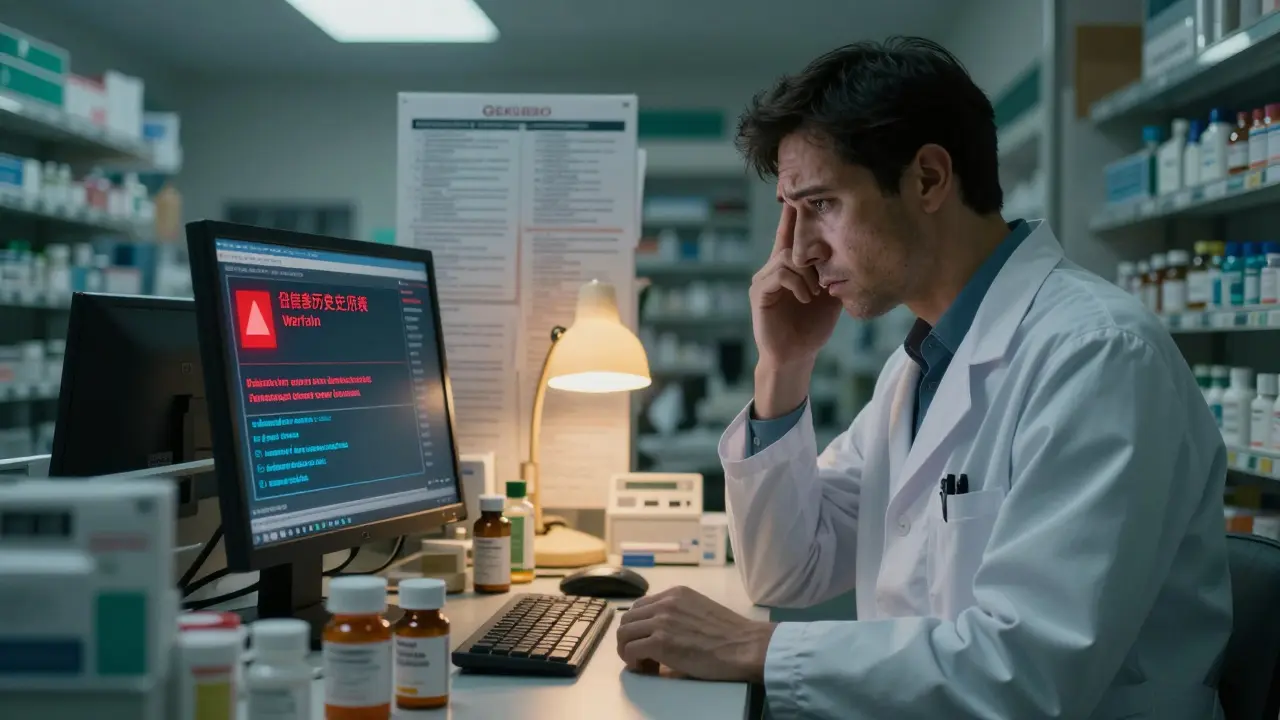
In hospitals, pharmacists do something called medication reconciliation. When a patient is admitted, they compare what the patient was taking at home with what the hospital ordered. On average, they find 2.3 discrepancies per patient. One common example? A patient on warfarin (a blood thinner) was prescribed a new antibiotic that shouldn’t be mixed with it. Left unchecked, this could cause internal bleeding. The pharmacist caught it, called the doctor, and changed the prescription.
In community pharmacies, technicians often do the first check. They catch obvious errors-like confusing drug names (e.g., hydroxyzine vs. hydralazine) or illegible handwriting. But the pharmacist does the final review. They check the National Drug Code (NDC), verify the patient’s history, and look for red flags like refills too soon or prescriptions for controlled substances without proper documentation.
Technology Helps-But Doesn’t Replace
Barcode scanning cuts dispensing errors by 51%. Automated cabinets reduce mistakes by 38%. Electronic prescribing eliminates handwriting errors by 95%. These tools are powerful. But they’re not foolproof.
A 2021 meta-analysis found that computerized order systems alone reduce errors by only 17-25%. Add a pharmacist into the mix, and that jumps to 45-65%. Why? Because technology doesn’t understand context. It doesn’t know that a patient is 80, frail, and lives alone. It doesn’t know that the patient’s daughter just called to say Mom forgot to take her pills last week. A pharmacist does.
Even the best systems fail in high-pressure environments. One Reddit user, a pharmacy technician, shared that they see 3-4 serious errors per week that slip past pharmacists because they’re rushing. That’s why double-checks matter-especially for high-risk drugs like insulin, heparin, or opioids.
The Double-Check System That Saves Lives
For drugs with high risk of harm, most pharmacies use a two-person verification process. One person prepares the medication. Another independently checks it. This simple step reduces errors by 42%.
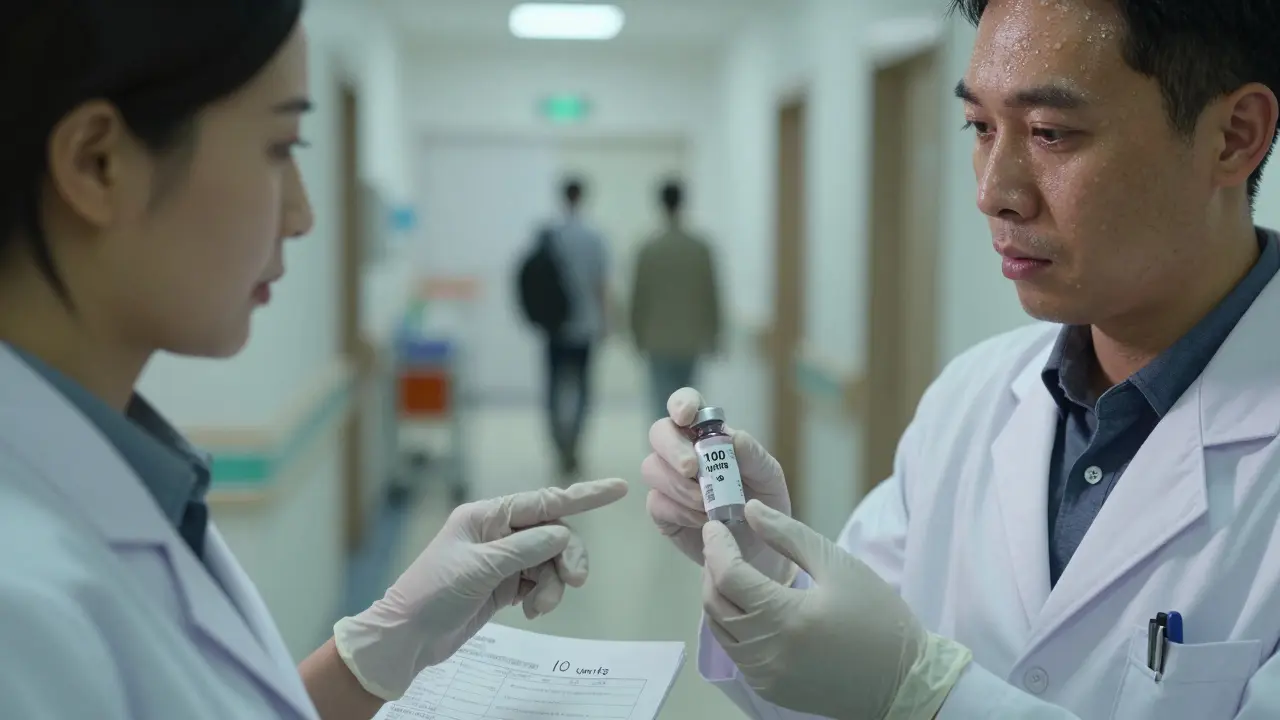
Take insulin. A 10-fold dosing error here can kill. In one documented case, a pharmacist caught a prescription for 100 units of insulin when the patient’s chart clearly said 10. The doctor had typed it wrong. The technician missed it. The pharmacist didn’t. They called the office. The error was fixed. The patient never got the wrong dose.
Same goes for anticoagulants like warfarin. A 2023 Yelp review described how a pharmacist in Melbourne caught a prescription for 5 mg of warfarin when the patient’s target INR level required only 1 mg. "I would’ve been in the ER by morning," the patient wrote. "That pharmacist saved my life."
Why Pharmacists Are Better Than Machines
AI and automation are getting smarter. But they still can’t replace the pharmacist’s clinical reasoning.
Take REMS programs-for drugs like thalidomide or isotretinoin. These require special protocols because they can cause severe birth defects. Only a pharmacist trained in these programs can verify that the patient has been counseled, signed the required forms, and is using contraception. A machine can’t do that. A pharmacist can.
Pharmacists also catch errors that no algorithm sees. A patient on multiple meds for depression, diabetes, and high blood pressure might be getting a drug that worsens their kidney function. A computer might not connect those dots. A pharmacist, who’s seen hundreds of similar cases, does.
Studies show pharmacist interventions improve therapeutic appropriateness by 28%. That means they don’t just stop mistakes-they make treatments better.
Where the System Breaks Down
Pharmacists aren’t magic. They work under pressure. In community pharmacies, one pharmacist might handle 300+ prescriptions a day. That’s about 1 every 2 minutes. No one can review each one deeply under those conditions.
Low-income countries face even bigger gaps. In places where pharmacists are stretched thin-sometimes 1 per 500 patients-error reduction drops to just 15%. Even in the U.S., independent pharmacies score lower on error reporting than hospital systems. Why? Lack of resources. Lack of staffing. Lack of time.
Alert fatigue is another problem. When a system pings 50 times a day with warnings, people start ignoring them. That’s why newer systems use tiered alerts-only the most dangerous ones interrupt workflow. This cut override rates from 49% down to 28%.
The Bigger Picture: Cost, Safety, and Future
Every prevented error saves an estimated $13,847 in healthcare costs. Annually, pharmacist interventions prevent $2.7 billion in avoidable expenses. That’s not just money-it’s hospital stays avoided, ER visits skipped, lives saved.
And the role is expanding. By 2026, the number of dedicated medication safety pharmacists is expected to rise by 22%. More states are allowing pharmacists to adjust medications independently under collaborative agreements. Hospitals are forming medication safety committees led by pharmacists. AI tools are now helping prioritize which prescriptions need human review-cutting pharmacist workload by 35% without losing accuracy.
But here’s the truth: no system works if pharmacists are overwhelmed. The best technology, the strictest protocols, the smartest alerts-they all fail if the person at the end of the line is burned out.
What Patients Can Do
Don’t assume the pharmacist will catch everything. Be your own advocate.
- Bring a list of all your meds-including supplements and over-the-counter drugs-to every appointment.
- Ask: "Is this the right dose for me?" Especially if you’re older or have multiple conditions.
- If something seems off-like a pill that looks different or a dose that feels too high-speak up. Pharmacists are trained to listen.
- Use one pharmacy. That way, they can track your full history and spot inconsistencies.
Pharmacists aren’t just filling prescriptions. They’re preventing disasters. Every time they stop a wrong dose, a dangerous interaction, or a missed allergy, they’re doing more than their job. They’re keeping people alive.
How often do pharmacists catch medication errors?
Pharmacists intercept an estimated 215,000 potentially harmful medication errors each year in the U.S. alone. Studies show they catch about 1 in 4 errors that would otherwise reach patients. In hospital settings, clinical pharmacists identify an average of 2.3 medication discrepancies per patient during admission.
Can technology alone prevent prescription errors?
No. While electronic prescribing, barcode scanning, and clinical decision support systems reduce errors by 17-95% depending on the type, they still miss critical context. Adding a pharmacist increases error detection rates to 45-65%. Machines can flag a drug interaction, but only a pharmacist can decide if it’s dangerous for this specific patient with their unique health history.
What’s the most common type of error pharmacists catch?
The most common errors include incorrect dosing (especially with high-risk drugs like insulin or warfarin), drug-drug interactions, allergies not documented in records, and confusing drug names (like hydroxyzine vs. hydralazine). Pharmacists also catch duplicate therapies, inappropriate prescribing for age or kidney function, and missing refill authorizations.
Do pharmacy technicians help prevent errors too?
Yes. Pharmacy technicians are often the first line of defense. They catch errors like illegible handwriting, mismatched National Drug Codes, and obvious dosage mismatches before the prescription reaches the pharmacist. In systems with a double-check protocol, technicians prevent 78% of dispensing mistakes. But the pharmacist still does the final clinical review.
Why do some errors still get through?
Workflow pressure, understaffing, and alert fatigue are the main reasons. Pharmacists in community pharmacies may handle 300+ prescriptions per day. In high-volume settings, even the most experienced professionals can miss something. Systems that overload pharmacists with irrelevant alerts also contribute-many override 50% of alerts because they’re not clinically meaningful. Better prioritization and more staffing are key fixes.
Sarah Barrett
February 15, 2026 AT 14:18Pharmacists are the unsung heroes of modern medicine-quiet, meticulous, and utterly indispensable. I once watched a pharmacist pause for ten full minutes over a prescription for a 78-year-old woman with renal impairment. The doctor had ordered a standard dose of an NSAID. The pharmacist flagged it, called the office, and got it changed to a safer alternative. No fanfare. No headlines. Just a woman who didn’t end up in dialysis because someone cared enough to double-check.
It’s not just about catching errors-it’s about understanding context. A machine sees a drug interaction. A pharmacist sees a widow who lives alone, forgets to eat, and takes her meds with coffee instead of water. That matters.
And yet, we treat them like glorified cashiers. We expect them to process 300 scripts a day while maintaining surgical precision. It’s a miracle anyone survives the shift.
When we finally start paying them like the clinical experts they are, instead of just dispensers of pills, we’ll see a real drop in preventable harm. Until then, they’re doing God’s work with a cracked coffee mug and a 12-minute lunch break.
Erica Banatao Darilag
February 17, 2026 AT 00:46i just want to say thank you to all the pharmacists out there. i had a med error once-my doc prescribed a drug that interacted with my blood pressure med, and the pharmacist caught it. she called me personally to explain why it was dangerous. i didn’t even know to ask. she saved me. and she didn’t get a medal. just a thank you note i wrote in shaky handwriting.
we need to do better by these people. they’re not just filling scripts-they’re holding the line between life and a very bad day.
Charlotte Dacre
February 18, 2026 AT 17:23Oh wow, a 1 in 4 error interception rate? That’s like a superhero with a clipboard. I didn’t realize pharmacists were basically the Batman of pharmaceuticals-no cape, just a stethoscope and a side-eye when you ask for OTC painkillers with your 12 new prescriptions.
And let’s be real: if you think AI is gonna save us from bad dosing, you’ve never seen a pharmacy system that flags ‘possible interaction’ 47 times an hour. Half the alerts are for drugs that were discontinued in 2012. I’m convinced the system was coded by someone who hates humans.
Esha Pathak
February 20, 2026 AT 15:50Every pill you swallow carries a silent guardian. A pharmacist, unseen, unthanked, often underpaid-yet the one who stands between chaos and calm. We live in an age of algorithms, yet the most vital intelligence remains human: intuition forged in years of watching, listening, remembering.
The machine sees a number. The pharmacist sees a life. A mother. A veteran. A diabetic who forgot to tell the doctor about her herbal tea. That’s not a job. That’s a calling.
And yet we treat it like a transaction. We rush. We scroll. We assume. But behind every bottle, there is a human who paused. Who cared. Who refused to let the system fail.
That’s not pharmacy. That’s sacred work.
🙏
Mike Hammer
February 22, 2026 AT 01:08my grandma’s pharmacist is basically her personal health detective. she’s 84, on like 12 meds, and the pharmacist remembers every single one-including the fish oil she swears is ‘not a real drug.’
last month, he noticed her new blood pressure med was making her dizzy, called her doctor, switched it, and even sent a handwritten note to her family. no one else even knew she was on it.
pharmacists are the OGs of patient care. tech helps, sure, but nothing beats someone who knows your name, your dog’s name, and that you hate grapefruit.
also, if you use one pharmacy, your life gets 300% easier. trust me.
Daniel Dover
February 22, 2026 AT 21:061 in 4 errors caught. That’s massive. And the double-check system? Pure genius. Simple. Effective. Why isn’t this mandatory everywhere?
Chiruvella Pardha Krishna
February 24, 2026 AT 02:38There is a profound metaphysical truth in the quiet vigil of the pharmacist. In a world drowning in noise, in data, in algorithmic noise, it is the human mind-trained, patient, and morally anchored-that discerns the signal from the static.
The machine sees a conflict. The pharmacist sees a story. A story of aging, of poverty, of loneliness, of a man who forgot to tell anyone he stopped eating because he couldn’t afford his insulin.
Technology optimizes. Humanity saves.
We are not merely dispensing drugs. We are tending to the fragile architecture of human survival. And when we forget that, we have already lost.
Joe Grushkin
February 25, 2026 AT 05:31Let’s be honest-the whole ‘pharmacist as last line of defense’ thing is just corporate PR. The real reason errors get caught is because someone forgot to automate the process. If we just had a robot that could read handwriting and know when someone’s grandma is too frail for a 50mg dose, we wouldn’t need humans at all.
Also, ‘double-check’? How quaint. We’ve got AI now. Why are we still relying on people who need coffee breaks and nap time? This is 2025. Not 1998.
PS: I’ve never met a pharmacist who didn’t overreact to a 5mg warfarin script. It’s like they think everyone’s one misstep from a bleeding funeral.