
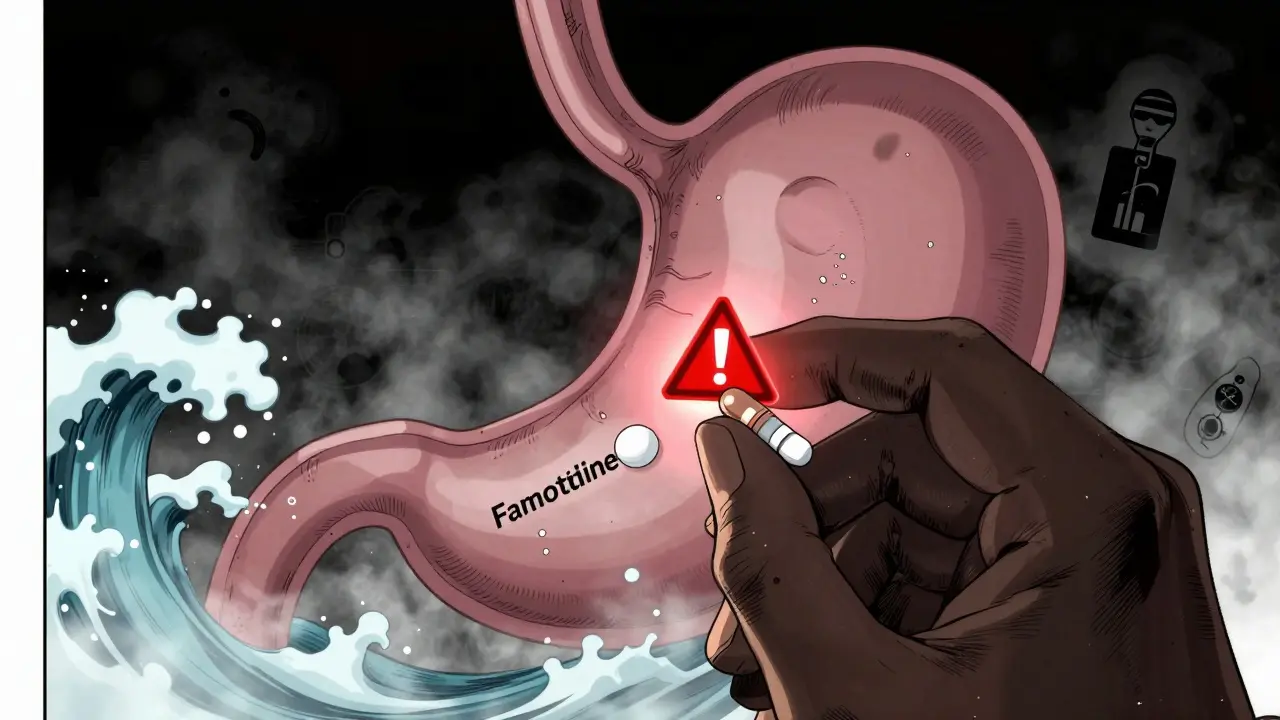
Drug Interaction Checker for H2 Blockers
This tool checks for dangerous interactions between common H2 blockers (famotidine, cimetidine, nizatidine) and antifungals/antivirals. Based on FDA guidance and clinical studies, this tool helps you understand when timing adjustments are needed or if a safer alternative exists.
Interaction Results
When you take an H2 blocker like famotidine or cimetidine for heartburn, you might not think twice about it. But if you're also on an antiviral or antifungal, this common medication could be quietly sabotaging your treatment. The problem isn't just theoretical - it's causing real treatment failures in hospitals and clinics every day. And most people, including some doctors, don't know about it.
What H2 Blockers Actually Do
H2 blockers - or histamine H2-receptor antagonists - work by turning down stomach acid. They block histamine from signaling your stomach cells to produce acid. This sounds helpful for acid reflux or ulcers, and it is. But your stomach needs acid. Not just for digestion, but for absorbing many important drugs.
The three H2 blockers still available in the U.S. are famotidine (a medication used to reduce stomach acid, sold under brands like Pepcid), cimetidine (the first H2 blocker approved in 1977, known as Tagamet), and nizatidine (a less commonly used acid reducer, sold as Axid). Ranitidine (Zantac) was pulled in 2020 after it was found to contain a cancer-causing contaminant. Famotidine is now the most prescribed, mostly because it’s cheaper and has fewer drug interactions than cimetidine.
Here’s the catch: H2 blockers raise your stomach pH from around 1-3 (very acidic) to 4-6 (nearly neutral). That’s fine for your esophagus, but terrible for drugs that need acid to dissolve.
Why Antifungals Are Especially at Risk
Antifungals like itraconazole and posaconazole don’t just need to be absorbed - they need to be dissolved first. And they need acid to do that.
Itraconazole (a triazole antifungal used for fungal infections like aspergillosis and histoplasmosis) is a classic example. When taken with an H2 blocker, its absorption drops by 40-60%. That’s not a small drop - it’s enough to make the drug useless. A 2024 study in the Journal of Antimicrobial Chemotherapy showed patients on itraconazole tablets with famotidine had blood levels so low, they couldn’t fight off even mild fungal infections.
But here’s the twist: the itraconazole oral solution (a liquid formulation containing citric acid that bypasses pH-dependent absorption) works fine even with H2 blockers. That’s because the citric acid keeps the drug dissolved. So if you’re on an H2 blocker and need itraconazole, ask your doctor for the liquid version.
Fluconazole, on the other hand, doesn’t care about stomach pH. It’s water-soluble and absorbs just fine regardless of acid levels. So if you’re on fluconazole for a yeast infection, you’re probably safe. But if you’re on voriconazole or posaconazole? You’re not.
Posaconazole’s label says clearly: take it at least 2 hours before or after an H2 blocker. Why? Because even a few hours of higher pH can ruin its absorption. The FDA flagged 17 cases of treatment failure linked to this exact mix in 2022.
How Cimetidine Makes Things Worse
Not all H2 blockers are equal. Cimetidine has a hidden danger: it blocks liver enzymes. Specifically, it inhibits CYP1A2, CYP2C9, CYP2C19, and CYP2D6 - the same enzymes that break down many antifungals and antivirals.
This means cimetidine doesn’t just reduce absorption - it can make your antifungal build up to toxic levels. For example, when cimetidine is taken with voriconazole (a potent antifungal used for invasive fungal infections), voriconazole levels can spike by 40%. That raises the risk of liver damage, hallucinations, or seizures.
Studies show cimetidine causes 63% of all documented interactions between H2 blockers and antifungals. Meanwhile, famotidine and nizatidine barely touch these enzymes. That’s why hospitals have switched almost entirely to famotidine when acid suppression is needed alongside antifungals.

Antivirals Are Also in Trouble
Antivirals aren’t off the hook. Many of them, especially those used for HIV or cancer, need acid to be absorbed.
Atazanavir (an HIV protease inhibitor that requires low pH for absorption) is one of the worst offenders. A 2022 FDA review found that when atazanavir is taken with famotidine, its absorption drops by up to 77%. That’s not just a drop - it’s a collapse. And if atazanavir levels fall too low, the HIV virus can start replicating again, leading to drug resistance.
The FDA’s official advice? Take atazanavir at least 2 hours before the H2 blocker. That gives the antiviral time to get absorbed before the stomach gets less acidic.
Other antivirals like dasatinib (a tyrosine kinase inhibitor used in some viral and cancer conditions) and elvitegravir (an HIV integrase inhibitor with pH-dependent absorption) show the same pattern. Out of 42 antiviral labels reviewed by the FDA in 2022, 68% had warnings about acid-reducing drugs. That’s not a coincidence - it’s a pattern.
What About Proton Pump Inhibitors (PPIs)?
You might wonder: if H2 blockers are risky, why not just use a PPI like omeprazole? After all, they’re stronger.
Actually, PPIs are worse. They suppress acid for 24+ hours. H2 blockers only last 6-12 hours. That means with H2 blockers, you can time your doses. Take the antifungal in the morning on an empty stomach, then wait 2 hours before taking your H2 blocker. With a PPI, your stomach stays neutral all day. No timing tricks work.
Plus, PPIs interact with more drugs. Cimetidine has 44 documented interactions. Omeprazole has 78. The University of Liverpool’s database shows H2 blockers are the lesser evil - if you use them right.

What Should You Do?
If you’re on an antifungal or antiviral and also need acid control, here’s what actually works:
- Ask which antifungal you’re on. If it’s itraconazole or posaconazole, avoid H2 blockers unless you’re using the oral solution. Fluconazole? You’re probably fine.
- Never take cimetidine. It’s outdated and dangerous with these drugs. Switch to famotidine if you need an H2 blocker.
- Time it right. Take your antifungal or antiviral at least 2 hours before your H2 blocker. Don’t take them together.
- Ask for therapeutic drug monitoring. If you’re on voriconazole or itraconazole, ask your doctor to check your blood levels. Target levels are 2-5 mcg/mL for voriconazole. If you’re below that, your treatment isn’t working.
- Don’t assume your pharmacist warned you. A 2022 survey of 1,200 hospital pharmacists found only 43% consistently gave patients timing instructions for itraconazole. You need to ask.
What’s Changing?
Things are getting better - slowly. The FDA is pushing for clearer labeling on all pH-dependent drugs. A proposed rule in late 2023 would require every drug affected by stomach acid to include specific timing instructions. That could cut interaction-related failures by 35%.
Researchers are also testing new antifungal formulations. One trial (NCT04821542) is testing lipid-based itraconazole that works even in neutral pH. If it works, we might finally be able to take these drugs with H2 blockers without fear.
Until then, the rules are simple: know your drugs. Know your stomach. And don’t let a common heartburn pill ruin your antifungal treatment.
Can I take famotidine with fluconazole?
Yes. Fluconazole doesn’t need stomach acid to be absorbed. It’s water-soluble and works fine even with H2 blockers like famotidine. No timing adjustments are needed.
Is cimetidine still available?
Yes, but it’s rarely prescribed. Cimetidine (Tagamet) is still available in the U.S., but it’s avoided in patients on antifungals or antivirals because it strongly inhibits liver enzymes and can cause dangerous drug buildup. Famotidine is the preferred H2 blocker in these cases.
Why does itraconazole fail when taken with H2 blockers?
Itraconazole tablets require a low pH (below 3) to dissolve properly. H2 blockers raise stomach pH to 4-6, preventing the drug from dissolving. This cuts absorption by 40-60%, making the drug ineffective. The oral solution avoids this issue because it contains citric acid.
Should I stop my H2 blocker if I start an antifungal?
Not necessarily. If you need acid control, switch to famotidine and take it at least 2 hours after your antifungal. For itraconazole, use the oral solution. Never stop acid suppression without talking to your doctor - uncontrolled reflux or ulcers can be just as dangerous.
Do antivirals like atazanavir need special timing with H2 blockers?
Yes. The FDA recommends taking atazanavir at least 2 hours before any H2 blocker. This allows it to be absorbed in the more acidic environment before the drug raises your stomach pH. Taking them together can reduce atazanavir levels by up to 77%, risking HIV resistance.
Are there any antifungals that are safe with all acid reducers?
Fluconazole and isavuconazole are the safest. Fluconazole doesn’t rely on stomach acid for absorption. Isavuconazole has minimal enzyme inhibition and limited pH sensitivity, making it a preferred choice in patients needing acid suppression. Both still benefit from separation timing, but they’re far less risky than itraconazole or voriconazole.
Gabrielle Conroy
February 22, 2026 AT 14:37OMG, I had no idea this was a thing!!! 😱 I'm on famotidine for my acid reflux and just started itraconazole for a fungal infection last week... I'm calling my doctor RIGHT NOW. Thank you for posting this!! I literally would've kept taking them together and maybe ruined my treatment. This is LIFE-SAVING info. 🙌
Spenser Bickett
February 24, 2026 AT 05:39Christopher Wiedenhaupt
February 24, 2026 AT 06:38Interesting post. The data on famotidine vs cimetidine interactions is well-documented in pharmacokinetic studies. I've reviewed several papers on this in my work as a clinical pharmacist. The 2024 JAC paper on itraconazole absorption is particularly compelling. What's concerning is that many primary care providers still don't screen for concomitant H2 blocker use when prescribing antifungals. This needs to be integrated into EHR alerts.
John Smith
February 24, 2026 AT 08:42Shalini Gautam
February 25, 2026 AT 18:40Wow, this is so important! I'm from India and we see a lot of fungal infections here due to climate and humidity. Fluconazole is the go-to here, but many patients are also on antacids. I'll share this with my colleagues in the pharmacy department. We need more awareness - especially in rural clinics where they just give whatever's cheapest. Thanks for writing this!
Natanya Green
February 27, 2026 AT 00:22I just screamed out loud when I read this. 😭 My mom is on voriconazole for aspergillosis and she's been taking Pepcid every night for years! I'm literally shaking right now. I'm calling her hospital right now. What if we'd lost her? This could've been a tragedy. I'm so grateful someone wrote this. Please keep sharing stuff like this!!
Steven Pam
February 28, 2026 AT 13:02This is one of those hidden dangers in medicine that flies under the radar. I love how you broke it down with the specifics - like the liquid vs tablet difference for itraconazole. That's the kind of detail that saves lives. I'm sharing this with my cousin who's on antivirals for HIV. She's been on famotidine for years and didn't even know this was a risk. Knowledge is power, and you just gave someone a serious upgrade.
Dominic Punch
March 1, 2026 AT 14:46Excellent breakdown. I'd add that the timing recommendation isn't just '2 hours before' - it's 'at least 2 hours before and ideally 4 hours if possible'. The gastric emptying time varies. Also, famotidine's duration is 10-12 hours, so taking it at night may still interfere with morning antifungal dosing. Consider splitting doses or switching to PRN use. And yes - PPIs are worse. I've seen patients on omeprazole with undetectable posaconazole levels. It's not even close.
Khaya Street
March 2, 2026 AT 22:49