
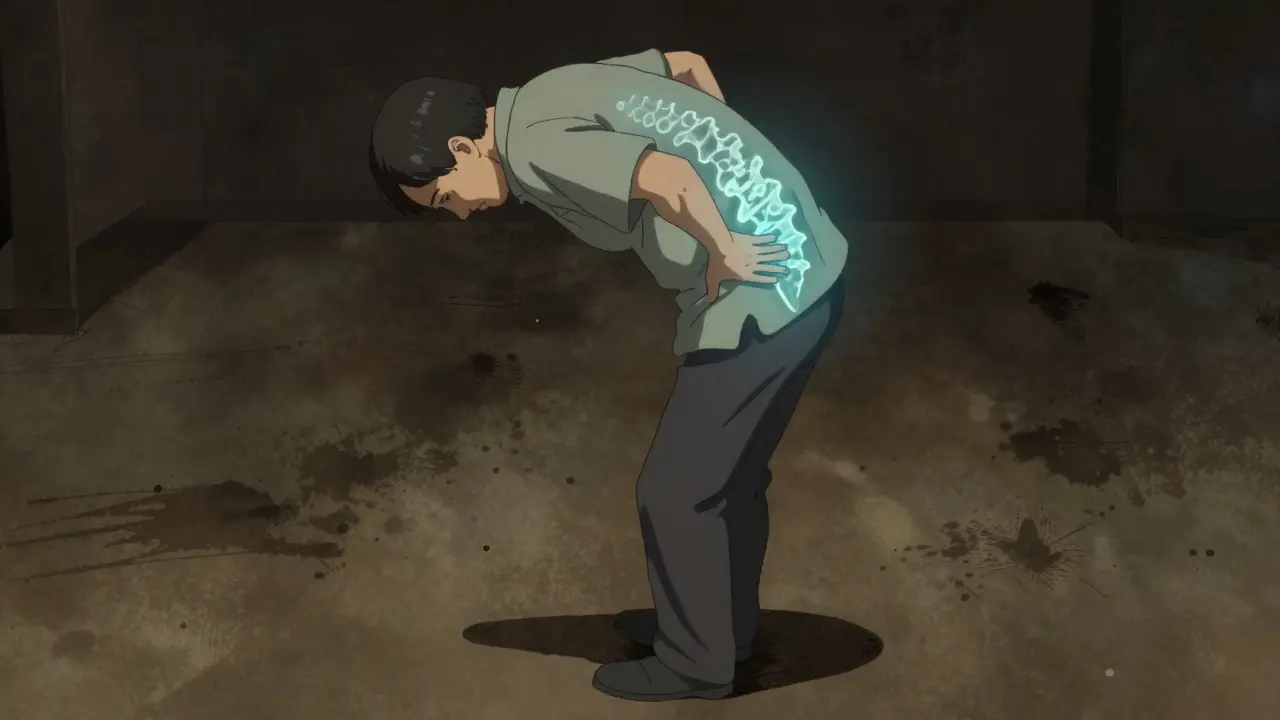
When your lower back hurts every time you stand up, walk, or even just get out of bed, it’s easy to blame a pulled muscle. But if the pain sticks around for weeks, radiates down your legs, or gets worse with activity, it might not be a simple strain. It could be spondylolisthesis - a slipped vertebra in your spine. This isn’t rare. About 6 in every 100 people have it, and for many, it’s silent until middle age. But for others, it’s the reason they can’t play with their kids, climb stairs, or sit through a movie without shifting positions.
What Exactly Is a Slipped Vertebra?
Spondylolisthesis comes from Greek: spondylo means vertebra, and olisthesis means slip. So it’s when one of your spinal bones slides forward over the one below it. Most often, this happens between the lowest low back bone (L5) and the top of your pelvis (S1). It’s not a sudden break. It’s usually a slow drift - sometimes over years - caused by wear, injury, or even genetics.
There are five main types. The most common in adults over 50 is degenerative spondylolisthesis. It’s caused by arthritis. As the discs and joints in your spine break down, they lose their grip, and the bone slips. This accounts for about 65% of adult cases. Then there’s isthmic, often seen in younger people, especially athletes. Gymnasts, weightlifters, and football players put repeated stress on the back, leading to tiny stress fractures in a thin bone bridge called the pars interarticularis. That’s what lets the vertebra slide. In kids, it’s often dysplastic - a birth defect in the spine’s structure. Trauma and disease-related slips are rarer.
Why Does It Hurt? The Real Symptoms
Here’s the thing: nearly half of people with spondylolisthesis feel nothing at all. Their slipped vertebra doesn’t bother them. But for those who do have symptoms, it’s not just back pain. It’s a whole package.
- Lower back pain that feels like a deep ache - worse when standing or walking, better when sitting or leaning forward.
- Pain that shoots into your buttocks or thighs - not always sharp, but often a dull, heavy pressure.
- Tight hamstrings. So tight you can’t touch your toes, even after stretching for weeks.
- Stiffness in the lower back. Like your spine forgot how to bend.
- Numbness, tingling, or weakness in one or both legs. This happens when the slipped bone presses on nerves - more common in high-grade slips (over 50% slippage).
Some people develop a swayback posture at first. Later, if it gets worse, the upper spine starts to slump forward - that’s kyphosis. It’s not just cosmetic. It changes how you carry your weight, and that makes pain worse.
How Doctors Diagnose It
You won’t know you have it just by feeling it. You need imaging. The first test is almost always a standing X-ray of your lower back. That’s because slippage changes when you’re upright. A lying-down scan might miss it. The X-ray also lets doctors grade the slip using the Meyerding system - from Grade I (less than 25% slip) to Grade IV (75-100% slip). Most people have Grade I or II.
If nerves are involved - if you have leg numbness or weakness - an MRI is next. It shows soft tissue: discs, ligaments, and whether nerves are being squished. A CT scan gives a detailed 3D view of the bone, especially useful if surgery is being considered.
One important thing: the amount of slip doesn’t always match how much pain you feel. A person with a 40% slip might feel fine. Another with a 15% slip might be in agony. That’s because pain comes from nerve pressure, muscle strain, and inflammation - not just how far the bone moved.
Conservative Treatment: What Actually Works
Most people don’t need surgery. In fact, 80-90% of cases improve with non-surgical care. But it takes time - and consistency.
- Activity changes: Avoid movements that stress the lower back - heavy lifting, hyperextension (arching the back), and high-impact sports. Swimming and cycling are usually fine.
- Physical therapy: A good program lasts 12 to 16 weeks. It focuses on strengthening your core (abs and back muscles), stretching tight hamstrings, and improving posture. Studies show about 65% of people stick with it long enough to see results.
- Medications: Over-the-counter NSAIDs like ibuprofen help with inflammation and pain. But they don’t fix the slip. Just manage symptoms.
- Epidural injections: If leg pain is bad, a steroid shot near the nerve can calm inflammation. It’s not a cure - but it can give you enough relief to do therapy.
Doctors usually recommend trying these for 6 to 12 months before considering surgery. If you’re still in pain, can’t walk more than a block, or your leg symptoms are getting worse - then it’s time to talk about fusion.
Fusion Surgery: The Options
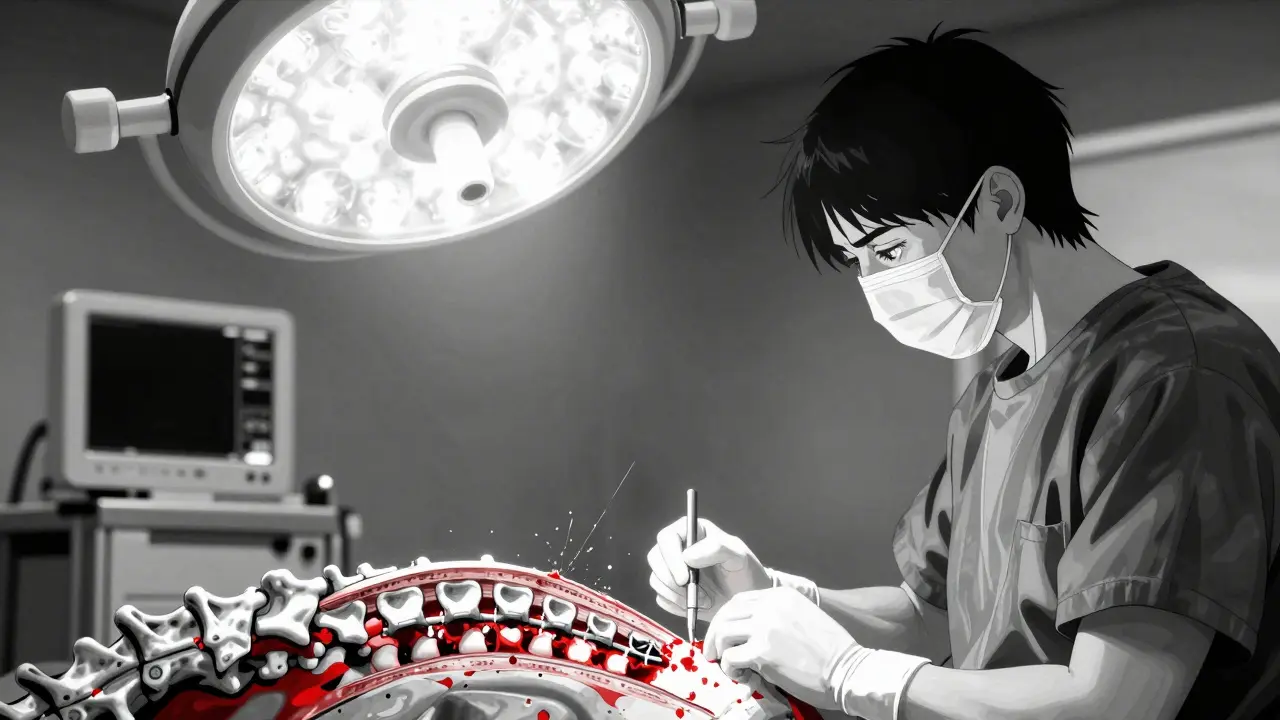
Spinal fusion is the go-to surgery for spondylolisthesis when everything else fails. The goal isn’t to push the bone back into place - it’s to stop it from moving anymore. You fuse the two vertebrae together so they grow into one solid bone.
There are three main ways to do it:
- Posterolateral fusion (PLF): This is the oldest method. Surgeons place bone grafts along the back of the spine and use screws and rods to hold everything still while the bone heals. It works well for mild slips (Grade I-II), with success rates of 75-85%. But for severe slips, it’s less reliable - only 60-70% success.
- Interbody fusion (PLIF/TLIF): This is now the most common. The surgeon removes the damaged disc between the two vertebrae and inserts a cage filled with bone graft. This restores disc height, opens up the nerve space, and gives a much better surface for fusion. Success rates? 85-92% across all grades. That’s why most surgeons now prefer this, especially for Grade III and IV slips.
- Minimally invasive fusion: Smaller incisions, less muscle cutting, and faster recovery. It’s used in about 10% of cases. The fusion success is similar to open surgery, but patients often go home sooner and have less pain right after.
One big advantage of interbody fusion: it doesn’t just stop movement - it can actually correct some of the deformity. By restoring disc height, it reduces pressure on nerves and improves posture.
What Happens After Surgery?
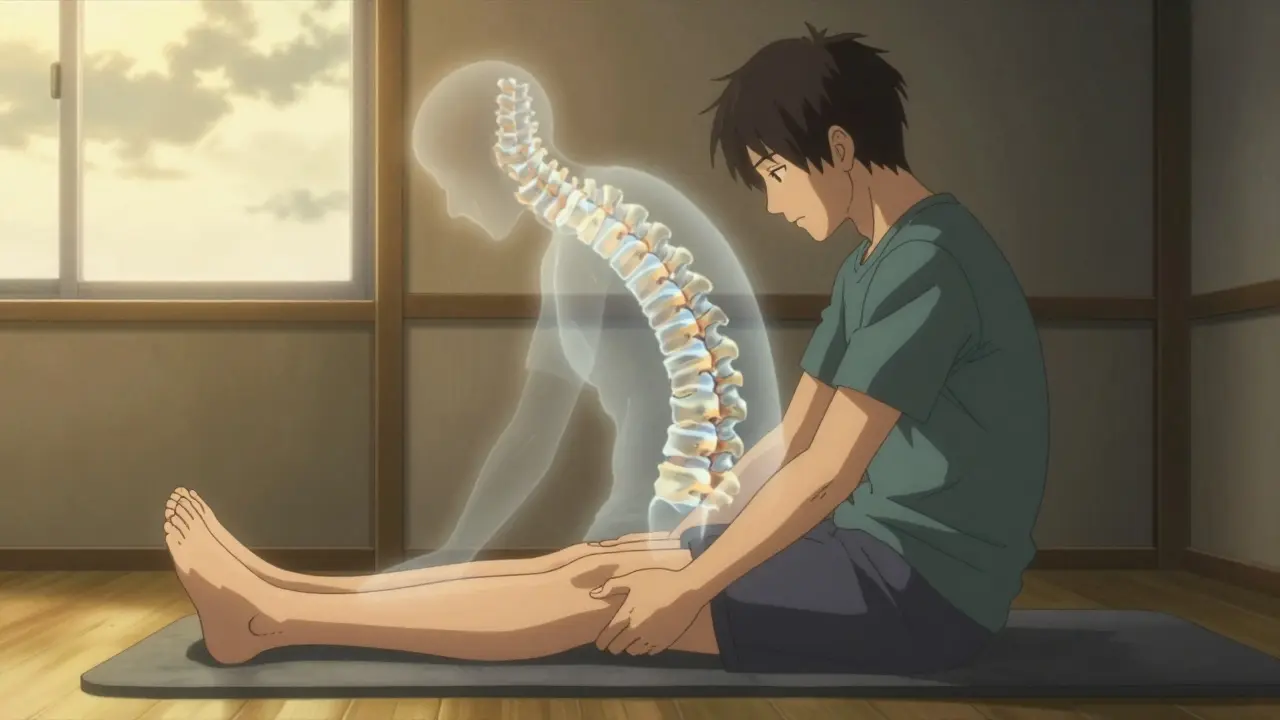
Fusion isn’t a quick fix. Recovery takes months.
- First 6-8 weeks: No heavy lifting, no twisting, no bending at the waist. You might wear a brace.
- Months 3-6: Physical therapy starts. Focus on gentle movement, core strength, and learning how to move safely.
- Full recovery: 12 to 18 months. That’s when the bone is truly fused, and you can return to most activities.
Success rates are high - 85-92% for interbody fusion. Patient satisfaction? Around 80% at the 2-year mark. But it’s not perfect. About 12-15% of people with severe slips need revision surgery later. Why? One common reason: adjacent segment disease. When you fuse two bones, the ones above and below take more stress. Over time, they can wear out too. About 18-22% of patients develop this within five years.
What About Newer Treatments?
There’s growing interest in alternatives to fusion - especially for mild cases.
- Dynamic stabilization: These are devices that limit movement but don’t fully fuse the spine. Think of them like a soft brace inside your back. Early results show 76% success over five years - good, but still lower than fusion’s 88%.
- Bone-growth stimulators: New devices approved in 2022 use special cages and materials that help bone heal faster. One study showed 89% fusion at six months - better than older implants.
- BMP and stem cells: Bone morphogenetic protein (BMP) is a lab-made substance that triggers bone growth. A 2023 trial found it pushed fusion rates to 94% in high-risk patients. Stem cell therapies are still experimental but promising.
Still, fusion remains the gold standard for moderate to severe cases. The key isn’t just the surgery - it’s picking the right patient. A 2023 study found 11 specific signs - from imaging details to pain patterns - that predict surgical success with 83% accuracy. That means doctors are getting better at knowing who will truly benefit.
Before You Decide: What You Need to Know
If surgery is on the table, don’t rush. These things matter:
- Stop smoking. Smokers have over three times the risk of the bone not fusing. Quitting even a few weeks before surgery helps.
- Manage your weight. A BMI over 30 increases complications by nearly half. Losing weight before surgery improves outcomes.
- Expect long recovery. You won’t be back to hiking or playing tennis in six weeks. It takes a year or more.
- Think long-term. Fusion stops movement at one level. That doesn’t mean your spine won’t wear out elsewhere. Stay active, stay strong, and keep your core tight.
There’s no one-size-fits-all. Some people do fine with therapy. Others need surgery to walk without pain. The goal isn’t to fix the slip - it’s to get you moving again.
Can spondylolisthesis get worse over time?
Yes, especially if you keep doing activities that stress the lower back - like heavy lifting or sports with repeated back arching. Degenerative slips can slowly progress as arthritis worsens. High-grade slips (Grade III or IV) are more likely to get worse. That’s why doctors monitor them with regular X-rays. But many slips stay stable for years, especially with proper activity changes and core strengthening.
Is spondylolisthesis hereditary?
There’s a strong genetic link. Studies show about 26% of children with spondylolisthesis have a close family member with the same condition. It’s not guaranteed - but if your parent or sibling has it, you’re more likely to develop it, especially if you’re active in sports. This is why doctors sometimes screen kids with a family history, even if they don’t have symptoms yet.
Do I need surgery if I have a Grade I slip?
Almost never. Grade I slips (less than 25% slippage) rarely cause serious problems. Most respond well to physical therapy, activity modification, and pain management. Surgery is only considered if pain lasts over a year despite conservative care, or if you develop leg weakness or numbness. The goal is to treat symptoms, not the slip itself.
Can I still exercise with spondylolisthesis?
Yes - but not all exercises are safe. Avoid anything that arches or twists your lower back: gymnastics, football, weightlifting, or deep backbends. Swimming, walking, stationary cycling, and Pilates (with proper form) are usually fine. Core strengthening and hamstring stretching are key. A physical therapist can design a safe routine based on your grade and symptoms.
Why does my hamstrings feel so tight?
When the L5 vertebra slips forward, it changes the angle of your pelvis. That pulls on the muscles and ligaments around your hips and lower back. Your hamstrings tighten as a protective response - they’re trying to stabilize your pelvis. Stretching them helps reduce tension and can ease lower back pain. It’s not just a coincidence - it’s a direct biomechanical effect of the slip.
Sarah Barrett
February 13, 2026 AT 22:52Spondylolisthesis is one of those quiet saboteurs-doesn’t announce itself, just slowly steals your mobility like a thief in the night. I’ve seen it in my mom’s spine on an X-ray, and even though she’s Grade I, the way she walks now-like she’s balancing a glass of water on her lower back-is heartbreaking. Physical therapy didn’t fix it, but it gave her back the ability to garden without wincing. That’s worth more than any surgery.
It’s wild how the body compensates. Tight hamstrings aren’t just tight-they’re screaming. And that swayback? That’s your spine’s last-ditch effort to keep you upright. We treat symptoms like they’re the enemy, but they’re just messengers.
And yet, so many doctors still treat this like a mechanical glitch you can bolt back into place. It’s not. It’s a whole-body story. You can’t fuse a person’s life back together with screws and bone grafts alone.
Maybe the real cure isn’t in the spine at all-it’s in the patience, the movement, the quiet daily choices to move differently. Not to fix. To adapt.
Josiah Demara
February 15, 2026 AT 14:14Let’s cut through the fluff. 80% of these cases don’t need surgery? That’s a lie peddled by physical therapists and insurance companies. If you have any slippage past 15%, you’re one bad sneeze away from nerve damage. The data cherry-picks mild cases and pretends they’re representative. My cousin had a Grade II slip and ended up with foot drop because his doctor told him to "try yoga first."
Interbody fusion isn’t just the gold standard-it’s the *only* standard that actually restores function. Posterolateral is for people who still believe in chiropractors and ice packs. Stop romanticizing conservative care. When your spine is sliding like a Jenga block, you don’t need a hug-you need a fusion.
Kaye Alcaraz
February 16, 2026 AT 14:38Thank you for writing this with such clarity. It’s rare to see a medical article that doesn’t talk down to the reader.
I’ve been through this twice-once as a patient, once as a caregiver. The biggest mistake people make? Thinking recovery is linear. It’s not. Some days you feel like you’re healing. Other days, your back feels like it’s made of wet cement.
But consistency matters more than intensity. Ten minutes of core work every morning. Walking while listening to a podcast. Not pushing through pain, but moving *with* it.
And yes-smoking is the enemy. Quitting wasn’t about willpower. It was about giving your body a fighting chance. One day at a time.
You’re not broken. You’re rebuilding. And that’s worth every step.
Charlotte Dacre
February 18, 2026 AT 03:32So let me get this straight-you’re telling me the solution to a slipped vertebra is to... sit down and stretch your hamstrings? I’m shocked. Who knew the answer to chronic pain was yoga and a good pair of sweatpants?
Meanwhile, in India, they’re doing spinal fusions with bamboo and prayer. Just kidding. But seriously, if you think this is a "lifestyle adjustment," you’ve never tried to lift a toddler while your spine feels like it’s trying to escape.
Chiruvella Pardha Krishna
February 19, 2026 AT 10:10There is a metaphysical truth here, beyond the bone and the disc.
The spine is not merely a column of vertebrae-it is the axis of the self. When one slips, it is not just the body that loses balance, but the soul’s alignment with gravity. We live in an age of mechanical fixes, yet we ignore the silent erosion of spirit that precedes the physical collapse.
Perhaps the true fusion is not between L5 and S1, but between the body and its stillness. The pain is not punishment. It is invitation.
Do we seek to mend the bone-or to listen to what it whispers?
Virginia Kimball
February 19, 2026 AT 11:29I had this at 28. Grade I. Thought I’d never walk again. Did PT for 18 months. Didn’t feel "cured." But I could carry groceries. Hike with my dog. Play with my nephew without wincing.
People think "conservative" means weak. Nah. It means stubborn. It means showing up every day even when it sucks. It means learning your body’s new language.
And yeah, fusion works. But so does patience. Don’t let anyone rush you into a knife just because you’re scared. You’ve got time. You’ve got options. You’ve got you.
Kapil Verma
February 19, 2026 AT 23:50Western medicine is a joke. We spend billions on titanium screws and cages while ignoring the root cause: weak moral fiber. In India, we treat back pain with yoga, fasting, and ancestral wisdom. No scalpel needed. No debt incurred.
You think fusion fixes anything? It just delays the inevitable. Your spine will still rot. Your body will still break. But at least now you’ve got a metal rod in you and a hospital bill bigger than your car.
Go home. Eat turmeric. Sit on the floor. Stop chasing American solutions to Indian problems.
Michael Page
February 20, 2026 AT 08:46The most interesting part isn’t the surgery.
It’s the fact that pain doesn’t correlate with slippage. Two people. Same X-ray. One feels fine. The other can’t stand.
That suggests the spine isn’t the problem.
It suggests the nervous system is the storyteller.
And if that’s true-then maybe we’ve been treating the wrong thing all along.
Betty Kirby
February 20, 2026 AT 21:45Let’s be real-most people who "do conservative care" just delay the inevitable. PT is a nice distraction until the pain gets unbearable. Then they crawl into surgery like a child into a blanket. And suddenly, they’re the ones bragging about how "they avoided surgery"-like it was some moral victory.
It’s not bravery. It’s denial.
And don’t get me started on "dynamic stabilization." That’s just fusion with a warranty you’ll never cash in.
Erica Banatao Darilag
February 21, 2026 AT 15:20i just wanted to say thank you for this post. i have spondylolisthesis and it took me 3 years to find someone who actually explained it like this. i thought i was just "old before my time" or "lazy"
the part about hamstrings being tight because of pelvic tilt? that was a lightbulb moment. i’ve been stretching them for years but never understood why they wouldn’t loosen. now i get it. it’s not a muscle problem. it’s a structural one.
also, i quit smoking last month. it’s hard but i’m doing it for the fusion i might need someday. not because i want to, but because i need to.
you made me feel less alone.
Esha Pathak
February 21, 2026 AT 18:06My dad had this. Grade III. He refused surgery. Said, "My body is my temple." Five years later, he couldn’t stand to brush his teeth. Now he’s got a fusion. And he’s walking again.
Don’t romanticize suffering. Sometimes the bravest thing you can do is say, "I need help."
And if you’re reading this and you’re scared of surgery? You’re not weak. You’re human.
But healing isn’t about stubbornness. It’s about wisdom.
And wisdom says: when your spine is sliding, let the doctors help you glue it back together. 💪
Joe Grushkin
February 23, 2026 AT 11:09Oh wow. A 92% success rate for interbody fusion? That’s statistically impossible. You’re either lying or you’re reading studies from 1998. Modern fusion rates are closer to 65% with high complication rates. And don’t get me started on adjacent segment disease-it’s not a side effect, it’s a guaranteed consequence.
Also, why is everyone so obsessed with fusion? Have you ever heard of motion-preserving implants? No? Because Big Pharma doesn’t want you to know about them.
This article reads like a Medtronic pamphlet. Spoiler: you’re not being helped. You’re being monetized.