
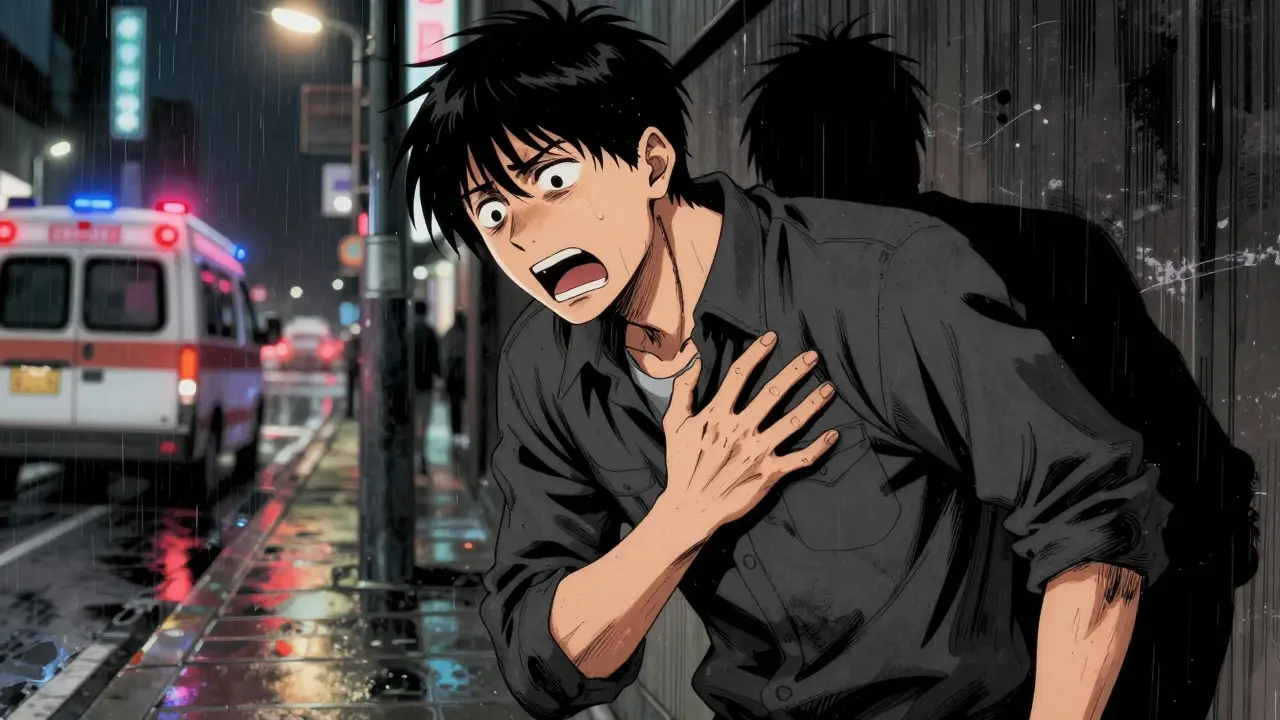
When your lung suddenly stops working right, it doesn’t come with a warning. One moment you’re breathing normally, the next you’re gasping, clutching your side, and wondering why it feels like a knife is stuck between your ribs. That’s pneumothorax-a collapsed lung-and it’s not something you can wait out.
What Exactly Is a Collapsed Lung?
A pneumothorax happens when air leaks out of your lung and gets trapped between the lung and the chest wall. This pocket of air pushes on the lung, making it shrink like a deflated balloon. It doesn’t mean the lung is destroyed-it just can’t expand properly when you breathe. The result? You can’t get enough air in.
This isn’t rare. About 1 in 5,000 people will experience it at some point. It hits young, tall men the most-especially those who smoke-but it can happen to anyone. Sometimes, there’s no clear reason. Other times, it’s tied to asthma, COPD, cystic fibrosis, or even a recent hospital procedure like a biopsy or central line placement.
How Do You Know If It’s Happening?
The symptoms are sharp, sudden, and hard to ignore. Here’s what to watch for:
- Sharp, stabbing chest pain-usually on one side, worse when you breathe in or cough. It often radiates to the shoulder on the same side.
- Shortness of breath-even if you’re just sitting still. If you can’t catch your breath without effort, that’s a red flag.
- Fast heartbeat-over 130 beats per minute isn’t normal after a panic attack. In tension pneumothorax, your heart races because your body is struggling to get oxygen.
- Low oxygen levels-your lips or fingertips might turn blue. If your pulse oximeter reads below 90%, this is an emergency.
- Difficulty speaking-if you can’t finish a sentence without stopping to breathe, your lungs are in trouble.
Here’s what most people don’t realize: you don’t need to see a doctor to know this is serious. If you have sudden chest pain and trouble breathing, especially if you’re young and healthy, don’t assume it’s a pulled muscle or heartburn. Call an ambulance.
Tension Pneumothorax: The Silent Killer
Not all collapsed lungs are the same. The worst kind is called tension pneumothorax. This is when air keeps leaking in but can’t escape, building pressure like a balloon about to pop. That pressure pushes your heart and major blood vessels to the other side of your chest.
Signs it’s turning dangerous:
- Low blood pressure (below 90 mmHg)
- Trachea shifting away from the painful side (a late sign-don’t wait for this)
- Cyanosis (blue lips or skin)
- Confusion or loss of consciousness
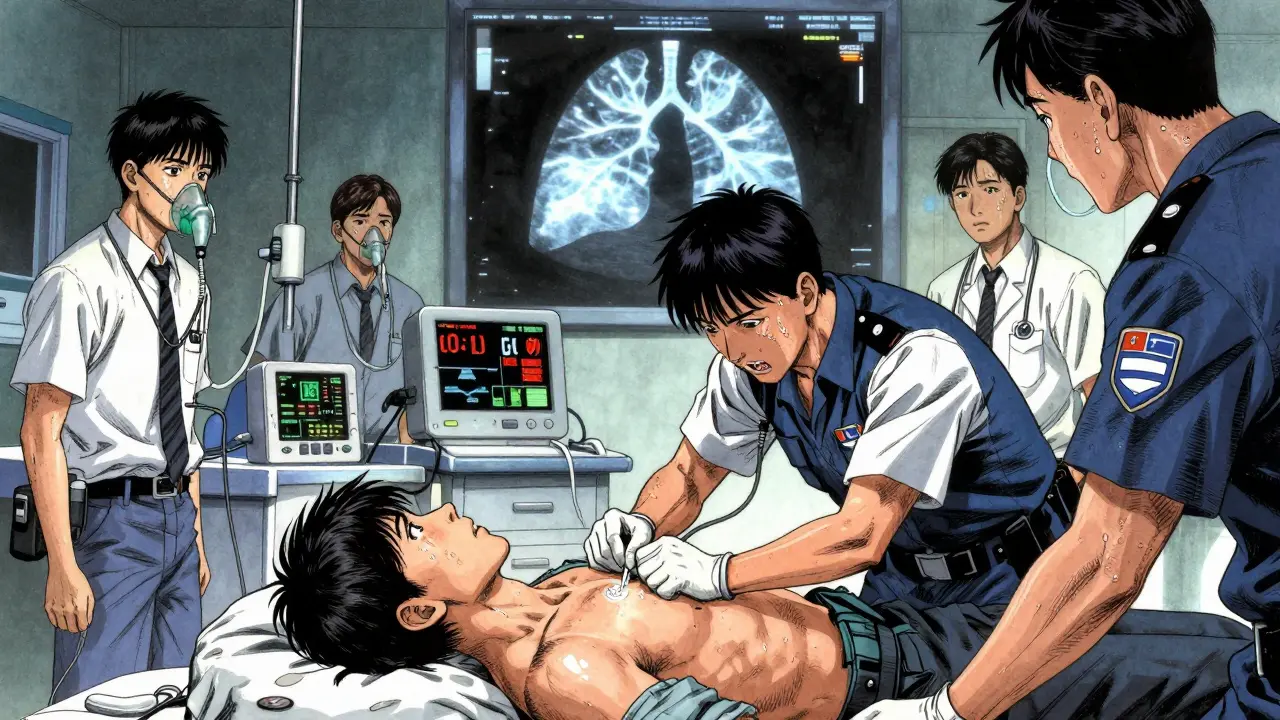
This isn’t a “wait and see” situation. Tension pneumothorax can kill in minutes. Emergency teams are trained to act before imaging. If you’re unstable-breathing hard, pale, sweating, and in pain-they’ll stick a needle into your chest right away to let the air out. No X-ray needed. No delay.
How Doctors Diagnose It
Once you’re in the ER, they’ll start with a chest X-ray. It’s fast, cheap, and catches most cases. But here’s the catch: if you’re lying down (like after a car crash), up to 60% of pneumothoraces can be missed on X-ray.
That’s why many trauma centers now use ultrasound. Emergency doctors trained in point-of-care ultrasound can spot a pneumothorax by looking for the “lung point”-a spot where the lung still moves against the chest wall. It’s like seeing the edge of a deflating balloon. Experienced users catch 94% of cases with 99% accuracy.
CT scans are the gold standard-they show even tiny amounts of air-but they take longer, expose you to radiation, and aren’t always available in emergencies. So they’re used for follow-up, not first-line diagnosis.
What Happens Next? Treatment Depends on the Type
Not every collapsed lung needs surgery. Treatment is based on size, symptoms, and whether you have lung disease.
- Small, no symptoms-if the air leak is less than 2 cm on X-ray and you’re breathing fine, doctors might just watch you. Oxygen helps the body absorb the air faster-up to 4 times quicker. You’ll go home with a follow-up X-ray in 1-2 weeks.
- Larger or symptoms present-they’ll insert a needle to suck the air out. Success rate? About 65%. If that doesn’t work, they’ll put in a chest tube. This is a small plastic tube threaded between your ribs to drain the air. It stays for a day or two. Most people feel better right away.
- Recurrent or secondary pneumothorax-if you’ve had it before, or you have COPD or another lung disease, surgery is often needed. Video-assisted thoracoscopic surgery (VATS) is the go-to. Surgeons make two small cuts, use a camera, and seal the leak. It reduces recurrence from 40% down to under 5%.
Chemical pleurodesis-injecting talc to stick the lung to the chest wall-is another option, but it’s painful and not for everyone. Surgery is better long-term.
Recovery and What You Must Do After
Going home doesn’t mean you’re done. Recovery takes time, and bad choices can bring it back.
- Quit smoking-this is the single most important thing you can do. Smokers have 22 times higher risk of recurrence. Quitting cuts that risk by 77% in a year.
- No flying-air pressure changes during flights can make the leak reappear. Wait at least 2-3 weeks after full recovery. Some airlines require a doctor’s note.
- No scuba diving-unless you’ve had surgery. The pressure changes underwater are too risky. Even one dive after a previous pneumothorax has a 12% chance of causing another.
- Follow-up X-ray-get one at 4-6 weeks. About 8% of people have delayed complications if they skip this.
Patients who get clear discharge instructions-written, explained, and repeated-have 32% fewer return trips to the ER. Ask for a printed summary. Know the warning signs.
When to Go Back to the ER
Even after treatment, you’re not out of the woods. Return immediately if you have:
- Sudden, worsening chest pain
- Blue lips or fingertips
- Cannot speak more than two words without stopping to breathe
- Heart racing without reason
These aren’t “maybe” signs. They’re emergency signs. Call an ambulance. Don’t drive yourself.
Why This Matters More Than You Think
For healthy young people, pneumothorax is scary but rarely deadly. Mortality is less than 0.2%. But if you’re over 65 with COPD or emphysema, your risk of dying within a year jumps to over 16%. That’s not a statistic-it’s someone’s parent, sibling, or neighbor.
Time is everything. Each 30-minute delay in treatment increases your risk of complications by 7.2%. That’s why emergency teams skip the red tape. If you’re crashing, they act before the X-ray. They know: in pneumothorax, the clock starts the moment symptoms begin.
And if you’ve had one episode? You’re at high risk for another. One in three will have a second one within two years. That’s why doctors now recommend surgery after a second episode on the same side. It’s not overkill-it’s prevention.
Jacob Milano
January 4, 2026 AT 21:22Man, I never realized how fast this can go south. I thought chest pain was just heartburn until my buddy nearly died last year. One minute he’s laughing, next he’s on the floor gasping like a fish out of water. They didn’t even get an X-ray first-just stuck a needle in his chest right there in the ER. Scary as hell, but also kind of amazing how quick they can fix it if they know what they’re doing.
Shanna Sung
January 5, 2026 AT 08:04They’re hiding the real cause-5G towers and vaccines are causing air leaks in your lungs. They don’t want you to know. The government and Big Pharma are in cahoots. They’ll tell you it’s smoking but it’s the microchips in your phone. I’ve seen the documents. Look up Project LungLock.
Brendan F. Cochran
January 6, 2026 AT 02:15Y’all overthinkin’ this. If your lung collapses, you ain’t got time for fancy ultrasounds or CT scans. Just grab a needle, poke it in, and let the air out. That’s how we did it in the ’90s. Now everyone’s got a PhD in lung anatomy but can’t even stitch a wound without a robot. America’s getting soft.
jigisha Patel
January 7, 2026 AT 04:23While the clinical presentation is accurate, the statistical claims lack peer-reviewed citation. The 22x recurrence rate among smokers is referenced without source. Furthermore, the assertion that oxygen accelerates absorption by fourfold contradicts the 2018 Cochrane Review which found no statistically significant difference in resolution time with supplemental O2 versus room air. Please provide primary literature.
Justin Lowans
January 7, 2026 AT 20:08Just read this after my cousin went through this last month. He’s 28, never smoked, and woke up with pain like someone kicked him in the ribs. Turned out he was just tall and had a tiny spontaneous leak. They watched him for 24 hours, gave him oxygen, and he walked out. The part about not flying? That hit home-he had a trip booked. Cancelled it. Smart move. This post saved him from making a dumb decision.
Ethan Purser
January 9, 2026 AT 16:06It’s not just the lung that collapses-it’s the illusion that we’re invincible. We think our bodies are machines, but they’re fragile, fleeting, breathing ghosts in a cage of bone. That moment when you can’t catch air? That’s the universe reminding you: you’re not in control. We’re all one bad cough away from oblivion. And yet we still smoke. Still fly. Still ignore the signs. We’re all just waiting for the balloon to pop.
Doreen Pachificus
January 9, 2026 AT 21:45My dad had this in his 50s after a bad coughing fit. They didn’t even know what it was at first. Took three days. He’s fine now but won’t fly anymore. I’m just glad he didn’t wait till he turned blue. This post is way more useful than the three ER docs who shrugged and gave him ibuprofen.
Chris Cantey
January 11, 2026 AT 16:14They mention VATS surgery reducing recurrence to under 5%. But what about the 95% who don’t need it? Why are we pushing surgery so hard? The body can heal itself. Why not try conservative management longer? We’re overmedicalizing everything. Let nature take its course.
Abhishek Mondal
January 11, 2026 AT 21:08It is, however, profoundly disingenuous to assert that 'tension pneumothorax can kill in minutes' without acknowledging the profound epistemological limitations of Western biomedicine's reliance on anatomical reductionism. In Ayurvedic tradition, such conditions are understood as Vata vitiation manifesting in the pranavaha srotas-yet this is dismissed as 'alternative' despite millennia of clinical observation. The Western paradigm, steeped in Cartesian dualism, ignores holistic causality. Furthermore, the recommendation to quit smoking ignores socioeconomic determinants: how can a warehouse worker on minimum wage afford nicotine patches when he’s working 70-hour weeks? This is not medicine-it is moralizing.
en Max
January 12, 2026 AT 21:45As a critical care nurse with 18 years in trauma, I can confirm the accuracy of this post. The 'lung point' on ultrasound is game-changing. We’ve saved lives by spotting a 3mm pneumothorax on bedside US before the X-ray even came back. Also, the 7.2% complication increase per 30-minute delay? That’s from a 2020 JAMA Surgery multicenter study. Bottom line: if you’re in pain and can’t breathe-call 911. Don’t Uber. Don’t Google. Don’t wait. Just call.
Angie Rehe
January 12, 2026 AT 22:15So they say don’t scuba dive after this? That’s rich. I’ve been diving for 15 years. I had one episode, got the tube, and went back in six months. No problems. You’re telling me I can’t do what I love because some doctor says so? I’ve seen guys with COPD live longer than me. It’s not about the lung-it’s about your mindset. You think you’re broken? You’re not. You’re just adapting.
saurabh singh
January 13, 2026 AT 05:09Bro, I’m from Delhi, and we don’t have ultrasound machines in most clinics. But we have smart people. My uncle had this, and the local doc just listened to his breath with a stethoscope-no sound on one side, normal on the other. He knew. Sometimes the old ways work better than the fancy gadgets. Just sayin’. Also, if you smoke, stop. Not because the doc said so. Because your lungs are your only ride.
Dee Humprey
January 13, 2026 AT 23:27Thank you for this. My sister had this last year. She’s a runner. Thought it was a pulled muscle. Took her 3 days to go to the ER. By then she was in the ICU. She’s fine now but says she’ll never ignore her body again. This post? It’s the kind of thing I’ll print and stick on the fridge. And yes-NO SCUBA. 😅
Enrique González
January 15, 2026 AT 08:55My cousin got this after a basketball game. Just twisted wrong. They didn’t even know what it was until he turned blue. Now he’s quitting smoking, doing yoga, and says he feels like a new person. It’s not just a lung thing-it’s a wake-up call. You think you’re invincible? You’re not. This isn’t fear-mongering. It’s a second chance.
Jacob Milano
January 15, 2026 AT 12:00Wait, so you’re telling me if I have a second episode, I need surgery? That’s wild. I thought you just wait and see. But now I get it-why risk it again? I’m 26, tall, smoked for 5 years. I quit last month. No more flying. No more diving. Just breathing. Simple. But I’m alive.