
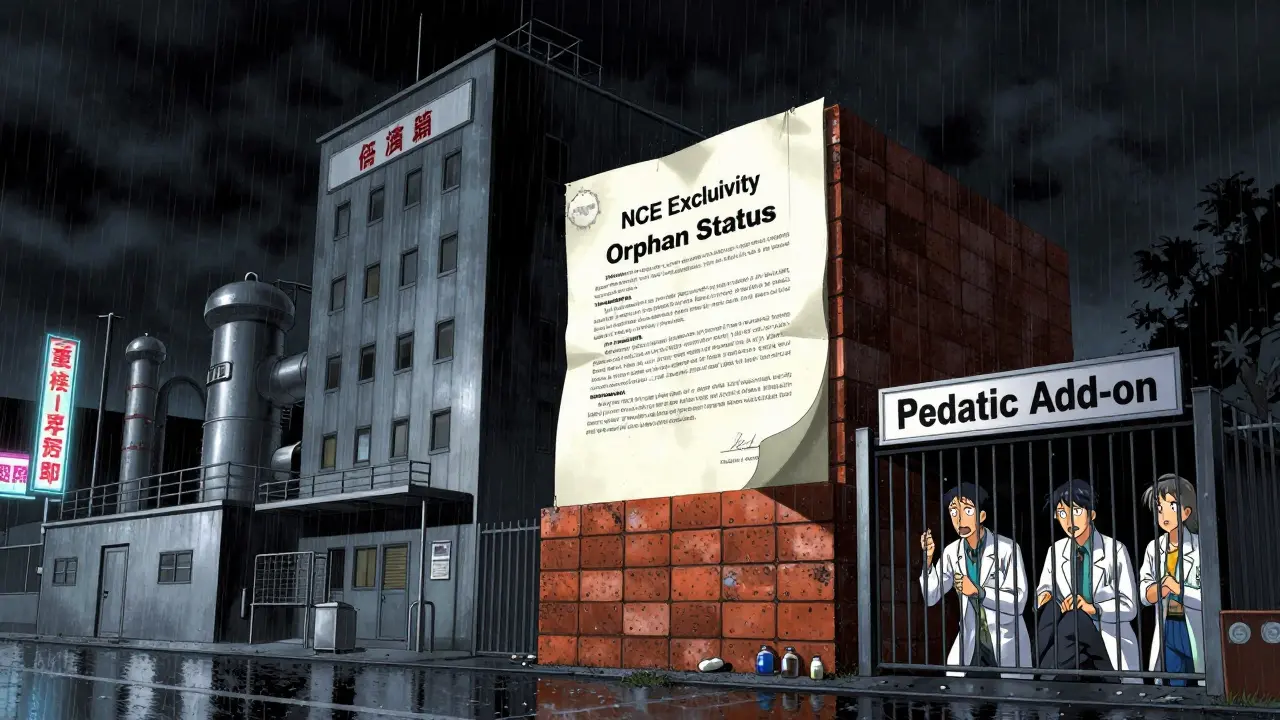
Most people think patents are the only thing protecting drug prices. If a patent expires, generics come in, prices drop, and everyone wins. But that’s not what happens in real life. In fact, market exclusivity-not patents-is often the real barrier keeping generics off shelves. Even after a patent runs out, a drug can stay monopoly-priced for years, sometimes decades, thanks to a web of regulatory tricks built into U.S. and EU law.
Patents Aren’t the Whole Story
The 20-year patent clock starts when a drug is first invented, not when it hits the market. By the time a drug clears clinical trials and gets FDA approval, it’s often already halfway through its patent life. That leaves maybe seven or eight years to make back the $2.3 billion it cost to develop. So regulators created market exclusivity-a separate, parallel system that gives drugmakers extra time to sell without competition. This isn’t a loophole. It’s written into law. The 1984 Hatch-Waxman Act was meant to balance innovation and access. But today, companies use it to stack protections like LEGO blocks. One drug can have a patent extension, orphan status, pediatric add-ons, and new indication exclusivity-all at the same time. The result? Many drugs stay price-protected for 15, 20, even 25 years after approval.How the U.S. System Stacks Exclusivity
In the U.S., there are five main types of market exclusivity beyond patents:- New Chemical Entity (NCE) exclusivity: 5 years of market protection for a drug with a completely new active ingredient. No generics allowed, even if the patent expired.
- Orphan Drug exclusivity: 7 years for drugs treating rare diseases (fewer than 200,000 U.S. patients). Even if the patent is gone, no other company can market the same drug for that condition.
- New Clinical Investigation exclusivity: 3 years for a new use, dosage, or formulation of an existing drug. But here’s the catch: the FDA now demands real clinical proof of benefit, not just minor tweaks.
- Pediatric exclusivity: A 6-month bonus added to any existing exclusivity period. Companies must complete FDA-requested pediatric studies. For blockbuster drugs, that’s billions in extra revenue.
- Patent challenge exclusivity: The first generic company to successfully challenge a patent gets 180 days of exclusive market access. It’s a race to the courthouse.
The European Edge: SPCs and Data Exclusivity
The EU doesn’t use patent term extensions the same way. Instead, it relies on Supplemental Protection Certificates (SPCs). These can extend market exclusivity up to 15 years after drug approval, with a maximum of 5 years added to the original 20-year patent. That’s one year longer than the U.S. cap. Europe also has a strong data exclusivity system: 8 years of data protection, plus 2 years of market exclusivity, and an extra year if pediatric studies are done. That’s 11 years total for new drugs, regardless of patent status. For orphan drugs, the EU gives 10 years of exclusivity-extended to 12 if pediatric data is submitted. That’s longer than the U.S. 7-year rule. But here’s the twist: the EU doesn’t allow stacking of exclusivity types the way the U.S. does. One exclusivity period usually applies at a time. That makes the U.S. system more powerful for extending monopolies.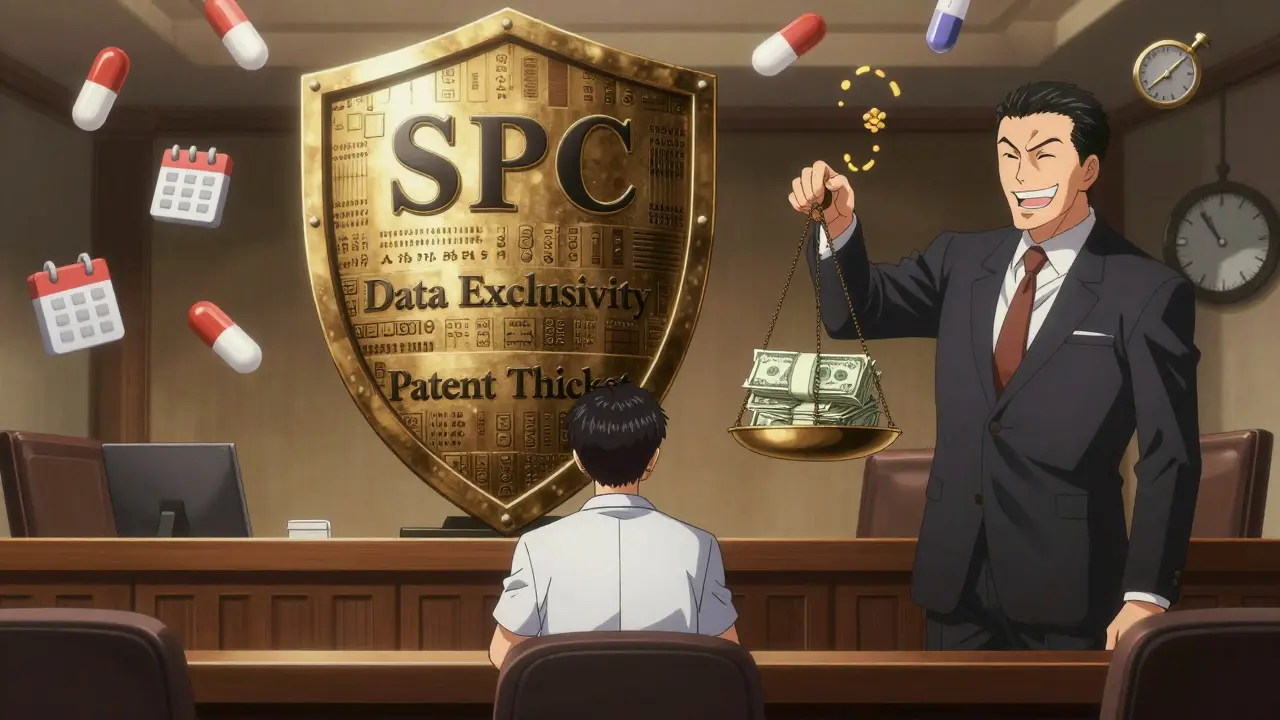
How Companies Game the System
The real game isn’t just getting exclusivity-it’s multiplying it. Take tazarotene, a skin drug. The core patent expired. But the company filed 48 secondary patents covering things like packaging, dosing schedules, and delivery methods. Each one delayed generic entry by a few months. It’s called a “patent thicket.” Another tactic is “product hopping.” Just before a patent expires, a company launches a slightly changed version-say, a pill instead of a liquid, or a once-daily instead of twice-daily. Then they stop selling the old version. Doctors switch to the new one. Generics can’t copy it because it’s not the same product. Teva reported this delayed generics for 17% of their targeted drugs. And then there’s the timing game. Some companies wait until after Phase II trials to file their main patent. That way, the 20-year clock doesn’t start ticking until the drug is closer to market. It’s legal. And it’s common. Companies like Novartis and Bristol Myers Squibb do it regularly.Why It Matters: Billions at Stake
In 2022, branded drugs made up just 10% of prescriptions in the U.S.-but 78% of spending. Why? Because market exclusivity keeps prices high. A 2023 study in JAMA Health Forum looked at four top-selling drugs: bimatoprost, celecoxib, glatiramer, and imatinib. When generics finally entered, the extra market exclusivity had already added $3.5 billion in spending over just two years. That’s not inflation. That’s monopoly pricing. For rare diseases, exclusivity is a lifeline. Orphan drug designations have jumped from 201 in 2010 to over 1,000 in 2022. That’s because without exclusivity, no company would spend $1 billion to treat 50,000 people. But critics say the system is being abused. Some companies file orphan status for drugs that could treat common conditions, just to lock in 7 years of protection.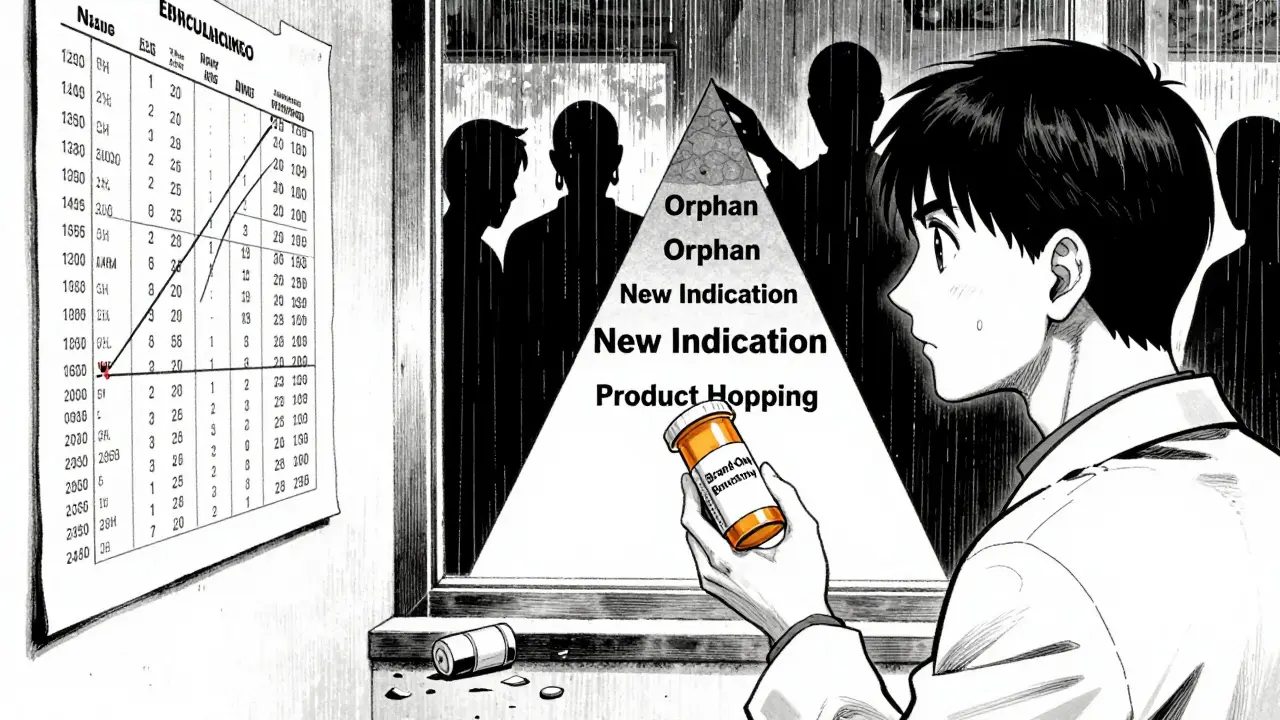
Regulators Are Fighting Back
The FDA and FTC are starting to push back. In April 2023, the FDA tightened rules for 3-year new indication exclusivity. Now, companies must prove their new use actually improves patient outcomes-not just changes how the drug is taken. The FTC filed a legal brief in June 2023 arguing that product hopping violates antitrust laws. That could open the door to lawsuits against companies that pull the old drug off shelves to block generics. The European Commission is also reviewing its SPC rules, aiming to stop companies from extending exclusivity for minor changes. A pilot program in September 2023 sped up pediatric study reviews, hoping to encourage real innovation instead of gaming the system.What This Means for Patients and Payors
If you’re paying for a drug out of pocket, or your insurer is covering it, market exclusivity directly affects your bill. The average new drug now enjoys 12.7 years of protection post-approval. By 2028, that’s expected to hit 16.3 years. That’s nearly two decades without generic competition. For patients with rare diseases, this system works. It’s why treatments for conditions like cystic fibrosis or spinal muscular atrophy exist. Vertex Pharmaceuticals extended exclusivity for its cystic fibrosis drugs to over 20 years by combining orphan status, pediatric add-ons, and patent extensions. But for common conditions-high blood pressure, diabetes, depression-these extensions mean higher costs for everyone. And they’re not about innovation. They’re about delaying competition.The Bottom Line
Patents are just the beginning. Market exclusivity is where the real battle for drug prices is fought. It’s complex, legal, and incredibly profitable for manufacturers. But it’s also why generic drugs take so long to arrive-and why drug spending keeps rising. The system was meant to reward innovation. Today, it often rewards clever lawyers and regulatory strategists. And unless regulators tighten the rules, those 20-year monopolies will keep getting longer.How long can a drug stay protected after its patent expires?
A drug can stay protected for years-or even decades-after its patent expires through market exclusivity. In the U.S., a combination of orphan drug exclusivity (7 years), pediatric exclusivity (6 months), and new indication exclusivity (3 years) can stack on top of patent term extensions. Some drugs, like those with multiple exclusivity layers, remain protected for 20+ years after approval. In the EU, Supplemental Protection Certificates (SPCs) can extend protection up to 15 years post-approval, plus data exclusivity.
What’s the difference between a patent and market exclusivity?
A patent is a legal right granted by the USPTO to protect an invention, usually for 20 years from filing. Market exclusivity is a regulatory protection granted by the FDA or EMA that blocks generic competitors from entering the market, regardless of patent status. Exclusivity is automatic if you meet criteria like being a new chemical entity or treating a rare disease. You can have exclusivity without a patent-and vice versa.
Can a generic drug enter the market if the patent is expired but exclusivity is still active?
No. Even if a patent has expired, a generic drug cannot be approved or sold until all active market exclusivity periods have ended. The FDA will not approve a generic application if the brand drug still holds orphan exclusivity, pediatric exclusivity, or new indication exclusivity. These protections are independent of patents and are enforced by regulatory agencies.
Why do pharmaceutical companies file so many secondary patents?
Secondary patents cover minor changes-like new dosages, delivery methods, or packaging-that don’t improve clinical outcomes but still qualify for patent protection. By filing dozens of these, companies create a “patent thicket” that makes it expensive and risky for generics to challenge. For example, the drug tazarotene had 48 secondary patents. Each one can delay generic entry by months or years, even if the core patent is expired.
Is orphan drug exclusivity only for rare diseases?
Yes, by definition. In the U.S., a disease must affect fewer than 200,000 people to qualify for orphan drug status. In the EU, the threshold is fewer than 5 in 10,000 people. But critics point out that some companies apply for orphan status for drugs that could treat more common conditions, just to lock in 7-12 years of exclusivity. The FDA has started cracking down on this, requiring stronger proof of true rarity and lack of alternative treatments.
Do market exclusivity extensions help innovation or just delay competition?
They do both. For truly novel treatments-especially for rare diseases-they’re essential. Without exclusivity, companies wouldn’t invest billions to treat small patient groups. But for common drugs, the system is often used to extend monopolies through minor changes, not real innovation. Studies show that 91% of drugs with patent extensions keep their monopolies long after those extensions expire, thanks to stacked exclusivities. The line between incentive and abuse is thin-and regulators are starting to draw it.
Andy Thompson
January 20, 2026 AT 00:52They’re laughing all the way to the bank while we pay $500 for a pill that costs 50 cents to make. 🤡 Big Pharma’s got the whole system rigged-patents, exclusivity, pediatric add-ons, you name it. It’s not capitalism, it’s corporate feudalism. And the FDA? More like FDA = For Drug Assassins. 🇺🇸💸
sagar sanadi
January 20, 2026 AT 09:57lol so drugs are expensive because they are 'special'? nah bro. they just pay lawyers to write magic words into laws. 7 years? 12 years? what next? 100 years? next thing you know, aspirin will be patented again.
kumar kc
January 20, 2026 AT 22:50This is theft disguised as policy. No one should profit from locking life-saving medicine behind legal barricades.
Thomas Varner
January 22, 2026 AT 17:32Wow. Okay. So… the system was designed to balance innovation and access… but now it’s just… a maze? Like, literally, you file a patent, then a pediatric add-on, then a new formulation, then a packaging patent, then… wait, did they just change the color of the pill? And now it’s another 5 years? 😅 I mean… I get why companies do it… but wow. That’s a lot of legal gymnastics for zero clinical benefit.
Edith Brederode
January 23, 2026 AT 00:37This is so important to understand 💔 I had a friend who couldn’t afford her insulin until generics came out… and it took 18 years. 18. Years. We need to fix this. 🤍
Arlene Mathison
January 23, 2026 AT 22:13Let’s not forget-without these protections, we wouldn’t have treatments for rare diseases at all. People with SMA, cystic fibrosis, Duchenne’s-they’re alive because of this system. The abuse? Yeah, that’s real. But don’t throw the baby out with the bathwater. We need reform, not revolution.
thomas wall
January 24, 2026 AT 11:51The erosion of public trust in pharmaceutical institutions is not incidental-it is systemic. The deliberate manipulation of regulatory frameworks to extend monopolistic rents constitutes, in effect, a form of legalized extortion. The moral hazard is not merely apparent; it is institutionalized.
Paul Barnes
January 25, 2026 AT 06:09Actually, the Hatch-Waxman Act was designed to incentivize generic entry, not block it. The problem isn’t the law-it’s how corporations exploit loopholes. The FDA’s recent crackdown on ‘product hopping’ and weak new indication claims is a step in the right direction. But enforcement is still weak.
Manoj Kumar Billigunta
January 25, 2026 AT 11:46Hey, I get it-companies want to make money. But when a kid with a rare disease can’t get their medicine because the company is busy filing patents on the color of the capsule… that’s not business. That’s cruel. We can fix this. We just need to care enough to push for change.
pragya mishra
January 26, 2026 AT 22:07Why are we still letting this happen? If you can’t prove your drug actually helps more than the old version, you shouldn’t get extra years. Stop hiding behind ‘innovation’ when you’re just changing the bottle.
Courtney Carra
January 28, 2026 AT 20:13It’s fascinating, really. We’ve turned healthcare into a legal chess game where the pieces are patents, the board is the FDA, and the players are billionaires in suits. The endgame? Profit. The players? Us. The checkmate? A generation of people who can’t afford to live. 🤔
Shane McGriff
January 29, 2026 AT 18:15Reading this made me realize how much I took generics for granted. I never knew that even after a patent expired, the drug could still be locked up. That’s insane. I’m going to start looking into how my meds are protected-maybe I can help push for change. We all need to be more aware.
Jacob Cathro
January 30, 2026 AT 06:26pharma = evil. patent thickets? product hopping? srsly? they’re not innovating-they’re just playing monopoly with our health. and the fda? they’re basically the bouncer at a club where only rich companies get in. #pharmabro