
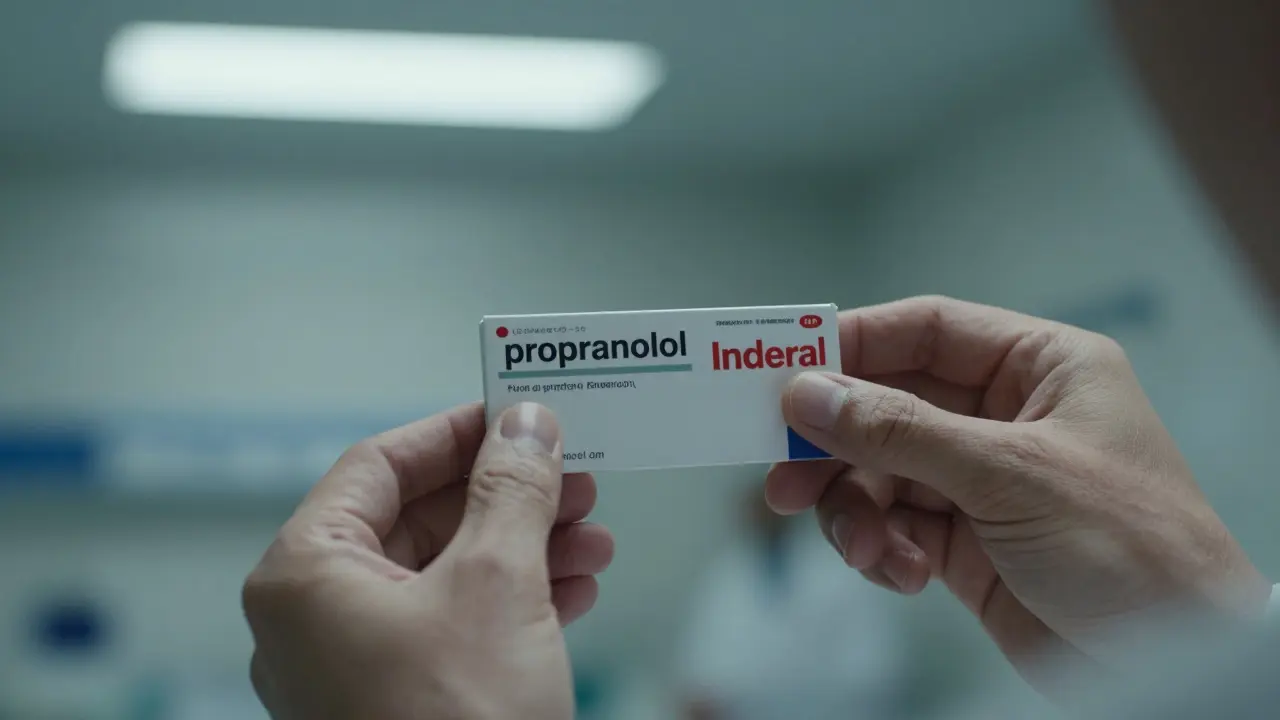
Ever picked up a prescription and wondered why the pill has three different names? You’re not alone. The same medicine might be called something scientific like 1-(isopropylamino)-3-(1-naphthyloxy) propan-2-ol on a lab report, propranolol on the bottle, and Inderal on the box. It’s confusing-but there’s a system behind it. And that system saves lives.
Why Drug Names Even Exist
Drugs aren’t just chemicals floating around. They’re tools used by millions every day. If every pharmacy, doctor, and patient used a different name for the same drug, mistakes would happen. A lot of them. The Institute of Medicine found that in the U.S. alone, at least 1.5 million preventable medication errors happen each year. Some of those come down to names that sound alike or look too similar. That’s why we have a global naming system-designed to be clear, consistent, and safe.
This system has three layers: chemical names, generic names, and brand names. Each one serves a different purpose. Think of it like a person’s full legal name, their common nickname, and their business title. All refer to the same person-but used in different contexts.
Chemical Names: The Science Version
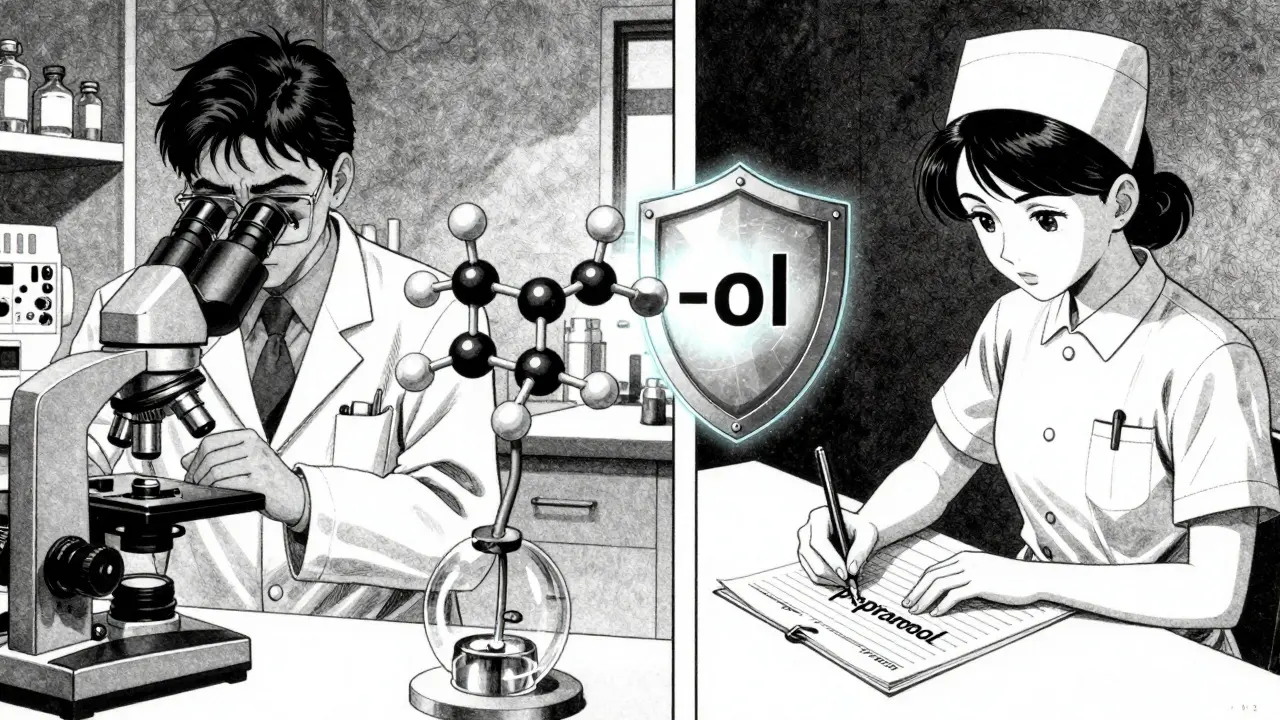
Chemical names are built using rules from the International Union of Pure and Applied Chemistry (IUPAC). They describe the exact structure of the molecule-every bond, every atom, every group. For example, the chemical name for propranolol is 1-(isopropylamino)-3-(1-naphthyloxy) propan-2-ol. That’s 50+ characters long. It’s precise. But it’s useless in a hospital.
Imagine a nurse trying to write that on a chart. Or a pharmacist shouting it over the counter. Or a patient trying to remember it. It’s not practical. Chemical names are for chemists, researchers, and patent lawyers. They’re the DNA of the drug. Useful in labs, but not in clinics.
That’s why we need something shorter. Something easier. Enter the generic name.
Generic Names: The Standardized Shortcut
Generic names-also called nonproprietary names-are the official public names for drugs. They’re assigned by global and national bodies like the World Health Organization (WHO) and the U.S. Adopted Names (USAN) Council. These names are designed to be clear, pronounceable, and informative.
Here’s the secret: the ending of a generic name tells you what kind of drug it is. These endings are called stems. And they’re not random.
- Drugs ending in -prazole (omeprazole, esomeprazole, pantoprazole) are proton pump inhibitors-used for acid reflux.
- Drugs ending in -tinib (imatinib, sunitinib, dasatinib) are tyrosine kinase inhibitors-used in cancer treatment.
- Drugs ending in -mab (adalimumab, rituximab) are monoclonal antibodies-targeted therapies for autoimmune diseases and cancer.
- Drugs ending in -citinib (tofacitinib, upadacitinib) are Janus kinase inhibitors-used for rheumatoid arthritis.
The prefix-the part before the stem-is what makes each drug unique. It’s chosen to be phonetically distinct. The USAN Council rejects about 30% of proposed generic names because they sound too similar to existing ones. That’s not bureaucracy. That’s safety.
Dr. Robert M. Goggin, former head of the USAN Council, said that well-designed generic names reduce medication errors by 27%. That’s not a guess. That’s data from real-world hospital studies.
Generic names are used by doctors when they write prescriptions. They’re used by pharmacists when they dispense pills. And they’re used by insurance companies when they decide what to cover. The brand name? That’s optional.
Brand Names: The Marketing Layer
Brand names are what drug companies choose to sell their product. These are the names you see on TV ads: Prilosec, Lyrica, Humira. They’re catchy. Memorable. Sometimes they sound like they’re from a sci-fi movie.
But here’s the catch: brand names have to pass a safety filter. The FDA doesn’t just approve them because they sound nice. They check for confusion risk.
Companies submit 150-200 name options. The FDA’s Medication Errors team screens them using software that checks spelling, sound, and even how they look when handwritten. About one in three names get rejected. Why? Because Hyzaar and Hytrin sound too similar. Because Propecia could be mistaken for Prozac. Because a name like Glucovance might be confused with Glucophage-and that could mean a diabetic patient gets the wrong dose.
Brand names also can’t make claims. You won’t see a drug called QuickCure or InstantRelief. The FDA bans those. They’re misleading. The only thing the brand name can do is identify the product. Everything else? That’s in the label.
And here’s something people don’t realize: generic and brand drugs are the same medicine. They contain the same active ingredient, in the same strength, in the same form-tablet, capsule, injection. The only differences are in the color, shape, flavor, or inactive ingredients (like fillers or dyes). That’s why a generic pill might look totally different from the brand version. It’s not a different drug. It’s the same drug in a different wrapper.
Still, 347 medication errors in 2022 were linked to confusion between brand and generic versions-mostly because patients didn’t recognize the pill looked different. That’s why pharmacists always ask: “Did you get this from your usual pharmacy?”
Company Codes: The Internal ID
Before a drug even gets a generic or brand name, it has a code. Pfizer uses PF-04965842-01. Merck uses MK-8668. These are internal labels used during research. The numbers tell scientists which compound it is, what salt form it’s in, and sometimes even which batch was tested.
These codes are never meant for public use. But they’re how the drug is tracked from the lab to the clinic. A compound might go through 10 years of testing under its company code before it ever gets a real name.
How the Whole System Works Together
The naming process starts early-often during preclinical testing. A company has a molecule. It gets a code. Then, as it moves into Phase I clinical trials (usually 2-3 years in), the company starts working with the USAN or WHO to pick a generic name. That process takes 12-18 months. The FDA and WHO review hundreds of options. They test pronunciation. They check databases of existing names. They simulate how a doctor might misread it.
Once the generic name is locked in, the company starts brainstorming brand names. That takes another 6-12 months. The FDA reviews them. The company files trademarks. And then, right before launch, the drug gets its final identity: a chemical name (for science), a generic name (for medicine), and a brand name (for marketing).
The whole process-from lab to shelf-takes 4 to 7 years. And every name is chosen with one goal: safety.

What’s Changing Now
The system isn’t static. As new types of drugs come out, the naming rules adapt.
For RNA-based therapies (like some COVID vaccines and new treatments for rare diseases), WHO introduced the stem -siran. For peptide-drug conjugates, they added -dutide. And for a new class of drugs called targeted protein degraders, experts predict a new stem: -tecan.
Since 2021, the USAN Council has been using AI to screen names. The system scans over 15,000 existing drug names in milliseconds. It flags anything that sounds like another drug. In its first year, it cut confusion risks by 42%.
And it’s working. Since 2010, standardized naming has reduced international medication errors by an estimated 18.5%. That’s thousands of lives saved just by making sure a name doesn’t sound like another.
Why You Should Care
You might think, “I just take my pills. I don’t need to know the names.” But here’s the thing: knowing the generic name helps you.
- If your insurance won’t cover the brand, you can ask for the generic-and know it’s the same thing.
- If you switch pharmacies and your pill looks different, you can check the generic name to be sure it’s still the right drug.
- If you’re traveling and need to refill your prescription abroad, you can give the generic name-and it’ll be recognized everywhere.
Patients who understand their drug’s generic name are less likely to make mistakes. A 2022 FDA survey found that 68% of patients felt confused by generic names-until a pharmacist explained the stems. Once they knew that -prazole meant acid reducer, they could group similar drugs in their head.
And pharmacists? 83% say standardized naming makes their job safer. They can spot a potential mix-up before it happens.
Bottom Line
Drug names aren’t random. They’re a silent safety net. The chemical name tells scientists what’s inside. The generic name tells doctors and pharmacists how to use it. The brand name tells you where to buy it.
When you see a name ending in -mab, you know it’s a targeted antibody. When you see -tinib, you know it’s a cancer drug. When you see -prazole, you know it’s for your stomach.
It’s not just chemistry. It’s communication. And in medicine, clear communication saves lives.
Aayush Khandelwal
December 29, 2025 AT 13:59Yo, this is wild-generic names are basically the periodic table of meds. That -mab suffix? That’s your golden ticket to knowing it’s a monoclonal antibody without cracking open a textbook. I’ve seen nurses miss that and give the wrong drug, and yeah, it’s scary. But once you learn the stems, it’s like unlocking a secret language. -tinib for cancer, -prazole for acid, -siran for RNA stuff now? Genius. Pharma’s got a secret weapon in linguistics.
Sandeep Mishra
December 31, 2025 AT 03:24It’s beautiful how science and communication merge here. The naming system isn’t just about labels-it’s about dignity, clarity, and preventing suffering. I’ve watched elderly patients panic because their pill changed color. But once we explained ‘it’s still propranolol’, their shoulders dropped. Names carry weight. This system? It’s a quiet act of love.
Hayley Ash
January 1, 2026 AT 21:13So you’re telling me the FDA spends millions to make sure ‘Hyzaar’ doesn’t look like ‘Hytrin’ but lets companies call a blood pressure drug ‘Nexium’? That’s a marketing bomb disguised as a medicine. And don’t get me started on ‘Lyrica’-sounds like a space station. This system isn’t safe, it’s performative. They just want you to remember the brand so you’ll pay $200 instead of $5
kelly tracy
January 3, 2026 AT 09:32Wow. Just wow. So we have a 10-year process to name a pill but people still mix up OxyContin and Oxycodone? You’re telling me this whole ‘system’ is a joke? The FDA rejects names that sound similar but lets ‘Zyrtec’ and ‘Zoloft’ coexist? That’s not safety, that’s negligence. And don’t even get me started on how generic pills are colored like a rainbow to confuse people. This isn’t healthcare-it’s a scam with a glossary.
Cheyenne Sims
January 3, 2026 AT 09:41The assertion that standardized nomenclature reduces medication errors by 18.5 percent is statistically unsubstantiated without citation of peer-reviewed methodology. Furthermore, the term 'silent safety net' is an anthropomorphic misrepresentation of regulatory procedure. The system is not sentient. It is a protocol. To ascribe moral agency to bureaucratic nomenclature is both linguistically and epistemologically flawed.
Shae Chapman
January 4, 2026 AT 04:36OMG I just cried reading this 😭 I never knew the -mab meant antibody! Now I can actually talk to my pharmacist without feeling dumb. My mom’s on adalimumab and I thought it was some fancy sci-fi drug. Turns out it’s just a smart name for a lifesaver. Thank you for making me feel like I’m not the only one who thought drug names were magic spells. 🙏💖
Nadia Spira
January 6, 2026 AT 00:58Let’s be real. This whole ‘stem’ thing is just corporate theater. You think a patient cares if -tinib means tyrosine kinase inhibitor? No. They care if it works and if their insurance covers it. The FDA’s ‘safety’ is just a PR stunt to make Big Pharma look ethical. Meanwhile, people are still dying because ‘Clonazepam’ and ‘Clonidine’ sound the same. This isn’t a system-it’s a placebo for accountability.
henry mateo
January 6, 2026 AT 01:02man i never thought about how hard it must be to name a drug. i just thought they picked random words. but like… -prazole? that’s not random. that’s science poetry. and the fact they reject 30% of names just to avoid mixups? that’s next level. i used to get mad when my pill looked different… now i get it. thanks for making me feel smarter lol
Kunal Karakoti
January 7, 2026 AT 14:49It is interesting how language, as a tool of human cognition, becomes a vessel for medical precision. The naming conventions reflect not only chemical reality but also the social contract between science and society. One might argue that the very act of naming is an act of care-assigning identity to an otherwise abstract molecule. The stems, then, are not mere suffixes, but symbolic anchors in a sea of complexity.
Kelly Gerrard
January 8, 2026 AT 19:40