
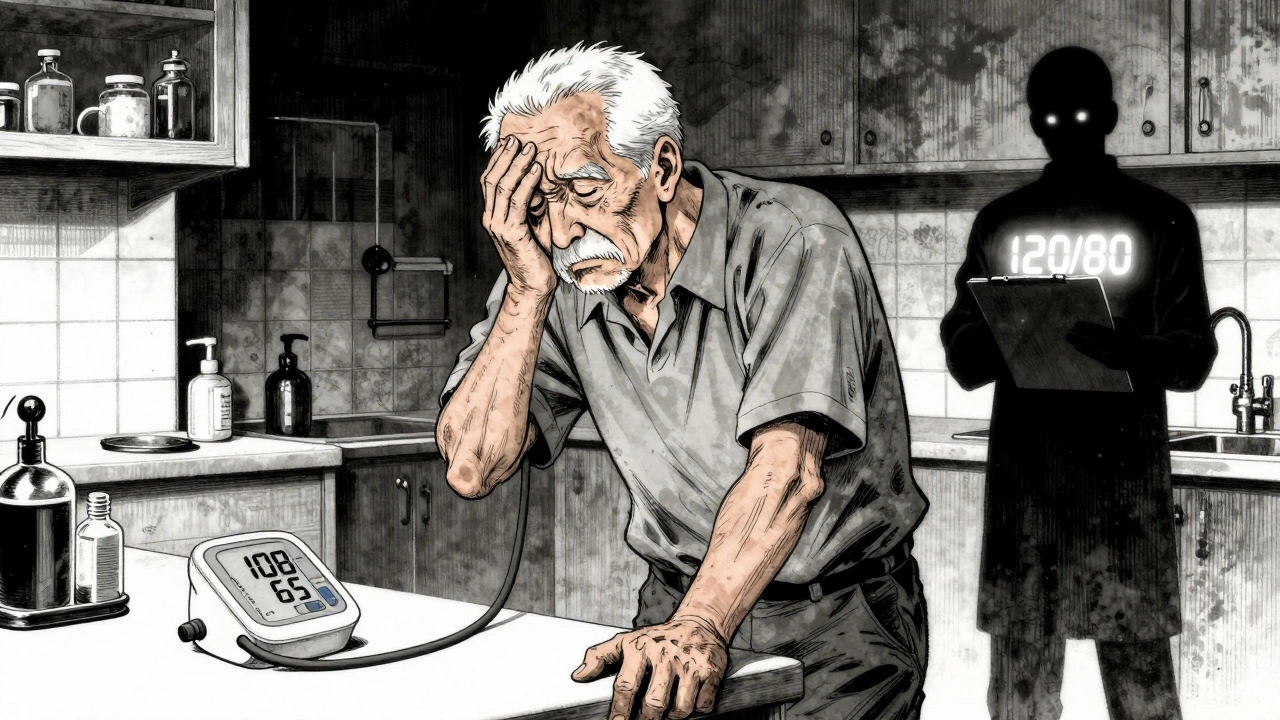
When it comes to blood pressure, the number you see on the monitor isn’t just a number-it’s a decision point. Is 120/80 the gold standard everyone should chase? Or is that goal too aggressive for some people, putting them at risk for dizziness, falls, or kidney issues instead of helping them live longer? The answer isn’t the same for everyone, and the medical world is split on why.
Why 120/80 Became the New Normal
The push for lower blood pressure targets started with the SPRINT trial in 2015. That study followed over 9,000 adults with high blood pressure but no diabetes or stroke history. One group was told to get their systolic pressure below 120 mm Hg. The other aimed for under 140. The results were striking: those who hit the lower target had 25% fewer heart attacks, strokes, and heart failure events-and 27% fewer deaths. It was a big deal. By 2017, the American Heart Association and American College of Cardiology changed their guidelines to say: 120/80 is the ideal goal for most adults.
Since then, that number has stuck. In 2025, the AHA/ACC doubled down. Their updated guidelines say if your blood pressure is 130/80 or higher, you should start thinking about medication-especially if you’ve already had heart disease, diabetes, or chronic kidney disease. For people with a 10-year cardiovascular risk of 7.5% or more (calculated using the PREVENT tool), even 130/80 is a red flag. The message is clear: don’t wait. Lower is better, and earlier intervention saves lives.
The Counterargument: Why 140/90 Still Makes Sense
But not every doctor agrees. The American Academy of Family Physicians (AAFP) reviewed the same data-and came to a different conclusion. Their 2022 guidelines say: stick with 140/90 as the primary target. Why? Because the benefits of going lower are small for the average person, and the risks are real.
Take the numbers: to prevent one heart attack by lowering systolic pressure from 140 to 120, you’d need to treat 137 people for over three years. That’s a lot of pills, doctor visits, and side effects for a single event prevented. Meanwhile, for every 33 people treated aggressively, one will experience a serious side effect-like fainting, low blood pressure, or kidney trouble. That’s not rare. That’s one in every three patients.
Family doctors see the real world. Their patients aren’t the healthy, carefully screened volunteers from SPRINT. They’re older adults with balance issues. People on multiple medications. Those with kidney disease or diabetes. For them, pushing pressure too low can mean more falls, more hospital visits, and worse quality of life-not less.
Global Differences: Japan Goes All In
While the U.S. debates, Japan made its move. In January 2025, the Japanese Society of Hypertension released new guidelines that say: everyone-young or old, healthy or sick-should aim for under 130/80. No exceptions. No age brackets. No risk scores. Just one target.
They based this on a massive meta-analysis showing that every 5 mm Hg drop in systolic pressure reduces major cardiovascular events by about 10%. That held true even in people over 80. Japan’s system is built for this kind of precision: regular check-ins, home monitoring, and fast adjustments. They don’t just set a target-they track it closely, and they react fast if side effects show up.
It’s a high-touch, high-tech approach. And it’s working. Japan has one of the lowest stroke rates in the world. But it’s not easy to copy. Most U.S. clinics don’t have the staff, time, or infrastructure to monitor patients this closely.
What About Age? The European Middle Ground
The European Society of Hypertension took a different path. They don’t believe in one-size-fits-all. Instead, they break it down by age:
- Under 65: aim for 120-129/70-79
- 65-79: target 130-139 systolic
- 80+: let it go up to 140-150
This isn’t about giving older people a pass. It’s about recognizing that as we age, our bodies change. Blood vessels stiffen. Kidneys don’t filter as well. Medications stick around longer. What’s safe for a 50-year-old might be dangerous for an 80-year-old. The ESH says: adjust the goal based on tolerance, not just numbers.
Who Should Aim for 120/80?
If you’re under 65 and you have:
- Diabetes
- Chronic kidney disease
- Coronary artery disease
- A 10-year risk of heart disease above 7.5%
-then 120/80 is a smart target. The data supports it. The benefits outweigh the risks. You’re likely to live longer and avoid a heart attack or stroke.
But if you’re over 75, have a history of falls, take multiple medications, or feel dizzy when you stand up? Pushing too hard might hurt you more than help. Your goal might be 130-140 systolic. That’s not failure. It’s smart management.
The Real Challenge: Adherence and Side Effects
Getting to 120/80 often means adding another pill. Maybe two. Maybe a combo pill. That increases cost, complexity, and the chance of side effects. The AHA/ACC recommends starting with a single-pill combination for stage 2 hypertension (140/90 or higher) to improve adherence. That’s practical.
But if you’re already on three medications and your blood pressure is 135/85, is pushing to 120/80 worth the trade-off? For some, yes. For others, no. That’s why shared decision-making matters. Your doctor shouldn’t just tell you your number. They should ask: How do you feel? Are you dizzy? Are you falling? Are you taking your meds?
Home monitoring helps. If you’re checking your pressure daily and noticing drops below 110 systolic with symptoms, that’s a signal-not a success. Adjustments should be made fast.

What’s Next? The SPRINT-2 Trial
The NIH just launched SPRINT-2 in March 2025. This time, they’re including people who were left out of the original study: those with diabetes, older adults with fall risk, and people from more diverse backgrounds. They’re tracking outcomes over five years with a $47 million budget.
If SPRINT-2 confirms the original results in real-world populations, the push for 120/80 will only grow stronger. But if it shows more harm than benefit in these groups? That could shift the entire conversation back toward individualized goals.
Bottom Line: There’s No One Right Number
120/80 is not a universal rule. It’s a starting point for some, a dangerous goal for others. The best target isn’t the lowest number on the chart-it’s the lowest number you can safely reach without feeling awful, falling down, or ending up in the ER.
Ask yourself:
- Do I feel lightheaded when I stand up?
- Am I taking more than three blood pressure pills?
- Have I had a fall in the past year?
- Do I have kidney disease or diabetes?
If you answered yes to any of these, talk to your doctor about whether 120/80 is right for you. Don’t chase a number. Chase health.
Is 120/80 the best blood pressure target for everyone?
No. While 120/80 is ideal for younger adults with diabetes, kidney disease, or high heart disease risk, it may be too aggressive for older adults, especially those with a history of falls, dizziness, or multiple medications. For many people over 75, a target of 130-140 systolic is safer and just as effective at preventing heart events.
Why do some doctors recommend 140/90 instead of 120/80?
The American Academy of Family Physicians recommends 140/90 because studies show that lowering blood pressure below that offers only small additional benefits in preventing heart attacks or death, while increasing the risk of side effects like fainting, kidney issues, and low blood pressure. For the average patient, the harms may outweigh the benefits.
Does age matter when setting blood pressure goals?
Yes. The European Society of Hypertension recommends different targets by age: under 65 should aim for 120-129/70-79, those 65-79 for 130-139 systolic, and those over 80 for 140-150. This reflects how aging affects blood vessel stiffness, kidney function, and medication tolerance.
What are the risks of lowering blood pressure too much?
Too-low blood pressure can cause dizziness, fainting, falls, acute kidney injury, and high potassium levels. In older adults, these side effects can lead to hospitalization or long-term disability. Studies show that for every 33 people treated to a systolic target below 120, one will experience a serious adverse event within 3.7 years.
Should I start medication if my blood pressure is 130/80?
If you’re under 65 and have diabetes, kidney disease, heart disease, or a 10-year cardiovascular risk of 7.5% or higher, yes-medication is recommended. If you’re healthy and over 65, lifestyle changes like reducing salt, exercising, and losing weight should come first. Medication can be added later if needed.
How can I tell if my blood pressure target is too low?
Watch for symptoms: feeling lightheaded when standing, blurred vision, fatigue, confusion, or frequent falls. If your home readings are consistently below 110/70 and you feel off, talk to your doctor. You may need to adjust your meds-not lower your target further.
What to Do Next
Don’t assume your doctor’s target is the only right one. Bring your home monitor readings to your next visit. Ask: Is my goal based on my age, health, and lifestyle-or just a number from a guideline?
If you’re on multiple medications and still not feeling well, ask about simplifying your regimen. Sometimes, reducing pills-even if pressure goes up a little-improves quality of life more than chasing a lower number.
And if you’re healthy, under 65, and your pressure is 130/80? Start with lifestyle: cut salt, walk daily, lose extra weight, and limit alcohol. You might not need a pill at all.
High blood pressure isn’t just a number. It’s a signal. Listen to your body. Work with your doctor. And don’t let a guideline tell you what’s right for you-unless it fits your life.
Lisa Whitesel
December 10, 2025 AT 22:34120/80 isn't a goal it's a mandate for the weak who can't handle real medicine
Larry Lieberman
December 12, 2025 AT 04:37bro i just checked my bp at home and it's 118/76 😎 but i'm dizzy as hell so idk if i should keep pushing or just chill 🤔
Courtney Black
December 13, 2025 AT 07:43There's a deeper truth here that nobody wants to face. We've turned a physiological variable into a moral benchmark. Blood pressure isn't a virtue. It's not a test of willpower. It's not a badge of honor to have a number lower than your neighbor's. It's a biological signal. And when we force everyone into the same box, we're not saving lives-we're pathologizing aging, normalizing pharmaceutical dependency, and eroding trust in the body's own wisdom. The SPRINT trial was a controlled experiment. Life isn't. And the people who get crushed under the weight of this dogma? They're not failures. They're casualties of a system that confuses control with care.
iswarya bala
December 14, 2025 AT 08:41my grandma in india she on 3 meds and she fall last year 😢 doc said 140 is fine for her now she feel better and eat good 🙏
Simran Chettiar
December 15, 2025 AT 05:50It is imperative to recognize that the medicalization of hypertension has evolved into a paradigm wherein quantitative metrics are elevated above qualitative lived experience. The reductionist approach to blood pressure management, as exemplified by the SPRINT trial and subsequent guideline revisions, neglects the intricate interplay between physiological resilience, pharmacological burden, and psychosocial context. In populations characterized by advanced age, polypharmacy, and frailty, the pursuit of arbitrary numerical targets may paradoxically engender iatrogenic harm, thereby subverting the foundational principle of medicine: primum non nocere. The Japanese model, while statistically compelling, is predicated upon infrastructural and cultural conditions that are neither scalable nor universally applicable. Individualized care is not a compromise-it is the ethical imperative.
Richard Eite
December 15, 2025 AT 06:15USA guidelines are right and everyone else is just weak. Japan's just copying us and Europe is just afraid to make hard calls. If you're over 75 and falling you're just lazy. Get off your butt and move. 120/80 is the American standard and we don't back down from standards. Stop making excuses and take your pills
Katherine Chan
December 16, 2025 AT 00:02love this post so much 🤗 i've been checking my bp at home and talking to my doc about how i feel not just the number and it's changed everything. no shame in 135 if you feel good. your body talks if you listen 💪
Philippa Barraclough
December 16, 2025 AT 21:10The discrepancy between clinical trial populations and real-world patient demographics is not merely a methodological oversight-it is a systemic failure in translational medicine. The SPRINT cohort was highly selected: relatively young, free of diabetes, without prior stroke, and under intensive monitoring. The extrapolation of these findings to the broader population, particularly the elderly and multimorbid, lacks epidemiological grounding. Furthermore, the cost-benefit analysis presented by the AAFP-NNT of 137 to prevent one event-is not trivial. When coupled with a NNH of 33 for serious adverse events, the risk-benefit ratio becomes ethically ambiguous. The European stratification by age is not a concession; it is a clinically sophisticated acknowledgment of physiological heterogeneity. The notion that a single target can be universally optimal is a relic of 20th-century medicine, not a blueprint for 21st-century care.
Tim Tinh
December 17, 2025 AT 04:32my uncle in texas he had a stroke at 72 and his doc told him to go to 120 he got so dizzy he fell and broke his hip. now he’s on just one pill and his bp is 138/82. he’s walking again and eating his grandkids’ birthday cake. sometimes less is more. just sayin’ 🤝